Acknowledgement or Acknowledgment: Correct Spelling, Regional Difference, Usage, and Examples Clearly Explained
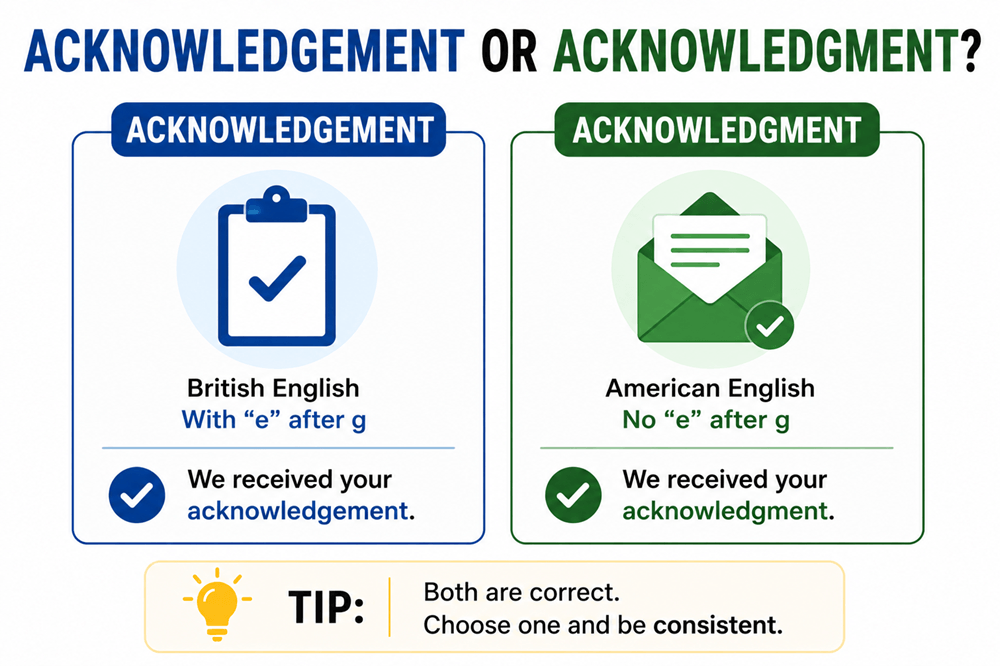
Acknowledgement and acknowledgment are both correct spellings, but they are not equally common everywhere. Acknowledgment is the preferred spelling in American English, while acknowledgement is more common in British English and many other varieties of English. If you are writing for a U.S. audience, use acknowledgment. If you are writing in British English, acknowledgement is usually the better choice.
Quick Answer
Use acknowledgment in American English.
- Correct: Thank you for your acknowledgment of the issue.
- Correct: The company sent an acknowledgment email.
- Correct: The report included an acknowledgment of everyone’s work.
Use acknowledgement in British English or when your style guide prefers the spelling with the extra e.
- Correct: Thank you for your acknowledgement of the issue.
- Correct: The company sent an acknowledgement email.
- Correct: The report included an acknowledgement of everyone’s work.
The simple rule is this: acknowledgment is American, and acknowledgement is British. Both are acceptable, but you should choose one spelling and stay consistent.
Acknowledgement or Acknowledgment: What Is the Difference?
The difference between acknowledgement and acknowledgment is spelling, not meaning. Both words mean recognition, acceptance, confirmation, or a statement that something has been received, noticed, or admitted.
The spelling acknowledgment drops the e after g. This shorter form is the standard spelling in American English. The spelling acknowledgement keeps the e, and it is common in British English, Australian English, and other English varieties influenced by British spelling.
| Word | Best Use | Example |
|---|---|---|
| Acknowledgment | American English | The form requires your acknowledgment. |
| Acknowledgement | British English | The form requires your acknowledgement. |
The meaning stays the same. The choice depends mainly on the style of English you are using.
What Does Acknowledgment Mean?
Acknowledgment means recognition, confirmation, acceptance, or admission. It is a noun. You use it when someone recognizes a fact, admits something is true, confirms receipt of something, or expresses appreciation for help.
Examples:
- The email was an acknowledgment that your application had been received.
- Her apology included an acknowledgment of the mistake.
- The book opened with an acknowledgment of the author’s family.
- The manager gave a public acknowledgment of the team’s effort.
In each sentence, acknowledgment refers to some kind of recognition or confirmation. It may be formal, emotional, legal, professional, or personal.
You may see acknowledgment in business emails, legal documents, receipts, academic papers, book sections, workplace messages, and formal notices.
- payment acknowledgment
- receipt acknowledgment
- written acknowledgment
- public acknowledgment
- formal acknowledgment
For American writing, this spelling without the extra e is usually preferred.
What Does Acknowledgement Mean?
Acknowledgement means the same thing as acknowledgment. It also refers to recognition, confirmation, admission, or appreciation. The difference is that this spelling keeps the e after g.
Examples:
- The school sent an acknowledgement of your registration.
- The letter included an acknowledgement of the delay.
- The author wrote a warm acknowledgement to her editor.
- The charity gave an acknowledgement of every donation.
These sentences have the same meaning as they would with acknowledgment. The spelling simply reflects a different regional preference.
If your article, essay, document, or website follows British spelling, acknowledgement will usually look more natural. It fits with spellings like colour, favour, centre, and organise.
Is Acknowledgement Wrong?
Acknowledgement is not wrong. It is a standard spelling in British English and is understood by English readers around the world. The mistake is assuming that only one spelling is correct everywhere.
For American English, however, acknowledgment is usually the preferred spelling. That means an American editor may change acknowledgement to acknowledgment for consistency.
Compare these examples:
- American style: The document includes an acknowledgment of the risks.
- British style: The document includes an acknowledgement of the risks.
Both sentences are correct. The better choice depends on your audience, location, and style guide.
When to Use Acknowledgment
Use acknowledgment when you are writing in American English. This is the safest spelling for U.S. websites, American school papers, business writing, legal documents, emails, reports, and professional content.
Examples:
- The system will send an acknowledgment after you submit the form.
- The employee signed an acknowledgment of the policy.
- The company issued an acknowledgment of the complaint.
- The author included an acknowledgment at the beginning of the book.
Use acknowledgment if the rest of your writing uses American spelling patterns:
- color
- favor
- center
- organize
- acknowledgment
This keeps your writing consistent. Consistency matters because mixed spelling styles can distract readers, even when the words are technically correct.
When to Use Acknowledgement
Use acknowledgement when you are writing in British English or following a style guide that prefers the spelling with the extra e.
Examples:
- The organisation sent an acknowledgement letter.
- The report included an acknowledgement of the committee’s support.
- The student wrote an acknowledgement section in the dissertation.
- The office requested written acknowledgement of the change.
Use acknowledgement if the rest of your writing uses British spelling patterns:
- colour
- favour
- centre
- organise
- acknowledgement
This spelling is common and acceptable. It simply belongs more naturally with British-style English.
Acknowledgment in Legal and Business Writing
In American legal and business writing, acknowledgment is especially common. You may see it in contracts, employee handbooks, consent forms, policy documents, receipts, and notices.
Examples:
- Please sign the acknowledgment form.
- The employee acknowledgment confirms receipt of the handbook.
- The customer received an acknowledgment of the complaint.
- The contract includes an acknowledgment of responsibility.
In these contexts, acknowledgment often means a formal statement that someone has read, received, understood, or accepted something.
For example, an employee may sign an acknowledgment saying they received a workplace policy. A customer may receive an acknowledgment that their payment went through. A company may issue an acknowledgment that a complaint has been received.
Acknowledgement in Academic and Book Writing
Acknowledgement is common in British-style academic and book writing, especially in the section where an author thanks people who helped with the work. In American English, that section is usually spelled acknowledgments. In British English, it is often spelled acknowledgements.
Examples:
- American: The acknowledgments section thanked the editor and research team.
- British: The acknowledgements section thanked the editor and research team.
This section may thank family members, advisors, editors, funders, teachers, colleagues, interviewees, or anyone who supported the project.
Both spellings are acceptable, but a book or academic document should choose one style and use it consistently.
Acknowledgment Email or Acknowledgement Email?
Both phrases can be correct. Use acknowledgment email in American English and acknowledgement email in British English.
American style:
- You will receive an acknowledgment email after submitting the form.
- The acknowledgment email confirms that your request was received.
British style:
- You will receive an acknowledgement email after submitting the form.
- The acknowledgement email confirms that your request was received.
If you are writing for a U.S.-based website, acknowledgment email is usually the better choice. If your audience expects British spelling, use acknowledgement email.
Acknowledgment of Receipt or Acknowledgement of Receipt?
Both versions can be correct, depending on spelling style. Acknowledgment of receipt is more common in American English. Acknowledgement of receipt is more common in British English.
American style:
- Please send an acknowledgment of receipt.
- The acknowledgment of receipt was attached to the email.
British style:
- Please send an acknowledgement of receipt.
- The acknowledgement of receipt was attached to the email.
This phrase means confirmation that something was received. It may refer to a document, payment, form, request, package, notice, or message.
Common Mistakes With Acknowledgement and Acknowledgment
The most common mistake is switching between the two spellings in the same piece of writing.
Inconsistent:
- The acknowledgment email was sent yesterday. The acknowledgement section appears at the end of the report.
Better American consistency:
- The acknowledgment email was sent yesterday. The acknowledgment section appears at the end of the report.
Better British consistency:
- The acknowledgement email was sent yesterday. The acknowledgement section appears at the end of the report.
Another mistake is assuming the longer spelling is always more formal. Acknowledgement may look more formal to some readers because it is longer, but in American English, acknowledgment is the standard formal spelling.
A third mistake is using acknowledge when the sentence needs the noun acknowledgment or acknowledgement.
- Incorrect: We received your acknowledge.
- Correct: We received your acknowledgment.
- Correct: We received your acknowledgement.
Acknowledge is a verb. Acknowledgment and acknowledgement are nouns.
Acknowledge, Acknowledged, and Acknowledging
The verb form is acknowledge. It means to recognize, admit, confirm, or show that you have received or noticed something.
Examples:
- Please acknowledge this message.
- She acknowledged her mistake.
- The manager acknowledged the team’s effort.
- He is acknowledging the problem for the first time.
The spelling of acknowledge keeps the e. The spelling difference appears mainly in the noun form:
- American noun: acknowledgment
- British noun: acknowledgement
This is why the pair can feel confusing. The verb has e, but the American noun usually drops it.
Examples of Acknowledgment in Sentences
Here are examples of acknowledgment used in American-style writing:
- The office sent an acknowledgment after receiving the application.
- Her speech included an acknowledgment of the volunteers.
- The signed form served as an acknowledgment of the rules.
- The report offered no acknowledgment of the earlier error.
- The author’s acknowledgment was short but sincere.
- The company requires written acknowledgment before processing the request.
- The website displays an acknowledgment message after payment.
In each sentence, acknowledgment means recognition, confirmation, admission, or appreciation.
Examples of Acknowledgement in Sentences
Here are examples of acknowledgement used in British-style writing:
- The office sent an acknowledgement after receiving the application.
- Her speech included an acknowledgement of the volunteers.
- The signed form served as an acknowledgement of the rules.
- The report offered no acknowledgement of the earlier error.
- The author’s acknowledgement was short but sincere.
- The company requires written acknowledgement before processing the request.
- The website displays an acknowledgement message after payment.
These examples mean the same thing as the American-style examples. The spelling simply follows a different convention.
How to Remember Acknowledgement or Acknowledgment
A simple way to remember the difference is this:
- Acknowledgment = American English
- Acknowledgement = British English
You can also remember that American English often prefers shorter spellings. Since acknowledgment drops the extra e, it fits that pattern.
For a U.S.-based website, business email, or article, choose acknowledgment. For British-style writing, choose acknowledgement. The most important thing is not to mix both spellings in the same document.
Final Answer
Acknowledgement and acknowledgment are both correct spellings of the same noun. They mean recognition, confirmation, admission, or appreciation. The difference is regional style. Acknowledgment is preferred in American English, while acknowledgement is more common in British English.
The easiest rule is simple: use acknowledgment for American writing and acknowledgement for British writing. If you are writing for WordBriefs or another U.S.-focused website, acknowledgment is usually the safer default.