Tying or Tieing: Correct Spelling, Meaning, and Easy Ways to Remember It
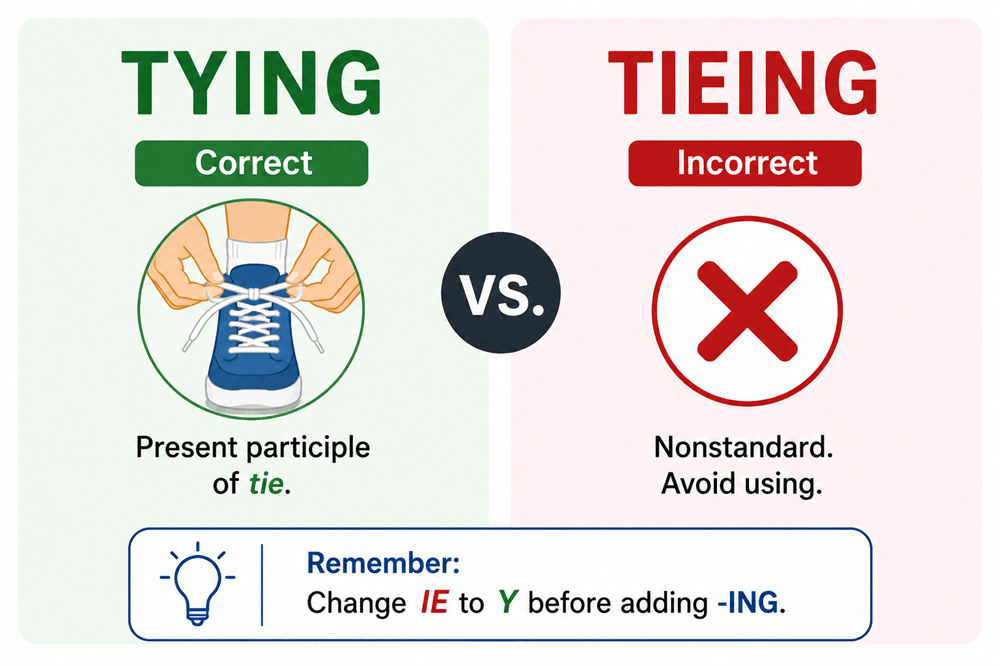
If you are choosing between tying or tieing, the standard spelling is tying. It is the present participle of tie, which means to fasten, connect, bind, or finish with the same score. Tieing may look logical because it keeps the full word tie, but in modern English, tying is the spelling you should use almost every time.
Tying or Tieing: Which Spelling Is Correct?
The correct spelling is tying.
Tieing is usually considered incorrect or nonstandard in modern English. You may occasionally see it as a rare variant, especially in older or specialized writing, but it is not the normal spelling. In schoolwork, emails, articles, instructions, captions, resumes, business writing, and everyday sentences, you should use tying.
You should write:
Correct: She is tying her shoes.
Incorrect: She is tieing her shoes.
The same rule applies whether you are talking about tying a knot, tying a ribbon, tying a game, tying ideas together, or tying something to another object.
What Does Tying Mean?
Tying is the -ing form of the verb tie. It can describe several related actions, but the basic idea is connection.
You can use tying when someone is fastening something with string, rope, ribbon, thread, or laces.
He was tying the rope around the post.
You can use it when someone is making a knot or bow.
You are tying the ribbon too tightly.
You can use it in sports when two sides have the same score.
The team is tying the game in the final quarter.
You can also use it in a figurative way, meaning to connect ideas, events, plans, or responsibilities.
The final paragraph is tying the whole argument together.
In all these examples, tying is the correct spelling.
Why Tieing Looks Like It Could Be Right
The spelling tieing looks tempting because many English verbs simply add -ing to the base word. For example, walk becomes walking, read becomes reading, and paint becomes painting. If you follow that pattern too directly, you might expect tie to become tieing.
But tie follows a different spelling pattern. When a verb ends in -ie, the ie usually changes to y before adding -ing.
That means:
tie → tying
The same thing happens with other short verbs ending in -ie.
die → dying
lie → lying
tie → tying
This pattern is one of the easiest ways to remember the correct spelling. You do not keep the ie. You change it to y.
The Simple Spelling Rule for Tying
The rule is:
For verbs ending in -ie, change -ie to y before adding -ing.
So instead of writing tieing, you write tying.
You can picture the change like this:
tie – ie + y + ing = tying
That may look strange at first, but it keeps the word easier to read and pronounce. Without the change, tieing would place too many vowel letters together. The spelling tying is cleaner and more standard.
This is also why you write lying, not lieing, and dying, not dieing, when you mean passing away. These words all follow the same structure.
A Simple Way to Remember Tying
The easiest memory trick is:
Change the IE to Y before ING.
That short phrase works for tie, lie, and die. When you see a verb ending in ie, do not just add ing. First, switch ie to y.
You can also remember this sentence:
You tie with a Y when you are tying.
That gives you a visual clue. The word tying has a y near the beginning, and that y replaces the ie from tie.
Another helpful comparison is:
tie → tying
lie → lying
die → dying
Once you memorize these three together, tying becomes much easier to spell correctly.
Common Phrases With Tying
You will often see tying in everyday phrases. Learning these phrases can help the correct spelling feel more natural.
Tying your shoes means fastening shoelaces.
The child is learning how to tie his shoes.
Tying a knot means making a knot in rope, string, thread, or another material.
She practiced tying a strong knot before the camping trip.
Tying a ribbon means fastening or decorating something with ribbon.
You are tying a red ribbon around the gift box.
Tying the score means making the score equal in a game or match.
The player scored a goal, tying the match in the final minute.
Tying things together means connecting ideas, details, or parts into one clear whole.
The conclusion does a good job of tying the story together.
In all these examples, the spelling is tying, not tieing.
Tying vs Tieing in Example Sentences
Side-by-side examples make the difference easier to see:
Correct: She is tying her hair back before practice.
Incorrect: She is tieing her hair back before practice.
Correct: He was tying the boat to the dock.
Incorrect: He was tieing the boat to the dock.
Correct: The team is tying the score with one last shot.
Incorrect: The team is tieing the score with one last shot.
Correct: You are tying the details together nicely.
Incorrect: You are tieing the details together nicely.
Correct: The florist is tying the stems with twine.
Incorrect: The florist is tieing the stems with twine.
The correction is simple: replace tieing with tying.
What About Tieing as a Variant?
You may sometimes see tieing mentioned as a rare spelling, especially in discussions of older usage or certain specialized contexts. However, that does not make it the best choice for normal modern writing.
For most writers, the practical answer is simple: use tying. It is the standard spelling, the spelling most readers expect, and the spelling that looks correct in polished English.
This matters because tieing can distract readers. Even if someone understands what you mean, the spelling may look like a mistake. If you want your writing to feel clean and correct, tying is the safer choice.
How to Check Yourself Before Writing Tying
Before you write the word, look at the base verb. If the word is tie and you need the -ing form, remember the pattern:
tie becomes tying
Ask yourself whether you would write lieing or dieing. In ordinary English, you would not. You would write lying and dying. That same spelling habit will lead you to tying.
You can use this quick check:
Does the verb end in -ie?
Change -ie to y.
Then add -ing.
That gives you tying.
The Final Answer on Tying or Tieing
The correct standard spelling is tying. Use it when describing someone fastening something, making a knot, connecting ideas, or bringing a score even. The spelling tieing may look logical, but it is not the normal modern form.
To remember it, use the rule change IE to Y before ING. Just as lie becomes lying and die becomes dying, tie becomes tying.
So when you are writing about shoelaces, ribbons, knots, scores, or ideas being connected, choose tying. It is the spelling that keeps your writing clear, standard, and easy to trust.