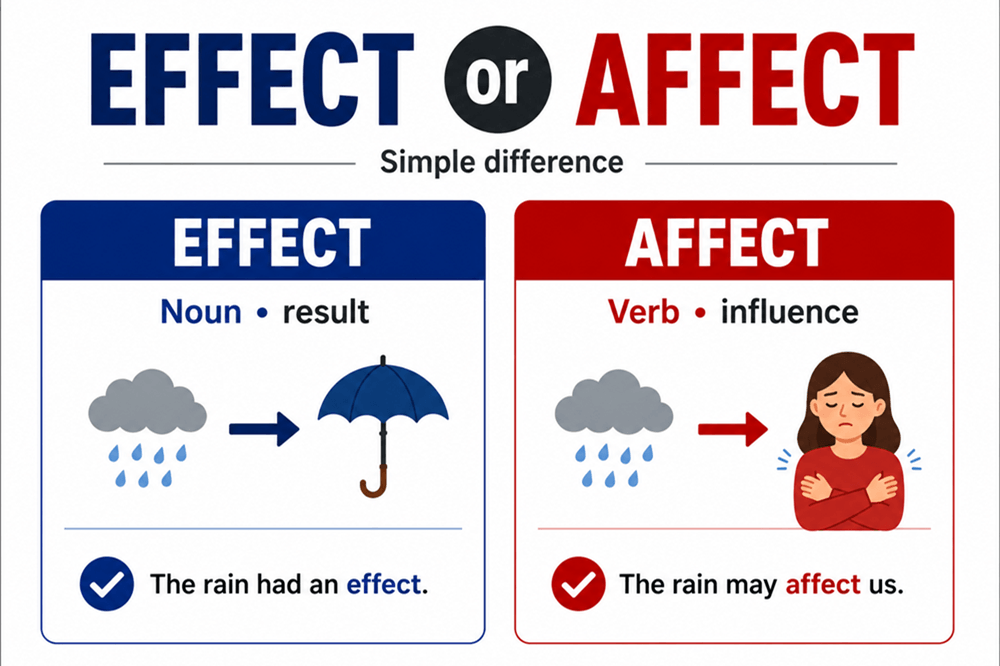
Effect or Affect: Simple Difference, Correct Usage, and Easy Examples for Writers
Effect and affect are easy to confuse because they sound similar and both relate to change. The quick rule is this: affect is usually a verb, and effect is usually a noun. If something changes something else, it affects it. The result of that change is the effect.
Quick Answer
Use affect when you mean “to influence” or “to change.”
- The weather can affect your mood.
- Stress may affect your sleep.
- The new rule will affect every employee.
Use effect when you mean “the result” or “the outcome.”
- The medicine had a strong effect.
- The speech had a positive effect on the audience.
- The new rule had an immediate effect.
The simplest way to remember the difference is: affect is the action, effect is the result.
Effect or Affect: What Is the Difference?
The main difference between effect and affect is how they are used in a sentence. Affect is usually used as a verb. A verb shows an action. When something affects something else, it changes it, influences it, or has an impact on it.
Effect is usually used as a noun. A noun names a thing, idea, result, or outcome. An effect is what happens because of an action, event, decision, or situation.
| Word | Most Common Use | Meaning | Example |
|---|---|---|---|
| Affect | Verb | To influence or change something | The rain may affect traffic. |
| Effect | Noun | A result or outcome | The rain had an effect on traffic. |
These two words often appear in similar sentences, which is why they cause so much confusion. The best way to choose the right one is to ask what role the word plays. Are you describing an action? Use affect. Are you naming a result? Use effect.
What Does Affect Mean?
Affect usually means to influence, change, or make a difference to something. It is most often used as a verb.
For example, if bad weather changes your travel plans, the weather affects your plans. If a new law changes how a company works, the law affects the company. If lack of sleep changes your mood, sleep affects your mood.
Here are some examples of affect in sentences:
- The delay will affect the entire schedule.
- Your tone can affect how people understand your message.
- Too much screen time may affect your sleep.
- The price increase will affect many customers.
- Her decision could affect the whole team.
- Cold weather can affect battery life.
In each sentence, affect shows that one thing is influencing or changing another thing.
What Does Effect Mean?
Effect usually means a result, outcome, or consequence. It is most often used as a noun.
If a speech changes how people feel, the change is the effect of the speech. If medicine makes you sleepy, sleepiness may be a side effect. If a new policy improves productivity, better productivity is an effect of that policy.
Here are some examples of effect in sentences:
- The new policy had a positive effect.
- The movie’s ending had a powerful effect on the audience.
- The medicine caused a strange side effect.
- The teacher’s encouragement had a lasting effect.
- The storm had a serious effect on local roads.
- The change took effect on Monday.
In these examples, effect names the result of something that happened.
Affect Is Usually the Action
A good shortcut is to connect affect with action. Both words begin with the letter a.
When you use affect, something is usually doing something to something else. It may not be a loud or obvious action, but there is still some kind of influence or change happening.
Examples:
- The news affected her deeply.
- The noise affected his concentration.
- The budget cuts affected several departments.
In these sentences, the news, the noise, and the budget cuts are all causing a change. That is why affect is the right word.
Effect Is Usually the Result
Another shortcut is to connect effect with end result. Both effect and end begin with the letter e.
When you use effect, you are usually talking about what happened after something else took place.
Examples:
- The training had a clear effect on performance.
- The argument had no lasting effect on their friendship.
- The new design created a calming effect.
In these sentences, the effect is the result or outcome. It is what happened because of the training, the argument, or the design.
Effect or Affect in Common Phrases
Some phrases almost always use effect. Learning these can make the choice easier.
- side effect
- special effect
- sound effect
- lasting effect
- positive effect
- negative effect
- take effect
- in effect
Examples:
- The medicine has a few side effects.
- The new rule will take effect next week.
- The lighting created a dramatic effect.
Other phrases usually use affect because they describe influence or change.
- affect your mood
- affect your health
- affect the outcome
- affect performance
- affect the decision
Examples:
- Sleep can affect your mood.
- The mistake did not affect the final score.
- The change may affect customer satisfaction.
How to Choose Between Effect and Affect
When you are not sure which word to use, try replacing the word with influence or result.
If influence fits, use affect.
- The weather may affect the game.
- The weather may influence the game.
Because influence works, affect is correct.
If result fits, use effect.
- The weather had an effect on the game.
- The weather had a result on the game.
The second sentence sounds a little awkward, but the idea is still about a result. That tells you effect is the better choice.
You can also look for small clues in the sentence. If the word comes after an, the, this, that, or strong, you probably need effect.
- an effect
- the effect
- this effect
- that effect
- a strong effect
If the word comes after a subject and shows what that subject does, you probably need affect.
- The change will affect us.
- The decision may affect sales.
- The result could affect your grade.
Examples of Effect and Affect Side by Side
Seeing both words in similar sentences can make the difference clearer.
| Affect | Effect |
|---|---|
| The rain may affect the roads. | The rain had an effect on the roads. |
| The change will affect your schedule. | The change had a clear effect on your schedule. |
| Stress can affect your appetite. | Stress can have an effect on your appetite. |
| The speech affected the crowd. | The speech had a strong effect on the crowd. |
In the affect sentences, something is doing the changing. In the effect sentences, the sentence is naming the result of that change.
The Rare Exceptions
The usual rule works most of the time: affect is a verb, and effect is a noun. However, there are a few exceptions.
Effect can sometimes be used as a verb meaning “to bring about” or “to cause something to happen.” This use is more formal.
Example:
- The new leader hopes to effect change.
In this sentence, effect change means to bring change into existence, not just influence it. This is much less common than using effect as a noun.
Affect can also be used as a noun in psychology, where it refers to an outward emotional expression.
Example:
- The patient showed a flat affect.
This use is specialized and uncommon in everyday writing. Most readers will not need it unless they are writing about psychology, medicine, or behavior.
For normal writing, the basic rule is still the best one: affect is usually the action, and effect is usually the result.
Common Mistakes to Avoid
One common mistake is using effect when the sentence needs a verb.
Incorrect:
- The delay will effect our plans.
Correct:
- The delay will affect our plans.
The delay is influencing the plans, so affect is correct.
Another common mistake is using affect when the sentence needs a noun.
Incorrect:
- The delay had a bad affect on our plans.
Correct:
- The delay had a bad effect on our plans.
The sentence is talking about the result of the delay, so effect is correct.
How to Remember Effect or Affect
Use this simple memory trick:
Affect = Action
Effect = End result
If something is doing the changing, use affect. If you are talking about what happened because of the change, use effect.
You can also remember this sentence:
The action affects you, and the effect is the result.
This sentence uses both words correctly and shows the difference clearly.
Final Answer
Affect is usually a verb that means to influence or change something. Effect is usually a noun that means the result or outcome of a change. Use affect for the action and effect for the result.