Another Word for Despite: Best Synonyms and Examples
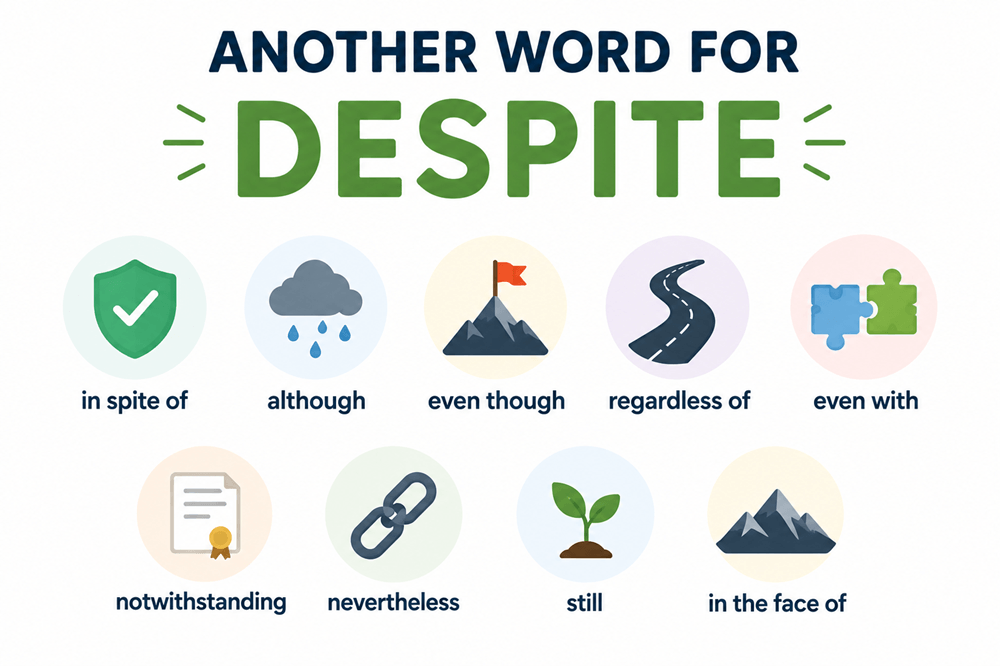
Another word for despite is although. You can also use in spite of, even with, regardless of, notwithstanding, even though, though, nevertheless, or still, depending on the sentence.
Despite means that something happens even when there is a difficulty, problem, or reason it might not happen.
Examples:
Despite the rain, we went outside.
Although it was raining, we went outside.
She smiled despite feeling tired.
She smiled even though she felt tired.
The best replacement depends on the grammar of the sentence.
Best Synonyms for Despite
Here are some common synonyms and alternatives for despite:
| Word or Phrase | Best For |
|---|---|
| in spite of | Closest direct replacement |
| although | Starting a contrast clause |
| even though | Strong contrast |
| though | Casual contrast |
| regardless of | Ignoring difficulty or conditions |
| even with | Simple everyday contrast |
| notwithstanding | Formal writing |
| nevertheless | Starting a new contrasting sentence |
| still | Casual “even so” meaning |
| in the face of | Strong difficulty or opposition |
Each option has a slightly different use, so choose the one that fits the sentence structure.
In Spite Of
In spite of is the closest synonym for despite. It has almost the same meaning and can often replace despite directly.
Examples:
Despite the delay, the event continued.
In spite of the delay, the event continued.
She stayed calm despite the pressure.
She stayed calm in spite of the pressure.
They finished the project despite many problems.
They finished the project in spite of many problems.
Use in spite of when you want a slightly longer but very natural alternative.
Although
Although can replace despite, but the sentence structure must change.
Despite is followed by a noun, pronoun, or -ing form.
Although is followed by a full clause with a subject and verb.
Examples:
Despite the rain, we played soccer.
Although it was raining, we played soccer.
Despite her fear, she spoke clearly.
Although she was afraid, she spoke clearly.
Despite feeling tired, he kept working.
Although he felt tired, he kept working.
Use although when you want to introduce a complete contrasting idea.
Even Though
Even though is stronger than although. It emphasizes that something happened in spite of a clear difficulty.
Examples:
Despite the cold weather, they went hiking.
Even though the weather was cold, they went hiking.
She passed the test despite being nervous.
She passed the test even though she was nervous.
He helped us despite having little time.
He helped us even though he had little time.
Use even though when the contrast feels surprising or important.
Though
Though is a shorter and more casual alternative to although.
Examples:
Despite the noise, I slept well.
Though it was noisy, I slept well.
Despite the high price, I bought it.
Though the price was high, I bought it.
The food was good, though a little salty.
Use though in everyday writing, blog posts, and casual conversation.
Regardless Of
Regardless of means something happens without being affected by a condition, problem, or difference.
Examples:
The game continued despite the weather.
The game continued regardless of the weather.
She treats everyone fairly despite their background.
She treats everyone fairly regardless of their background.
We will continue regardless of the result.
Use regardless of when the meaning is “no matter what.”
Even With
Even with is a simple alternative to despite. It works well in casual or clear writing.
Examples:
Despite the extra help, the task was difficult.
Even with the extra help, the task was difficult.
Despite more time, they could not finish.
Even with more time, they could not finish.
The room felt cold even with the heater on.
Use even with when something remains true although another condition exists.
Notwithstanding
Notwithstanding is a formal synonym for despite. It is common in legal, academic, and official writing.
Examples:
The policy remained in place, notwithstanding public criticism.
The results were accepted, notwithstanding several objections.
Notwithstanding the delay, the contract remained valid.
Use notwithstanding carefully. It can sound too formal in everyday writing.
Nevertheless
Nevertheless means “even so” or “despite that.” It usually starts a new sentence or clause.
Examples:
The task was difficult. Nevertheless, she finished it.
The evidence was limited. Nevertheless, the report was useful.
He was tired. Nevertheless, he kept going.
Use nevertheless when you want to connect two sentences with a formal contrast.
Still
Still can mean “even so.” It is a casual and natural alternative when starting a new contrast.
Examples:
It was raining. Still, we went outside.
The price was high. Still, the product was worth it.
She was nervous. Still, she gave a strong speech.
Use still when you want a simple, conversational tone.
In the Face Of
In the face of means despite strong difficulty, danger, opposition, or pressure.
Examples:
They stayed brave despite danger.
They stayed brave in the face of danger.
The team continued despite criticism.
The team continued in the face of criticism.
She remained calm in the face of pressure.
Use in the face of when the obstacle is serious or dramatic.
Despite vs Although
Despite and although are close in meaning, but they use different grammar.
Use despite before a noun, pronoun, or -ing phrase.
Examples:
Despite the rain
Despite the delay
Despite his fear
Despite feeling sick
Use although before a full clause.
Examples:
Although it rained
Although the train was delayed
Although he was afraid
Although he felt sick
Correct:
Despite the rain, we left early.
Although it rained, we left early.
Incorrect:
Despite it rained, we left early.
Despite vs In Spite Of
Despite and in spite of mean almost the same thing.
Examples:
Despite the mistake, the answer was useful.
In spite of the mistake, the answer was useful.
Despite being tired, she smiled.
In spite of being tired, she smiled.
The main difference is length. Despite is shorter. In spite of is longer but very natural.
Both are correct in standard English.
Formal Synonyms for Despite
For essays, reports, academic writing, and professional documents, these are good formal alternatives:
- although
- even though
- notwithstanding
- nevertheless
- regardless of
- in spite of
- in the face of
Examples:
Although the results were limited, they were useful.
The plan continued notwithstanding objections.
The evidence was weak. Nevertheless, the case moved forward.
The company succeeded in spite of several setbacks.
Casual Synonyms for Despite
For everyday speech, blog writing, and simple explanations, these alternatives sound natural:
- even though
- though
- still
- even with
- in spite of
- no matter
Examples:
Even though it was late, we stayed.
The food was good, though a little cold.
It was expensive. Still, I bought it.
We went outside even with the rain.
Common Mistakes
One common mistake is using despite before a full sentence.
Incorrect:
Despite it was raining, we went outside.
Correct:
Despite the rain, we went outside.
Correct:
Although it was raining, we went outside.
Correct:
Even though it was raining, we went outside.
Another mistake is using despite of.
Incorrect:
Despite of the delay, we arrived on time.
Correct:
Despite the delay, we arrived on time.
Correct:
In spite of the delay, we arrived on time.
The correct phrase is despite, not despite of.
Final Answer
Another word for despite is in spite of.
Other good alternatives include although, even though, though, regardless of, even with, notwithstanding, nevertheless, still, and in the face of.
Use in spite of as the closest direct replacement.
Use although or even though before a full clause.
Use regardless of when the meaning is “no matter what.”
Use nevertheless or still when starting a new contrasting sentence.
The best synonym for despite depends on whether your sentence uses a noun, a full clause, or a separate contrasting sentence.