What Is the Plural of Status? Meaning and Examples
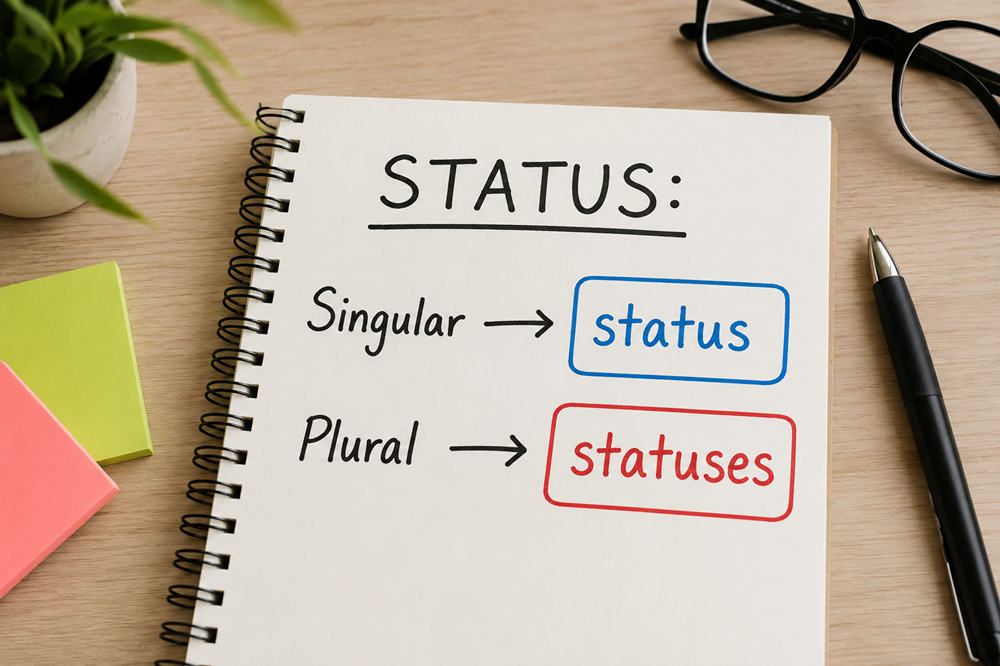
The plural of status is statuses. Use status for one condition, position, or update and statuses when referring to two or more.
- The order has a new status.
- The orders have different statuses.
Stati is sometimes used by mistake, but it is not the standard English plural of status.
What Is the Plural of Status?
The correct plural form of status is statuses.
| Form | Example |
|---|---|
| Status | I checked the status of my application. |
| Statuses | I checked the statuses of my applications. |
The same plural is used for every common meaning of the word. You can talk about application statuses, employment statuses, project statuses, account statuses, or social media statuses.
Why Is the Plural Statuses?
English nouns ending in an s sound often form their plurals by adding -es. For example:
- class → classes
- bus → buses
- status → statuses
Adding -es creates an extra syllable, making the plural easier to pronounce.
Although status came into English from Latin, it follows the regular English plural pattern. You do not need to give it a special Latin-style ending.
Is Stati the Plural of Status?
No, stati is not the standard plural of status. It may appear as a joke or an informal invention, but it should be avoided in normal writing.
The mistake probably comes from Latin-derived words such as alumnus, which becomes alumni. However, words ending in -us do not all follow the same plural rule.
- Incorrect: The accounts have different stati.
- Correct: The accounts have different statuses.
Use statuses in formal, academic, professional, and everyday English.
Status or Statuses: How to Choose
Use status when discussing one condition, position, classification, or update.
- The payment status is still pending.
- Her employment status recently changed.
- What is the current status of the project?
- She posted a new social media status.
Use statuses when discussing several separate conditions, positions, classifications, or updates.
- The payment statuses appear in the final column.
- The survey recorded the employment statuses of all participants.
- The manager reviewed the statuses of several projects.
- Her recent social media statuses were about her holiday.
The plural is especially useful when each person or item has a separate status.
- All three applications have the same status.
- The three applications have different statuses.
When Status Is Uncountable
Status can also mean social importance, respect, or prestige. In this sense, it is often uncountable and does not normally take a plural form.
- The promotion gave her greater status within the company.
- Owning land was once a sign of social status.
- The award raised his status in the industry.
Use statuses when referring to separate official positions or classifications:
- The report compares the legal statuses of the organizations.
- The applicants had different immigration statuses.
How to Pronounce Statuses
Statuses usually has three syllables:
STAY-tuh-siz or STAT-uh-siz
The first syllable varies because speakers pronounce status differently. In either version, the plural ends with an extra iz sound.
- status: STAY-tuhs or STAT-uhs
- statuses: STAY-tuh-siz or STAT-uh-siz
Possessive Forms of Status and Statuses
An apostrophe shows possession. It does not make the word plural.
Singular Possessive: Status’s
The singular possessive is usually written status’s.
- The status’s label changed from pending to approved.
Although this form is grammatically correct, rewriting the sentence can sometimes sound more natural:
- The label for the status changed from pending to approved.
Plural Possessive: Statuses’
The plural possessive is statuses’. Because statuses already ends in s, add only an apostrophe.
- The statuses’ labels were updated.
This form is correct, but a rewritten version may be clearer:
- The labels for the statuses were updated.
| Form | Meaning |
|---|---|
| Status | One condition, position, or update |
| Statuses | Two or more conditions, positions, or updates |
| Status’s | Belonging to one status |
| Statuses’ | Belonging to multiple statuses |
Examples of Statuses in Sentences
- Customers can check their order statuses online.
- The dashboard displays the statuses of all connected devices.
- We reviewed the application statuses before the meeting.
- The report compares the marital statuses of the participants.
- Different icons show the current statuses of the servers.
- The platform allows users to hide their statuses from selected contacts.
Common Errors to Avoid
The most common mistakes are using stati, leaving the plural unchanged, or adding an apostrophe unnecessarily.
- Incorrect: The orders have different stati.
- Correct: The orders have different statuses.
- Incorrect: We reviewed the status of five separate applications.
- Better: We reviewed the statuses of five separate applications.
- Incorrect: The account status’s are listed below.
- Correct: The account statuses are listed below.
Remember that an apostrophe is used for possession, not for an ordinary plural.
Final Summary
The plural of status is statuses.
- Use status for one condition, position, classification, or update.
- Use statuses for two or more.
- Use uncountable status when referring to prestige or social importance.
- Do not use stati as the standard English plural.
- The singular possessive is status’s.
- The plural possessive is statuses’.
The simplest way to remember the plural is: one status, several statuses.