Is Nevermind One Word? Never Mind vs. Nevermind Explained
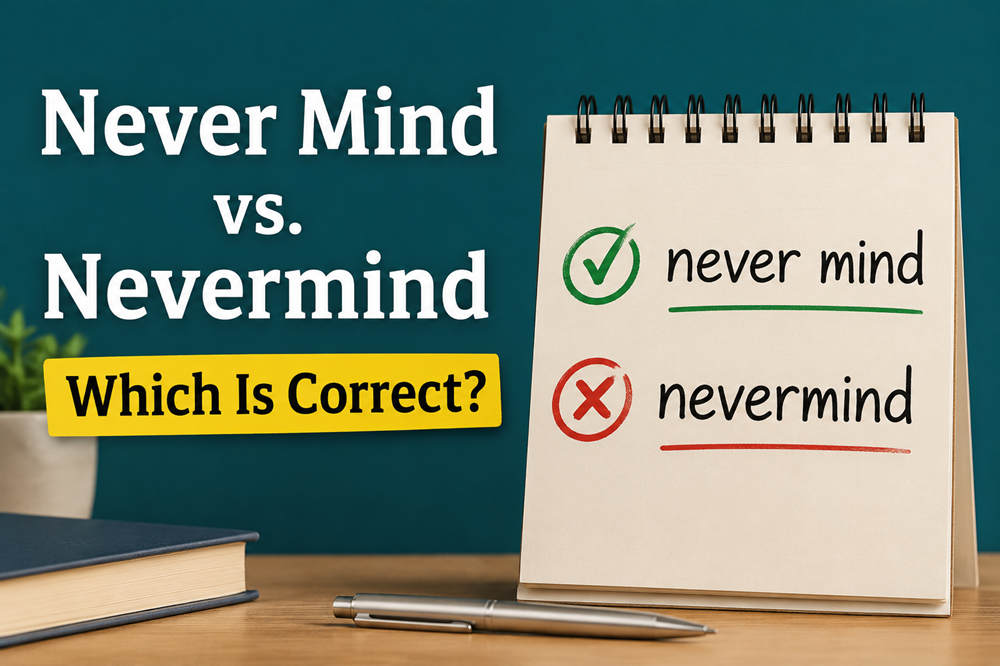
Never mind is normally written as two words. This is the standard spelling when you mean “do not worry,” “ignore that,” or “let alone.” The one-word form nevermind also exists, but it is an uncommon informal noun with a different use.
Is Nevermind One Word or Two?
For almost every everyday sentence, write never mind as two separate words.
- Standard: Never mind, I found my keys.
- Standard: Never mind what he said.
- Standard: She cannot drive a car, never mind a truck.
The closed spelling nevermind often appears in text messages, social media posts, and other casual writing. However, never mind remains the standard form in edited, academic, and professional writing.
What Does “Never Mind” Mean?
The phrase never mind has a few closely related meanings. The intended meaning is usually clear from the context.
Do Not Worry About It
You can use never mind to reassure someone that a mistake or problem is not important.
- “I’m sorry I arrived late.” “Never mind. The meeting has not started.”
- Never mind the spilled water. I’ll clean it up.
- Never mind about the mistake. We can correct it.
In these sentences, the phrase means something similar to “don’t worry about it” or “it doesn’t matter.”
Ignore or Disregard Something
Never mind can also tell someone to ignore an earlier question, request, or comment.
- Can you help me find the document? Never mind, I found it.
- What time are we leaving? Actually, never mind. Sarah just told me.
- Never mind what I said earlier.
This use is common when the situation changes or the speaker no longer needs an answer.
Let Alone or Much Less
The phrase can introduce something that is even more difficult, unlikely, or extreme than what has already been mentioned.
- He cannot boil an egg, never mind cook an entire dinner.
- I barely have enough money for the ticket, never mind a hotel room.
- She had never visited Italy, never mind lived there.
In this use, never mind means “let alone” or “much less.”
When Is “Nevermind” One Word?
Nevermind can be written as one word when it functions as an informal noun meaning attention, concern, importance, or responsibility.
It is most often found in traditional expressions such as:
- Don’t pay him no nevermind.
- It’s no nevermind of yours.
The first example contains a double negative because it reflects an established dialectal expression. It would not normally be used in formal writing.
This noun form is chiefly associated with informal American English and can sound regional or old-fashioned. Although dictionaries recognize it, most speakers would use a more familiar word such as attention, concern, or business.
- Dialectal: Don’t pay the criticism no nevermind.
- Standard: Don’t pay any attention to the criticism.
The difference between the standard phrase and the uncommon noun form of nevermind explains why both spellings can appear in dictionaries while having different uses.
Never Mind vs. Nevermind
| Form | Use | Meaning | Example |
|---|---|---|---|
| never mind | Standard expression | Do not worry or ignore it | Never mind, I can fix it. |
| never mind | Connecting expression | Let alone or much less | He cannot walk a mile, never mind run one. |
| nevermind | Informal noun | Attention, concern, or importance | It’s no nevermind of yours. |
| never-mind | Rare dialectal noun spelling | Attention or concern | Not normally used in everyday writing. |
Is “Never-Mind” Hyphenated?
The familiar expression is not hyphenated. Write never mind, not never-mind, when you are telling someone not to worry or asking them to disregard something.
- Correct: Never mind the cost for now.
- Nonstandard: Never-mind the cost for now.
The hyphenated spelling has occasionally been used as a version of the rare dialectal noun, but it is not needed in normal sentences.
Can You Write “NVM” in a Text?
NVM is a common abbreviation for never mind in texts and online chats. It is suitable for casual communication but should usually be written out in formal or professional writing.
Final Answer
Write never mind as two words when you mean “do not worry,” “ignore that,” or “let alone.” This is the correct form for nearly all everyday uses.
Use nevermind only for the uncommon informal noun meaning attention, concern, or importance, as in “It’s no nevermind of yours.”