Is Alongside One Word? Alongside vs. Along Side Explained
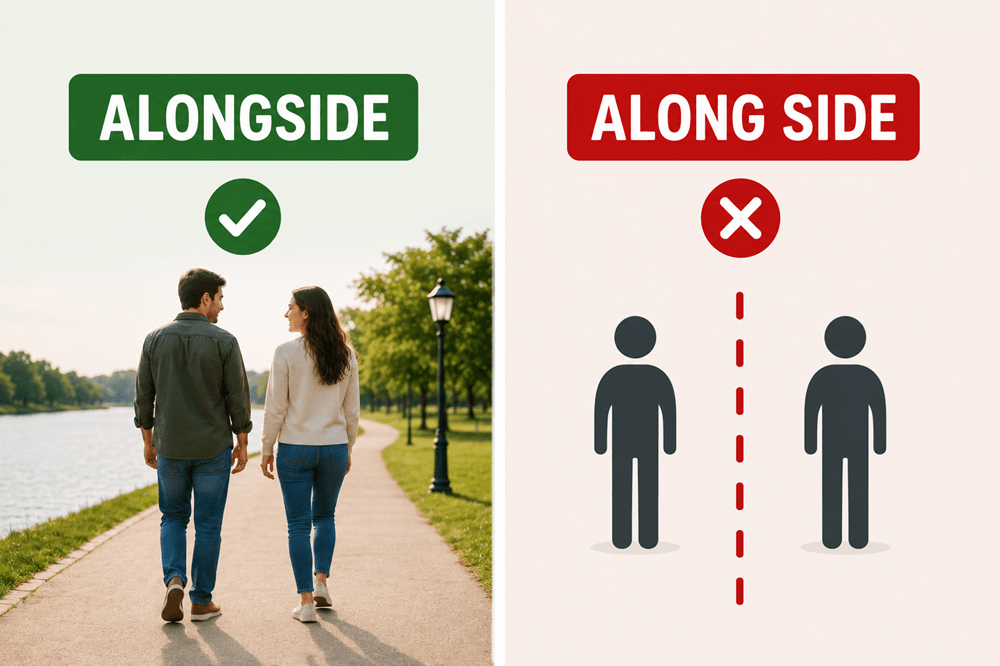
Alongside is normally written as one word.
It can mean next to, beside, together with, or at the same time as someone or something else.
Correct:
- She walked alongside her friend.
- The boat moved alongside the dock.
- He works alongside experienced designers.
- The new system will operate alongside the old one.
The two-word form along side is usually incorrect when you mean “beside” or “together with.”
Quick Answer
Use:
alongside
Do not normally use:
along side
Examples:
- The child stood alongside his mother.
- A bicycle path runs alongside the road.
- She studied alongside several international students.
A simple memory rule is:
If alongside means “next to” or “together with,” write it as one word.
What Does Alongside Mean?
Alongside commonly means:
- next to
- beside
- together with
- in cooperation with
- at the same time as
Examples:
- The police car stopped alongside us.
- She worked alongside her father.
- Traditional methods continued alongside new technology.
- A narrow trail runs alongside the river.
The exact meaning depends on the sentence.
Sometimes it describes physical position. In other cases, it describes people or systems working together.
Is Alongside One Word or Two?
Alongside is one word in standard English.
Correct:
- alongside
- work alongside
- walk alongside
- alongside the road
Incorrect in most ordinary uses:
- along side
- along-side
Although along and side are both separate words, they combine to form the established preposition and adverb alongside.
Why Is Alongside One Word?
Alongside is a closed compound word.
A closed compound joins two words without a space or hyphen.
Examples include:
- inside
- outside
- beside
- throughout
- alongside
The two original ideas—along and side—have combined into one word with a clear meaning.
The word no longer simply means “along a side” in a literal grammatical structure. It functions as one complete unit meaning “next to” or “together with.”
Alongside in a Sentence
Examples:
- The dog ran alongside the bicycle.
- She sat alongside her sister.
- The ship came alongside the pier.
- New apartments were built alongside the park.
- He trained alongside professional athletes.
- The charity works alongside local schools.
- Digital records exist alongside paper files.
- A row of trees grows alongside the highway.
In every example, alongside is written as one word.
Alongside as a Preposition
Alongside often functions as a preposition because it appears before a noun or pronoun.
Examples:
- alongside the building
- alongside her
- alongside the river
- alongside other employees
Examples in sentences:
- The car parked alongside the building.
- He stood alongside her during the ceremony.
- A walking path follows alongside the river.
- She works alongside other employees in the department.
In these sentences, the word connects one person or thing to another.
Alongside as an Adverb
Alongside can also function as an adverb when the object is understood.
Examples:
- The smaller boat pulled alongside.
- We waited until the vehicle came alongside.
- She walked alongside for several minutes.
In these examples, the sentence does not state exactly what the person or object is beside because the context already makes it clear.
Is Along Side Ever Correct?
The sequence along side can appear when along and side belong to separate parts of a sentence, but this is uncommon.
For example:
- The path runs along Side Street.
Here, Side Street is a proper name, so along remains separate.
Another possible structure is:
- We walked along the side of the building.
This phrase uses:
- along
- the side
It is not the same as the single word alongside.
Compare:
- We walked alongside the building.
- We walked along the side of the building.
Both are correct, but the grammatical structures differ.
Do not write:
- We walked along side the building.
Alongside vs. Along the Side Of
These expressions are similar but not always identical.
Alongside
Means next to or beside.
- The path runs alongside the river.
Along the side of
Emphasizes movement or position following one particular side.
- The path runs along the side of the riverbank.
The first is shorter and more general. The second may be more precise when you want to emphasize a specific edge or surface.
Alongside vs. Beside
Alongside and beside both mean next to.
Examples:
- She stood alongside me.
- She stood beside me.
However, alongside can suggest that two people or things extend or move together.
Example:
- The road runs alongside the railway.
Beside often describes a simpler fixed position.
Example:
- The lamp is beside the bed.
In many sentences, either word is possible.
Alongside vs. Next To
Next to is a common two-word phrase meaning beside.
Compare:
- He sat alongside his friend.
- He sat next to his friend.
Both are correct.
Next to sounds more conversational.
Alongside may sound slightly more formal or may suggest working, moving, or continuing together.
Examples:
- She works alongside medical professionals.
- She sits next to her coworker.
Alongside vs. Together With
Alongside can mean together with, especially in work or cooperation.
Examples:
- The organization works alongside local volunteers.
- The organization works together with local volunteers.
Both sentences describe cooperation.
However, alongside can also describe physical position, while together with usually emphasizes participation or inclusion.
Work Alongside
The phrase work alongside means to work with someone, often as a colleague or partner.
Examples:
- She works alongside engineers.
- Students worked alongside community leaders.
- He has worked alongside the same team for years.
- Nurses work alongside doctors and other medical professionals.
Do not write:
- work along side
Walk Alongside
The phrase walk alongside means to walk next to someone or something.
Examples:
- He walked alongside his daughter.
- The guide walked alongside the group.
- A child walked alongside the horse.
- She walked alongside me for several blocks.
The word remains closed.
Stand Alongside
Stand alongside can describe both position and support.
Physical meaning:
- She stood alongside her brother.
Figurative meaning:
- We will stand alongside the affected families.
In the second sentence, stand alongside means support or remain loyal to someone.
Alongside Each Other
The phrase alongside each other means next to one another or working together.
Examples:
- The two buildings stand alongside each other.
- Different generations worked alongside each other.
- The boats floated alongside each other.
This phrase can sound slightly repetitive because alongside already suggests being next to something, but it is common and acceptable.
Alongside or Along With?
Alongside and along with can sometimes express inclusion, but they are not always interchangeable.
Alongside
Often emphasizes cooperation or parallel activity.
- She worked alongside the director.
Along with
Often means together with or in addition to.
- She attended the meeting along with the director.
Compare:
- The new software will run alongside the old program.
Both will operate at the same time. - The package includes a guide along with the software.
The guide is included in addition to the software.
Is Alongside Hyphenated?
No. The standard spelling does not use a hyphen.
Correct:
- alongside
Incorrect:
- along-side
This applies whether the word functions as a preposition or adverb.
Common Misspellings
Common incorrect forms include:
- along side
- along-side
- allongside
- alongisde
- alongsid
The correct spelling is:
alongside
Think of it as one complete word, just like:
- inside
- outside
- beside
Common Mistakes
Separating the word
Incorrect:
- She walked along side me.
Correct:
- She walked alongside me.
Adding a hyphen
Incorrect:
- The boat moved along-side the dock.
Correct:
- The boat moved alongside the dock.
Confusing alongside with along the side of
Correct:
- We walked alongside the wall.
- We walked along the side of the wall.
Incorrect:
- We walked along side the wall.
Using alongside when inclusion is clearer
Less precise:
- Alongside the report, she submitted two photographs.
Clearer:
- Along with the report, she submitted two photographs.
Use alongside when the idea is position, cooperation, or parallel activity.
How to Remember the Spelling
Compare alongside with other one-word location terms:
- inside
- outside
- beside
- alongside
They all describe position and are written as one word.
A useful memory sentence is:
When two things stay side by side, the letters in alongside stay together.
You can also test the meaning:
If you can replace the word with beside, use alongside as one word.
Example:
- She walked alongside me.
- She walked beside me.
Final Answer
Alongside is written as one word.
It means beside, next to, together with, or working in cooperation with.
Correct:
- She stood alongside her friend.
- The road runs alongside the river.
- He works alongside experienced teachers.
- The new system operates alongside the old one.
The two-word form along side is usually incorrect unless along and side have separate grammatical roles.
Remember:
If it means “beside” or “together with,” write alongside as one word.