Complement or Compliment: Correct Meaning, Spelling Difference, Usage, and Easy Examples Explained
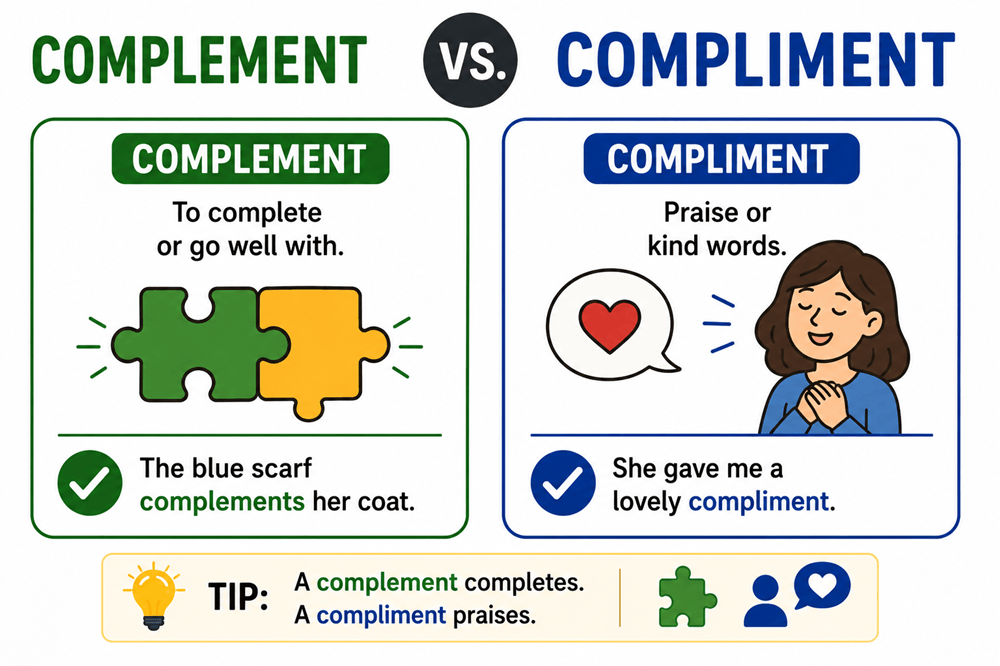
Complement and compliment are both correct words, but they mean different things. Use complement when one thing completes, improves, or goes well with another. Use compliment when someone says something kind, polite, or admiring. The easiest rule is: a compliment is praise, while a complement completes.
Quick Answer
Use complement when something completes or matches something else well.
- The red scarf complements her coat.
- The wine was a perfect complement to the meal.
- His calm personality complements her energy.
Use compliment when you mean praise or a kind remark.
- She gave me a lovely compliment.
- He complimented her on the presentation.
- Thank you for the compliment.
The simple rule is: complement means complete or go well with. Compliment means praise.
Complement or Compliment: What Is the Difference?
The difference between complement and compliment is meaning. These words sound the same, which makes them easy to confuse, but their spellings point to different ideas.
Complement is about completion, matching, balance, or improvement. When one thing complements another, it makes the other thing feel more complete, more effective, or better suited.
Compliment is about praise, admiration, politeness, or kind words. When someone gives you a compliment, they are saying something nice about you, your work, your appearance, your effort, or your character.
| Word | Meaning | Example |
|---|---|---|
| Complement | To complete, match, or improve something | The sauce complements the fish. |
| Compliment | Praise or a kind remark | She gave him a compliment. |
If your sentence is about something fitting well with something else, use complement. If your sentence is about saying something nice, use compliment.
What Does Complement Mean?
Complement means something that completes, balances, improves, or pairs well with something else. It can be used as a noun or a verb.
As a noun, a complement is something that completes or improves another thing.
- The salad was a nice complement to the pasta.
- The soft music was the perfect complement to the quiet evening.
- Her skills are a strong complement to the team.
As a verb, complement means to complete, enhance, or go well with something.
- The blue curtains complement the gray walls.
- His experience complements her creativity.
- The spices complement the flavor of the soup.
In each example, complement is not about praise. It is about a good fit or a sense of completion.
What Does Compliment Mean?
Compliment means praise, admiration, or a polite expression of approval. It can also be used as a noun or a verb.
As a noun, a compliment is something nice someone says.
- That was a thoughtful compliment.
- She smiled after hearing the compliment.
- He accepted the compliment graciously.
As a verb, compliment means to praise someone or say something kind.
- She complimented him on his cooking.
- The teacher complimented the student’s essay.
- He complimented her new haircut.
In each example, compliment is about kind words, not completion or matching.
Complement as a Noun
When complement is a noun, it refers to something that completes or improves another thing. This use is common in food, fashion, design, teamwork, business, and writing.
Examples:
- The roasted vegetables were a perfect complement to the chicken.
- The necklace was a beautiful complement to her dress.
- His technical knowledge was a useful complement to her leadership skills.
- The bright pillows added a cheerful complement to the plain sofa.
In these sentences, the complement adds something useful. It makes the whole result feel more balanced, complete, or attractive.
Complement as a Verb
When complement is a verb, it describes the action of completing or improving something by pairing well with it.
Examples:
- The lemon flavor complements the fish.
- The simple frame complements the painting.
- Her strengths complement his strengths.
- The new software complements the existing system.
This word is often useful when you want to describe harmony. Colors can complement each other. Skills can complement each other. Foods, ideas, tools, and personalities can complement each other too.
Compliment as a Noun
When compliment is a noun, it means a kind remark or expression of praise.
Examples:
- She received a compliment on her speech.
- That is the nicest compliment anyone has given me.
- He took the comment as a compliment.
- The chef appreciated the customer’s compliment.
A compliment can be about appearance, effort, talent, kindness, work, taste, courage, intelligence, or any quality someone admires.
Compliment as a Verb
When compliment is a verb, it means to give praise.
Examples:
- She complimented his writing style.
- He complimented the team on their hard work.
- The guest complimented the host on the meal.
- My manager complimented me after the meeting.
The verb compliment is usually followed by the person being praised, the thing being praised, or a phrase beginning with on.
- She complimented him.
- She complimented his work.
- She complimented him on his work.
Examples of Complement in Sentences
Here are natural examples of complement used correctly:
- The fresh herbs complement the rich sauce.
- The black shoes complement the navy suit.
- The quiet ending was a perfect complement to the emotional story.
- The two employees have skills that complement each other.
- The painting is a nice complement to the room’s warm colors.
- The new feature complements the original design.
- Her practical thinking complements his big ideas.
- The dessert was a sweet complement to the spicy meal.
In every sentence, complement is about matching, improving, or completing something.
Examples of Compliment in Sentences
Here are natural examples of compliment used correctly:
- She gave him a sincere compliment.
- He complimented her on her patience.
- The teacher’s compliment encouraged the student.
- I took your words as a compliment.
- They complimented the chef after dinner.
- That was a generous compliment.
- She felt shy after receiving the compliment.
- He complimented the design of the website.
In every sentence, compliment is about praise or kind words.
Complementary or Complimentary?
Complementary and complimentary are also commonly confused.
Complementary means matching well, completing each other, or working together.
- Their skills are complementary.
- Blue and orange are complementary colors.
- The two products offer complementary benefits.
Complimentary can mean praising, but it can also mean free of charge.
- She made a complimentary comment about his work.
- The hotel offers a complimentary breakfast.
- Guests received complimentary tickets.
This is an important difference. A complementary breakfast would mean a breakfast that matches or completes something else. A complimentary breakfast means a free breakfast.
Common Phrases With Complement
Use complement in phrases about matching, completing, or going well together.
- complement each other
- a perfect complement
- complement the design
- complement the flavor
- complement the outfit
- complementary colors
- complementary skills
Examples:
- The colors complement each other.
- The salad was a perfect complement to the main dish.
- Her communication skills complement his technical knowledge.
Common Phrases With Compliment
Use compliment in phrases about praise, admiration, politeness, or free items.
- give a compliment
- receive a compliment
- take it as a compliment
- compliment someone on something
- return the compliment
- complimentary breakfast
- complimentary tickets
Examples:
- She gave me a kind compliment.
- I took his words as a compliment.
- The hotel gave guests a complimentary breakfast.
Common Mistakes to Avoid
The biggest mistake is using compliment when the sentence needs complement.
Incorrect:
- The sauce compliments the pasta.
- Her skills are a good compliment to the team.
Correct:
- The sauce complements the pasta.
- Her skills are a good complement to the team.
Another mistake is using complement when the sentence needs compliment.
Incorrect:
- He gave her a nice complement.
- The manager complemented the team on its effort.
Correct:
- He gave her a nice compliment.
- The manager complimented the team on its effort.
If praise is involved, use compliment. If completion or matching is involved, use complement.
How to Remember Complement or Compliment
Here is an easy memory trick:
Complement has an e, and complete has an e.
Compliment has an i, and I like it sounds like praise.
- Complement = completes or goes well with
- Compliment = praise or kind words
You can also remember this sentence:
A complement completes; a compliment praises.
Final Answer
Complement and compliment are both correct, but they mean different things. Use complement when something completes, improves, balances, or goes well with something else. Use compliment when someone gives praise or says something kind. Remember: a complement completes, and a compliment praises.