Either or Neither: Correct Meaning, Difference, Grammar, and Examples for Clear Writing
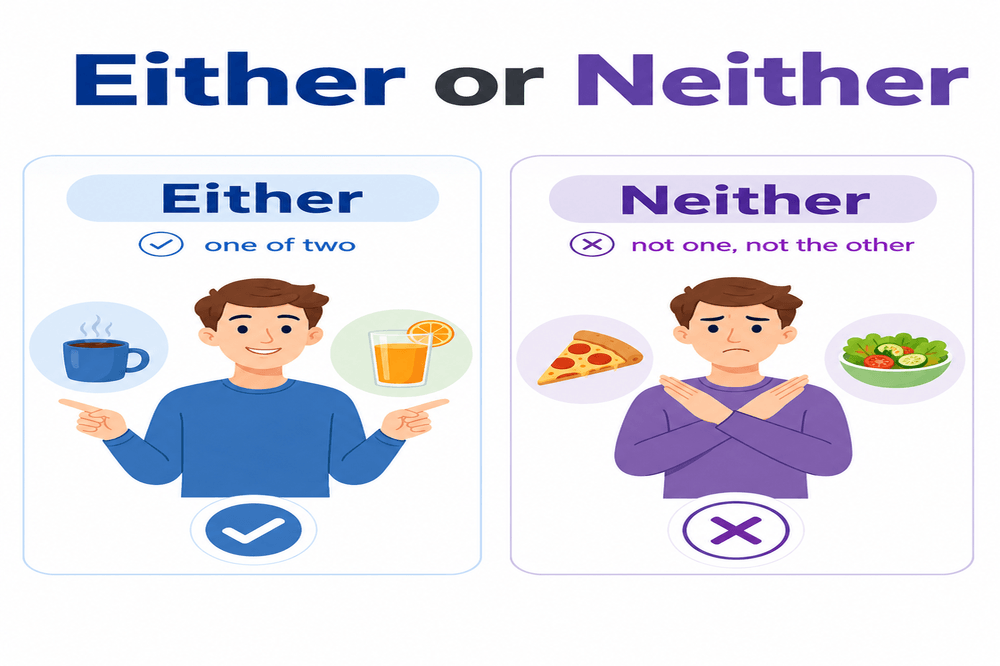
Either and neither are both used when comparing two choices, but they have opposite meanings. Use either when one of two options is possible, acceptable, or being offered. Use neither when both options are rejected, unavailable, or not true. The easiest rule is this: either means one or the other, while neither means not one and not the other.
Quick Answer
Use either when you mean one of two choices, or when both choices are acceptable.
- Correct: You can choose either option.
- Correct: Either answer could be right.
- Correct: We can meet either today or tomorrow.
Use neither when you mean that both choices are not true, not wanted, or not available.
- Correct: Neither option works.
- Correct: Neither answer is correct.
- Correct: She likes neither coffee nor tea.
The simple rule is this: either gives a choice. Neither says no to both choices.
Either or Neither: What Is the Difference?
The difference between either and neither is the difference between possibility and rejection. Either is usually positive or open. It means one choice or the other can work. Neither is negative. It means both choices are ruled out.
For example, if you say, “Either jacket is fine,” you mean both jackets are acceptable, and someone can choose one. If you say, “Neither jacket is fine,” you mean both jackets are unsuitable.
| Word | Main Meaning | Example |
|---|---|---|
| Either | One or the other | Either road will take you there. |
| Neither | Not one and not the other | Neither road will take you there. |
Those two sentences look similar, but their meanings are very different. Either road will take you there means both roads are possible choices. Neither road will take you there means both roads are wrong.
What Does Either Mean?
Either means one of two things, any one of two things, or one or the other. It is used when two options are being offered, compared, or considered.
Examples:
- You can sit in either chair.
- Either answer is acceptable.
- We can take either route.
- She can wear either dress to the dinner.
In these sentences, either shows that one choice is possible. Sometimes it means only one should be chosen. Other times it means both options are acceptable, but only one is needed.
Either can also appear with or. This creates the common pair either…or.
- You can have either soup or salad.
- Either call me tonight or email me tomorrow.
- The package will arrive either Monday or Tuesday.
In each example, either…or presents two possible choices.
What Does Neither Mean?
Neither means not either one. It is used when two choices are both rejected, both unavailable, or both untrue.
Examples:
- Neither answer is correct.
- Neither restaurant is open.
- Neither of the shirts fits.
- Neither plan solved the problem.
In each sentence, there are two choices, and both fail in some way. The answers are both wrong. The restaurants are both closed. The shirts both do not fit. The plans both failed.
Neither can also appear with nor. This creates the common pair neither…nor.
- She likes neither coffee nor tea.
- Neither the manager nor the assistant was available.
- The movie was neither funny nor interesting.
In each example, neither…nor rejects both things.
When to Use Either
Use either when one of two options can be chosen or when both options are acceptable.
Examples:
- Either date works for me.
- You may choose either color.
- Either room would be large enough.
- We can leave by either exit.
You can often test either by replacing it with one or the other.
- Either option is fine.
- One option or the other is fine.
The second sentence sounds less natural, but the meaning is close. If the sentence is about choosing one of two possibilities, either is probably correct.
Either can also be used at the end of a negative sentence to mean “also not.”
- I do not like that movie either.
- She was not ready either.
- The second answer does not work either.
In this use, either does not introduce a choice. It adds another negative statement.
When to Use Neither
Use neither when both of two options are rejected or not true.
Examples:
- Neither candidate gave a clear answer.
- Neither key opened the door.
- Neither of the books was available.
- Neither explanation made sense.
You can often test neither by replacing it with not either one.
- Neither key worked.
- Not either one of the keys worked.
The second version is awkward, but it shows the meaning. Both keys failed, so neither is correct.
Because neither is already negative, avoid adding another negative word unless the sentence is intentionally informal or dialectal.
- Incorrect: Neither answer is not correct.
- Correct: Neither answer is correct.
The word neither already contains the negative meaning, so another not usually makes the sentence confusing.
Either Or vs Neither Nor
Use either…or when you are offering two possible choices.
- You can order either pasta or rice.
- Either John or Maria will lead the meeting.
- The store will open either today or tomorrow.
Use neither…nor when you are excluding both choices.
- She ordered neither pasta nor rice.
- Neither John nor Maria will lead the meeting.
- The store will open neither today nor tomorrow.
The pairings matter. Either goes with or. Neither goes with nor.
| Pair | Meaning | Example |
|---|---|---|
| Either…or | One choice or the other | Either tea or coffee is fine. |
| Neither…nor | Not this and not that | Neither tea nor coffee is available. |
If the sentence offers a choice, use either…or. If the sentence rejects both choices, use neither…nor.
Either Is or Either Are?
Either is usually treated as singular when it means one of two options. That means either is is usually the safer choice in formal writing.
- Correct: Either answer is acceptable.
- Correct: Either of the rooms is available.
- Correct: Either choice is fine.
In casual speech, you may sometimes hear either are, especially when the phrase includes a plural noun.
- Casual: Either of the rooms are available.
- More formal: Either of the rooms is available.
For polished writing, either is is usually better.
Neither Is or Neither Are?
Neither is also usually treated as singular when it means not one and not the other. That means neither is is often the safer formal choice.
- Correct: Neither answer is correct.
- Correct: Neither option is ideal.
- Correct: Neither of the cars is ready.
In everyday speech, many people use neither are when talking about plural things.
- Casual: Neither of the cars are ready.
- More formal: Neither of the cars is ready.
For clear and careful writing, use neither is when referring to one of two choices. If the sentence sounds stiff, you can rewrite it.
- Formal: Neither of the cars is ready.
- Smoother: Both cars are not ready.
- Smoother: The cars are not ready.
Me Either or Me Neither?
Me neither is the more standard phrase when you are agreeing with a negative statement.
- Person A: I do not like cold coffee.
- Person B: Me neither.
This means “I do not like cold coffee either.”
Me either is sometimes heard in casual American speech, but me neither is more widely accepted.
- Casual: Me either.
- More standard: Me neither.
In formal writing, a complete sentence is usually better.
- Casual: Me neither.
- Formal: I do not either.
- Natural: I do not like it either.
Either of Us or Neither of Us?
Use either of us when one of two people could do something or be chosen.
- Either of us can drive.
- You can call either of us for help.
- Either of us would be happy to answer.
Use neither of us when both people are not included or when both people do not do something.
- Neither of us can drive.
- Neither of us knew the answer.
- Neither of us wanted to leave early.
The difference is simple. Either of us means one of the two people. Neither of us means not one and not the other.
Common Mistakes With Either and Neither
The most common mistake is using neither with another negative word.
Incorrect:
- I do not like neither option.
- Neither answer is not right.
- We did not choose neither plan.
Correct:
- I do not like either option.
- Neither answer is right.
- We did not choose either plan.
Another common mistake is mixing the word pairs.
Incorrect:
- Either tea nor coffee is available.
- Neither tea or coffee is available.
Correct:
- Either tea or coffee is available.
- Neither tea nor coffee is available.
A third mistake is choosing either when the sentence actually means both options are rejected.
- Wrong meaning: Either answer is correct.
- Correct if both are wrong: Neither answer is correct.
Either answer is correct means one or both answers may work. Neither answer is correct means both answers are wrong.
Examples of Either in Sentences
Here are examples of either used correctly:
- Either jacket will keep you warm.
- You may take either road.
- Either of the plans could work.
- The meeting can happen either Monday or Wednesday.
- She can choose either the blue dress or the green dress.
- I do not want dessert either.
- The second explanation does not make sense either.
- Either candidate would bring experience to the role.
In most of these examples, either offers a choice. In the negative examples, it means “also not.”
Examples of Neither in Sentences
Here are examples of neither used correctly:
- Neither jacket fits well.
- Neither of the answers is correct.
- Neither road leads to the campsite.
- She wanted neither attention nor praise.
- Neither the teacher nor the principal was available.
- Neither option gives us enough time.
- Neither of us expected the delay.
- The movie was neither exciting nor funny.
In each sentence, neither rejects both choices or says both are not true.
How to Remember Either or Neither
A simple way to remember the difference is this:
- Either = one or the other
- Neither = not either one
You can also remember the matching pairs:
- Either…or = choose one
- Neither…nor = no to both
Try this quick test:
- If the sentence gives a choice, use either.
- If the sentence rejects both choices, use neither.
Examples:
- Either answer is fine. This means one answer or the other works.
- Neither answer is fine. This means both answers fail.
Final Answer
Either and neither are both correct words, but they have different meanings. Use either when one of two options is possible, acceptable, or being offered. Use neither when both options are rejected, unavailable, or not true.
The easiest rule is simple: either means one or the other, while neither means not one and not the other. Use either…or for choices and neither…nor for two negative options.