Yours or Your’s: Correct Spelling, Meaning, Possessive Rule, and Examples Clearly Explained
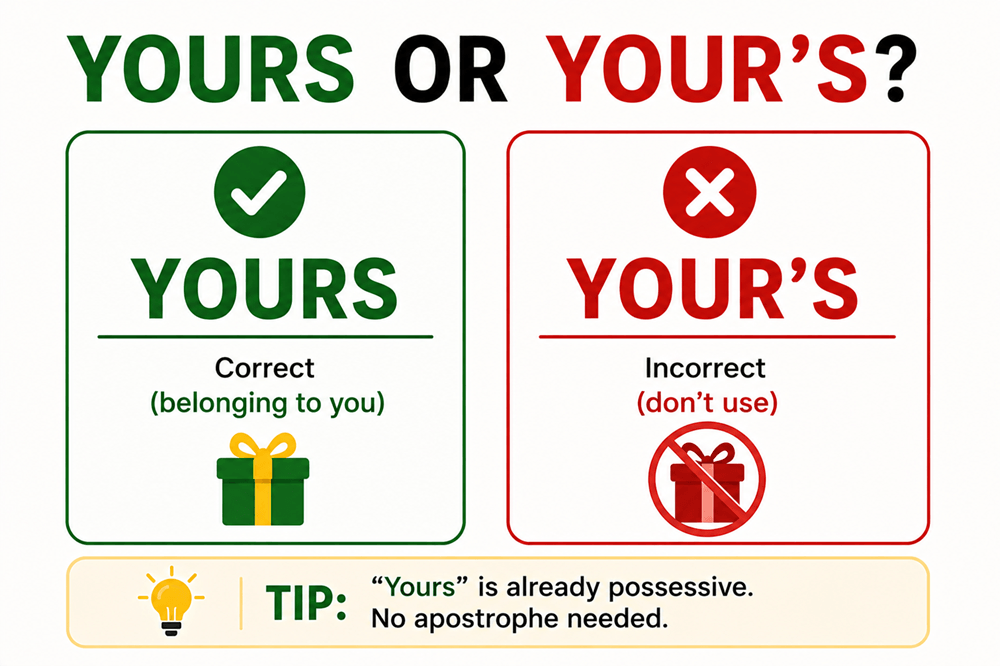
Yours is the correct spelling. Your’s is incorrect and should not be used in standard English. The word yours already shows possession, so it does not need an apostrophe. Use yours when something belongs to or is connected with the person you are speaking to. The easiest rule is simple: write yours, never your’s.
Quick Answer
Use yours when you mean “belonging to you.”
- Correct: This book is yours.
- Correct: The choice is yours.
- Correct: Is this jacket yours?
- Correct: Sincerely yours, Anna.
Your’s is not correct.
- Incorrect: This book is your’s.
- Incorrect: The choice is your’s.
- Incorrect: Is this jacket your’s?
- Incorrect: Sincerely your’s, Anna.
The simple rule is this: yours is already possessive. Do not add an apostrophe.
Yours or Your’s: What Is the Difference?
The difference between yours and your’s is spelling and correctness. Yours is the correct possessive pronoun. It shows that something belongs to the person being spoken to. Your’s is a common misspelling caused by adding an unnecessary apostrophe.
Many people add apostrophes when they see possession because apostrophes often show ownership in English. For example, you write Sarah’s phone, the dog’s leash, and the teacher’s desk. However, possessive pronouns do not use apostrophes.
| Word | Status | Example |
|---|---|---|
| Yours | Correct possessive pronoun | The red bag is yours. |
| Your’s | Incorrect spelling | The red bag is your’s. |
If you are writing a sentence, email, note, card, caption, message, or formal letter, use yours.
What Does Yours Mean?
Yours means “belonging to you” or “connected with you.” It is a possessive pronoun, which means it replaces a noun phrase instead of coming before a noun.
Examples:
- This seat is yours.
- The final decision is yours.
- That phone looks like yours.
- My handwriting is messy, but yours is neat.
In each sentence, yours points back to something owned, chosen, used, or associated with the person being addressed. It does not need another noun after it.
Compare:
- Your car is outside.
- The car outside is yours.
Your comes before a noun, like car. Yours stands alone and replaces the full idea of your car.
Why Your’s Is Incorrect
Your’s is incorrect because possessive pronouns do not take apostrophes. The word yours already shows possession by itself. Adding an apostrophe does not make it more possessive; it only makes the spelling wrong.
Compare these examples:
- Incorrect: That umbrella is your’s.
- Correct: That umbrella is yours.
- Incorrect: The responsibility is your’s.
- Correct: The responsibility is yours.
- Incorrect: This opportunity is your’s.
- Correct: This opportunity is yours.
The same rule applies to other possessive pronouns:
- his, not hi’s
- hers, not her’s
- ours, not our’s
- theirs, not their’s
- yours, not your’s
These words already show ownership, so they do not need apostrophes.
When to Use Yours
Use yours when something belongs to the person or people you are addressing. It can refer to physical objects, choices, opinions, feelings, responsibilities, ideas, or relationships.
Examples:
- The blue notebook is yours.
- This side of the room is yours.
- The next move is yours.
- That opinion is yours, and this one is mine.
- The house will be yours after the paperwork is complete.
Yours can also appear in comparisons.
- My answer is shorter than yours.
- Her car is newer than yours.
- Their plan is different from yours.
In these examples, yours replaces a phrase like your answer, your car, or your plan.
Yours in Letters and Emails
Yours is often used in letter closings. These phrases are traditional and should not contain an apostrophe.
- Yours truly,
- Yours sincerely,
- Sincerely yours,
- Yours faithfully,
Examples:
- Correct: Yours truly, Michael
- Correct: Sincerely yours, Rebecca
- Correct: Yours sincerely, Daniel
Do not write:
- Incorrect: Your’s truly, Michael
- Incorrect: Sincerely your’s, Rebecca
- Incorrect: Your’s sincerely, Daniel
In modern American business writing, many people simply use Sincerely, Best, or Regards. Still, if you use a closing with yours, spell it without an apostrophe.
Your vs Yours
Your and yours are both possessive, but they are used differently. Your comes before a noun. Yours stands alone.
| Word | Use | Example |
|---|---|---|
| Your | Comes before a noun | Your coat is on the chair. |
| Yours | Stands alone | The coat on the chair is yours. |
Examples with your:
- Your keys are on the table.
- Your idea sounds interesting.
- Your room is ready.
Examples with yours:
- The keys on the table are yours.
- That idea sounds like yours.
- The room at the end of the hall is yours.
A quick test is this: if a noun comes right after the word, use your. If the word stands by itself, use yours.
Yours vs You’re
Yours and you’re are completely different words. Yours shows possession. You’re is a contraction of you are.
| Word | Meaning | Example |
|---|---|---|
| Yours | Belonging to you | This seat is yours. |
| You’re | You are | You’re sitting here. |
Examples:
- Correct: This gift is yours.
- Correct: You’re going to love this gift.
- Correct: The decision is yours.
- Correct: You’re responsible for the decision.
If you can replace the word with you are, use you’re. If you mean something belongs to you, use yours.
Is Yours Ever Written With an Apostrophe?
No, yours is not written with an apostrophe in standard English. The form your’s is always considered incorrect when you mean “belonging to you.”
This can feel surprising because apostrophes often show possession with names and nouns.
- Maria’s book
- the cat’s bowl
- the company’s policy
But possessive pronouns follow a different rule.
- my book → mine
- your book → yours
- her book → hers
- our book → ours
- their book → theirs
None of these forms use apostrophes. That is why yours is correct and your’s is not.
The Choice Is Yours or Your’s?
The correct phrase is the choice is yours.
Correct:
- The choice is yours.
- The final choice is yours.
- You can stay or leave; the choice is yours.
Incorrect:
- The choice is your’s.
- The final choice is your’s.
- You can stay or leave; the choice is your’s.
This phrase means the decision belongs to you. Since yours already shows possession, no apostrophe is needed.
Is This Yours or Your’s?
The correct question is Is this yours?
Correct:
- Is this yours?
- Is this phone yours?
- Is this seat yours?
Incorrect:
- Is this your’s?
- Is this phone your’s?
- Is this seat your’s?
This question asks whether something belongs to the person being addressed. The correct spelling is yours.
Sincerely Yours or Sincerely Your’s?
The correct phrase is sincerely yours.
Correct:
- Sincerely yours,
- Very sincerely yours,
- Yours sincerely,
Incorrect:
- Sincerely your’s,
- Very sincerely your’s,
- Your’s sincerely,
This phrase appears in letter closings, formal notes, and traditional correspondence. Even in formal writing, there is no apostrophe in yours.
Common Mistakes With Yours and Your’s
The most common mistake is adding an apostrophe because the word shows ownership. This mistake is understandable, but it does not follow the rule for possessive pronouns.
Incorrect:
- The last slice is your’s.
- This responsibility is your’s.
- The better idea was your’s.
- That parking space is your’s.
Correct:
- The last slice is yours.
- This responsibility is yours.
- The better idea was yours.
- That parking space is yours.
Another mistake is using your when the sentence needs yours.
Incorrect:
- This book is your.
Correct:
- This book is yours.
Use your before a noun. Use yours when the possessive word stands alone.
Examples of Yours in Sentences
Here are examples of yours used correctly:
- This pen is yours.
- The decision is yours to make.
- My desk is clean, but yours is covered in papers.
- The blue cup is mine, and the green one is yours.
- That email looks like yours.
- The responsibility is yours now.
- These shoes are not mine; they must be yours.
- The future is yours if you keep working for it.
In each sentence, yours shows possession without an apostrophe.
Examples of Your’s as an Incorrect Spelling
Here are examples showing why your’s should be avoided:
- Incorrect: This seat is your’s.
- Correct: This seat is yours.
- Incorrect: The next turn is your’s.
- Correct: The next turn is yours.
- Incorrect: That backpack is your’s.
- Correct: That backpack is yours.
- Incorrect: The honor is your’s.
- Correct: The honor is yours.
The correct spelling is always yours.
How to Remember Yours or Your’s
A simple way to remember the correct spelling is this:
- Yours already means “belonging to you.”
- Possessive pronouns do not need apostrophes.
- Your’s is always wrong in standard English.
You can also compare yours with other possessive pronouns:
- mine
- hers
- ours
- theirs
- yours
None of these words use apostrophes. That pattern can help you remember that yours does not need one either.
Another quick memory trick is:
Yours is yours already.
Since the word already shows ownership, an apostrophe is unnecessary.
Final Answer
Yours is the correct spelling. It is a possessive pronoun that means something belongs to or is connected with the person you are speaking to. Use it in sentences like This is yours, The choice is yours, Is this yours?, and Sincerely yours.
Your’s is incorrect because possessive pronouns do not use apostrophes. The easiest rule is simple: write yours, not your’s.