Medicare or Medicaid: Key Differences, Eligibility, Coverage, Costs, and Examples Explained Clearly
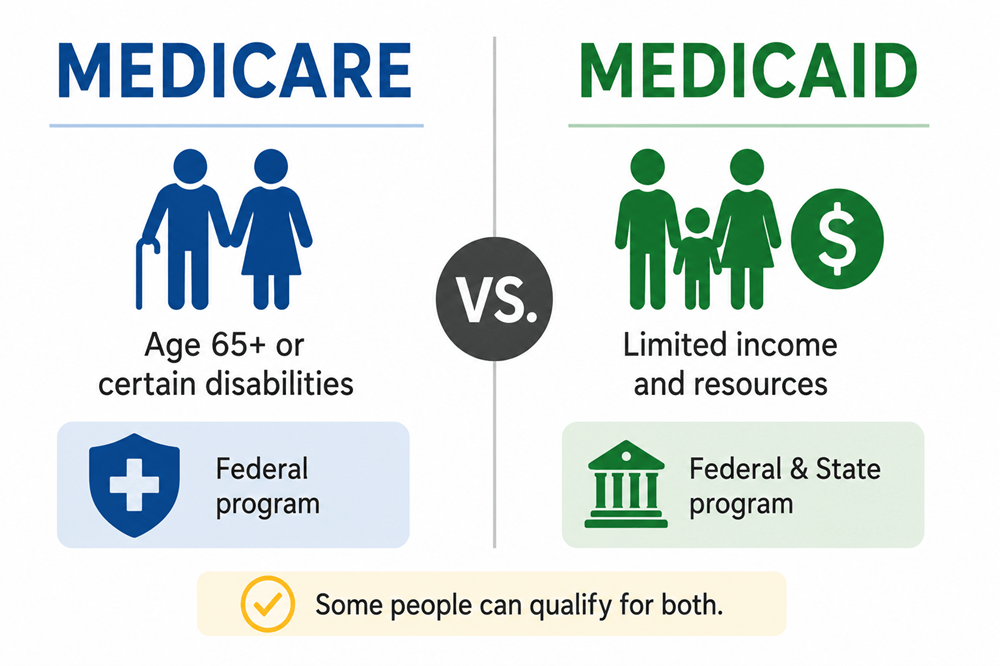
Medicare and Medicaid are both U.S. health coverage programs, but they are not the same. Medicare is mainly for people age 65 or older and certain younger people with disabilities. Medicaid is mainly for people with limited income and resources. Some people can qualify for both.
Quick Answer
Use Medicare when talking about federal health insurance mostly connected to age or disability.
- She enrolled in Medicare when she turned 65.
- Medicare can help cover hospital care, doctor visits, and prescription drugs.
- Some younger people with disabilities may qualify for Medicare.
Use Medicaid when talking about health coverage based mostly on income, resources, and state eligibility rules.
- He applied for Medicaid because his income was limited.
- Medicaid rules vary by state.
- Medicaid may help cover services that Medicare does not fully cover.
The simple rule is: Medicare is mainly age or disability based, while Medicaid is mainly income based.
Medicare or Medicaid: What Is the Difference?
The biggest difference between Medicare and Medicaid is who they are designed to help. Medicare is a federal program. It is most often associated with people who are 65 or older, though certain younger people with disabilities or specific medical conditions may also qualify.
Medicaid is a joint federal and state program. It helps eligible people with limited income and resources get health coverage. Because states help run Medicaid, the exact rules are not the same everywhere.
| Program | Main Basis | Who Runs It? |
|---|---|---|
| Medicare | Age, disability, or certain conditions | Federal government |
| Medicaid | Income, resources, and state rules | Federal and state governments |
What Is Medicare?
Medicare is a federal health insurance program. It is best known for covering people age 65 or older, but it can also cover certain younger people with disabilities or qualifying medical conditions.
Medicare is divided into parts. These parts help cover different types of care:
- Part A: hospital insurance
- Part B: medical insurance, such as doctor visits and outpatient care
- Part C: Medicare Advantage, offered through approved private plans
- Part D: prescription drug coverage
Medicare is not the same as free health care. Many people still have premiums, deductibles, copayments, coinsurance, or other out-of-pocket costs. The exact cost depends on the type of Medicare coverage someone has.
What Is Medicaid?
Medicaid is a health coverage program for eligible people with limited income and resources. It can cover children, pregnant women, parents, older adults, people with disabilities, and other qualifying groups.
Unlike Medicare, Medicaid is run by both the federal government and individual states. This means Medicaid eligibility, benefits, and application rules can vary depending on where a person lives.
Medicaid may cover doctor visits, hospital care, long-term care, preventive care, and other health services. In some cases, Medicaid can also help with services that Medicare does not fully cover, such as certain long-term care, transportation to medical appointments, or personal care services. Coverage depends on the state and the person’s eligibility category.
Who Qualifies for Medicare?
Medicare is usually connected to age or disability. Many people become eligible when they turn 65. Some younger people may qualify if they have received certain disability benefits or have specific serious conditions.
Examples:
- A person turns 65 and enrolls in Medicare.
- A younger person with a qualifying disability receives Medicare.
- A person with a qualifying medical condition may become eligible before 65.
Medicare eligibility is not mainly based on low income. A person can have a higher income and still qualify for Medicare if they meet the age, disability, or condition requirements.
Who Qualifies for Medicaid?
Medicaid eligibility is usually connected to income, resources, household size, age, disability status, pregnancy, or family situation. Because Medicaid is partly run by states, a person must check the rules in their own state.
Examples:
- A low-income adult may qualify for Medicaid in their state.
- A pregnant woman may qualify based on income and state rules.
- A child may qualify for Medicaid or CHIP.
- An older adult may qualify for Medicaid help with certain long-term care costs.
Medicaid is not automatic for everyone with a low income. A person must meet the program rules and apply through the correct state process.
Can You Have Both Medicare and Medicaid?
Yes. Some people qualify for both Medicare and Medicaid. These people are often called dual eligible. In that situation, Medicare usually pays first for covered services, and Medicaid may help with costs or services that Medicare does not fully cover.
For example, someone may have Medicare because they are 65 or older and Medicaid because they also meet income and resource rules in their state. Having both can lower certain health care costs, but the exact benefits depend on the person’s state and coverage type.
Medicare vs Medicaid Costs
Medicare often includes costs such as premiums, deductibles, coinsurance, and copayments. Some people pay no premium for Part A, but many still pay for Part B, Part D, Medicare Advantage, or supplemental coverage.
Medicaid usually has lower out-of-pocket costs for eligible people, but the rules vary by state. Some Medicaid programs may have small copayments, while others may have little or no cost for covered services.
| Program | Cost Pattern |
|---|---|
| Medicare | Often includes premiums and out-of-pocket costs |
| Medicaid | Usually low cost, depending on state rules |
Common Mistake
The most common mistake is thinking Medicare and Medicaid are two names for the same program. They are separate programs with different eligibility rules.
Incorrect idea:
- Medicare and Medicaid are the same thing.
Correct idea:
- Medicare is mainly based on age or disability.
- Medicaid is mainly based on income and state rules.
Another mistake is assuming that someone cannot have both. In reality, some people are eligible for both programs at the same time.
How to Remember the Difference
Use this simple memory trick:
- Medicare often comes with age care, especially around 65.
- Medicaid often gives aid to people with limited income.
This is not a complete legal rule, but it helps you remember the basic difference. Medicare is mainly tied to age, disability, or certain conditions. Medicaid is mainly tied to financial need and state eligibility rules.
Final Answer
Medicare and Medicaid are both health coverage programs, but they serve different purposes. Medicare is a federal program mainly for people age 65 or older and certain younger people with disabilities or qualifying conditions. Medicaid is a joint federal and state program for eligible people with limited income and resources.
If the question is about age-based or disability-based federal health insurance, the word is Medicare. If the question is about income-based health coverage through state rules, the word is Medicaid. Some people can qualify for both.