Queue or Que: Correct Spelling, Meaning, Pronunciation, Usage, and Examples Explained Clearly
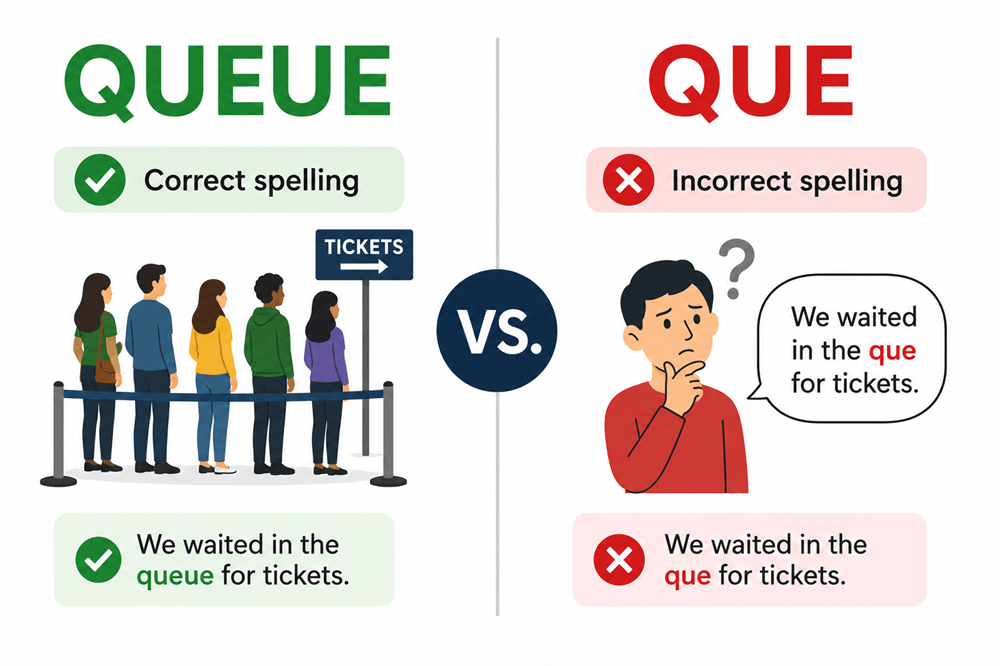
Queue is the correct English word when you mean a line of people, a waiting list, or a sequence of items waiting to be handled. Que is not the correct spelling for this meaning in English. If you are talking about waiting your turn, use queue.
Quick Answer
Use queue when you mean a line, waiting list, or ordered sequence.
- We waited in the queue for tickets.
- Your request has been added to the queue.
- The printer has three documents in the queue.
Que is not standard English for a line or waiting list.
- Incorrect: We waited in the que.
- Correct: We waited in the queue.
The simple rule is: queue is correct, and que is usually a misspelling.
Queue or Que: What Is the Difference?
The difference between queue and que is that queue is the correct English spelling, while que is usually wrong when used in its place. The word queue can be a noun or a verb. As a noun, it means a line or list. As a verb, it means to line up or add something to a waiting list.
| Word | Status | Example |
|---|---|---|
| Queue | Correct English spelling | Please join the queue. |
| Que | Usually incorrect in English | Please join the que. |
If you are writing in English and the meaning is “line,” “waiting list,” or “sequence,” the spelling should be queue.
What Does Queue Mean?
Queue means a line of people, vehicles, tasks, messages, files, or requests waiting for attention. It is common in everyday English, technology, customer service, transportation, and business writing.
Examples:
- There was a long queue outside the theater.
- The emails are waiting in the support queue.
- The cars formed a queue at the toll booth.
- The printer queue is full.
- She joined the queue at the coffee shop.
In British English, queue is especially common for a line of people. In American English, people often say line instead, but queue is still correct, especially in technical or formal contexts.
What Does Que Mean?
Que is usually not a standard English word for a line or waiting list. In many cases, it is simply a misspelling of queue. People often write que because queue has an unusual spelling and is pronounced like the letter Q.
Examples:
- Incorrect: The files are in the que.
- Correct: The files are in the queue.
- Incorrect: Add my name to the que.
- Correct: Add my name to the queue.
Que can appear in other languages, especially Spanish and French, but it is not the correct English spelling for queue. If your sentence is in English, use queue.
How Do You Pronounce Queue?
Queue is pronounced like the letter Q. The extra letters are silent.
- Queue = “kyoo”
This pronunciation is one reason the word is often misspelled. The spelling looks much longer than the sound. Even though the word has five letters, it is pronounced as one simple sound.
Examples:
- The queue moved slowly.
- He waited in the queue for twenty minutes.
- The task is still in the queue.
In each sentence, queue sounds like Q.
Queue as a Noun
As a noun, queue refers to a line or waiting list. This can be a physical line of people or a digital list of tasks.
Examples:
- The queue at the airport was long.
- A queue formed outside the store.
- Your order is now in the queue.
- The system processes jobs in a queue.
The noun form is useful when you want to talk about waiting, order, or sequence.
Queue as a Verb
Queue can also be a verb. It means to line up or place something in a waiting list.
Examples:
- People queued outside the stadium.
- Please queue the next song.
- The app queued the download automatically.
- Several customers are queuing for service.
The verb forms can look a little strange, but they are correct:
- queue
- queued
- queuing
- queues
In American English, you may also see queueing spelled as queuing. Queuing is the more common spelling.
In Queue or In the Queue?
Both phrases can be correct, depending on the sentence.
Use in the queue when talking about a specific line or list.
- Your request is in the queue.
- There are five people in the queue.
- The file is in the print queue.
Use in queue in some technical or shortened contexts, though in the queue usually sounds more natural in regular writing.
- The task is waiting in queue.
- The task is waiting in the queue.
For everyday writing, in the queue is usually the clearer choice.
Queue vs Cue
Queue is also confused with cue. These words sound the same, but they have different meanings.
| Word | Meaning | Example |
|---|---|---|
| Queue | A line or waiting list | Join the queue. |
| Cue | A signal or prompt | That was my cue to leave. |
Use cue when you mean a signal, hint, prompt, or reminder. Use queue when you mean a line or list.
Common Mistakes
The most common mistake is spelling queue as que.
Incorrect:
- The download is in the que.
- We had to stand in a long que.
- The ticket system has a waiting que.
Correct:
- The download is in the queue.
- We had to stand in a long queue.
- The ticket system has a waiting queue.
Another mistake is using queue when the meaning should be cue.
Incorrect:
- That was my queue to speak.
Correct:
- That was my cue to speak.
How to Remember the Difference
Remember this simple rule:
- Queue = line or waiting list
- Que = not the English spelling for this meaning
- Cue = signal or prompt
You can also remember that queue has a line of silent letters waiting behind the Q. That makes the spelling easier to picture: the word itself looks like a queue.
Final Answer
Queue is the correct English spelling when you mean a line, waiting list, or sequence of items waiting to be handled. Que is usually a misspelling in this context.
Use queue in sentences like “Join the queue” or “Your request is in the queue.” Use cue only when you mean a signal or prompt, as in “That was my cue to speak.”