OK or Okay: Meaning, Correct Spelling, Usage, Capitalization, and Memory Tips Explained
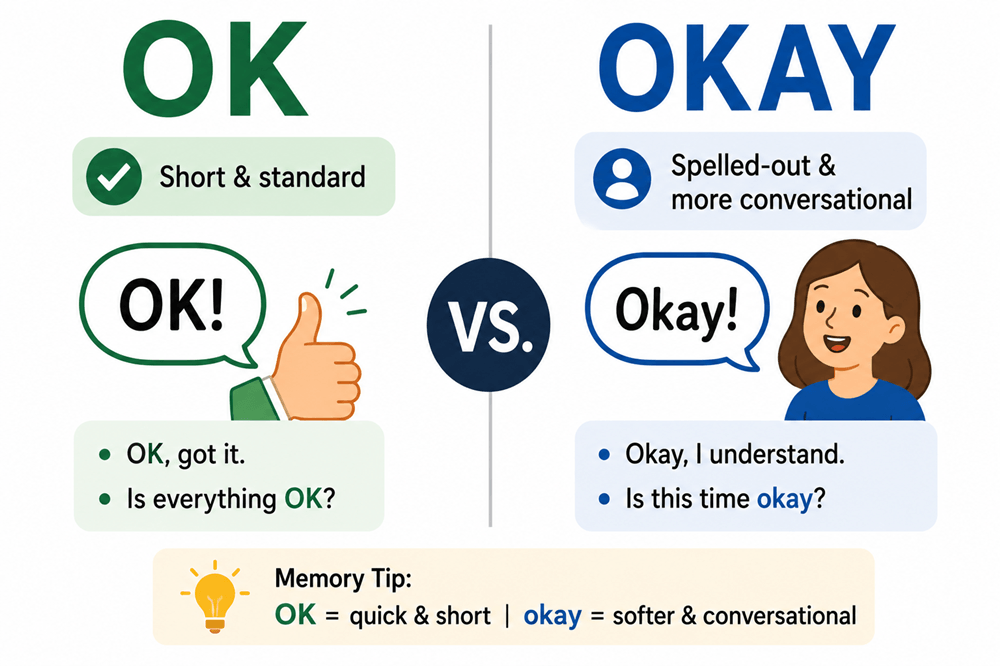
OK and okay are both correct. They mean acceptable, fine, all right, or approved. The main difference is style. OK is shorter and more common in quick writing, while okay feels a little more casual, softer, and conversational. Ok with only the O capitalized is common online, but OK or okay is usually better in polished writing.
Quick Answer
Use OK as the standard short form.
- OK, I will call you later.
- The manager said the plan is OK.
- Are you OK?
Use okay when you want the word written out fully.
- Okay, I understand.
- Everything will be okay.
- Is this time okay for you?
The simple rule is: OK and okay are both correct, but avoid lowercase “ok” in formal writing.
OK or Okay: What Is the Difference?
The difference between OK and okay is mostly spelling and tone, not meaning. Both words can mean acceptable, safe, approved, good enough, or understood.
| Word | Best Use | Example |
|---|---|---|
| OK | Short, standard form | The report looks OK. |
| Okay | Spelled-out form | The report looks okay. |
| Ok | Informal typing | Ok, see you soon. |
If you want the cleanest choices, use OK or okay. If you are writing a professional email, article, school assignment, or published content, ok may look too casual.
What Does OK Mean?
OK can mean fine, acceptable, approved, safe, or understood. It can work as an adjective, adverb, noun, verb, or interjection.
Examples:
- The food was OK, but not amazing.
- Are you feeling OK today?
- She gave the project her OK.
- The editor OK’d the headline.
- OK, let’s begin.
OK is useful because it is short and direct. It works well in quick messages, workplace notes, forms, instructions, and casual writing. However, because it is brief, it can sometimes sound flat or neutral.
What Does Okay Mean?
Okay means the same thing as OK. It is simply the fully written form. Many people use okay when they want the word to feel more natural in a sentence.
Examples:
- Everything is going to be okay.
- Okay, I will wait here.
- Is it okay if I bring a friend?
- The movie was okay, but I expected more.
- She said she was okay after the accident.
Okay often feels softer than OK. For example, “Are you okay?” can feel warmer than “Are you OK?” though both are correct.
Is Ok Correct?
Ok is common in texting, comments, and quick online messages, but it is not the best spelling for careful writing. The more standard short form is OK, with both letters capitalized.
Informal:
- Ok, I’ll be there soon.
Better:
- OK, I’ll be there soon.
- Okay, I’ll be there soon.
If you are writing casually to a friend, ok is usually understood. If you are writing for a website, workplace, school, or professional setting, choose OK or okay.
Spelling Structure: Why OK Is Capitalized
OK is usually written in all capital letters because it developed as a short expression, not as a regular lowercase word. That is why OK looks different from ordinary words like fine, yes, or good.
Think of OK as a compact two-letter word:
- O + K = OK
Because it has only two letters, capitalizing both letters makes it look complete and intentional. Lowercase ok can look like a quick text message, not polished writing.
Spelling Structure: Why Okay Is Easy to Remember
Okay is the spelled-out version of OK. It begins with the same sound:
- O + kay = okay
A simple way to remember it is this: okay sounds like “O-kay.” The first letter is o, and the second part sounds like the letter K.
Do not spell it as okey in standard writing. The usual spelling is okay, with kay at the end.
When to Use OK
Use OK when you want a short, simple, direct form. It is common in quick replies, approvals, notes, and labels.
- OK, thanks for letting me know.
- The design looks OK to me.
- Please click OK to continue.
- She gave the final OK before launch.
OK works especially well when space is limited or when the tone is brief and practical.
When to Use Okay
Use okay when you want the word to blend smoothly into a sentence. It often feels more conversational and less abrupt than OK.
- It is okay to ask for help.
- Are you okay with this plan?
- Okay, let’s try again tomorrow.
- The first draft is okay, but it needs editing.
Okay is a good choice in dialogue, advice, personal writing, and emotional sentences.
OK vs Okay in Tone
Although the meaning is the same, the tone can feel slightly different.
| Form | Tone | Example |
|---|---|---|
| OK | Short and direct | OK, send it. |
| Okay | Softer and more conversational | Okay, send it when you are ready. |
In emotional writing, okay may feel warmer. In technical writing, OK may feel cleaner.
Common Mistakes
The most common mistake is using ok in writing that should look polished.
Less polished:
- Is this ok for the final version?
Better:
- Is this OK for the final version?
- Is this okay for the final version?
Another mistake is thinking OK and okay have different meanings. They do not. The choice depends on tone, style, and context.
How to Remember the Difference
Use these memory tips:
- OK is short, so it is good for quick approval.
- Okay is longer, so it often feels softer in a sentence.
- Ok looks like a text shortcut, so avoid it in polished writing.
- Okay sounds like O-kay, which helps you remember the spelling.
A simple memory sentence is: OK is quick; okay is conversational.
Final Answer
OK and okay are both correct. They mean acceptable, fine, approved, or all right. Use OK when you want the shorter standard form, and use okay when you want the spelled-out form.
Ok is common in casual typing, but it is less polished. For most articles, school writing, business writing, and published content, choose OK or okay.