Like or As: Difference, Correct Usage, Grammar Rules, Examples, and Memory Tips Explained
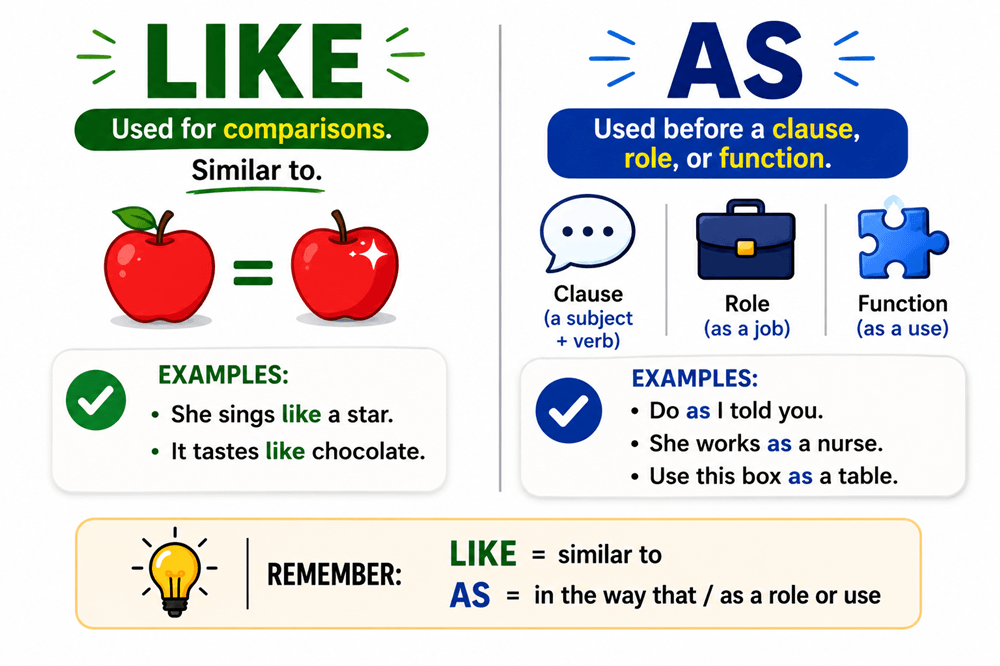
Like and as are both correct words, but they are used differently. Like is usually used to compare nouns or noun phrases. As is usually used before a clause with a subject and verb, or when describing a role, job, function, or identity. The easiest rule is: like compares things; as introduces actions, roles, or full clauses.
Quick Answer
Use like when comparing one thing to another.
- She sings like a professional.
- This fabric feels like silk.
- He runs like the wind.
Use as when a subject and verb follow, or when describing a role or function.
- Do as I said.
- She works as a teacher.
- As we expected, the meeting was short.
The simple rule is: like means similar to; as means in the way that, while, because, or in the role of.
Like or As: What Is the Difference?
The main difference between like and as is grammar. Like is commonly followed by a noun, pronoun, or noun phrase. As is commonly followed by a clause, which means a group of words with a subject and a verb.
| Word | Best Use | Example |
|---|---|---|
| Like | Compares nouns or noun phrases | She dances like a star. |
| As | Introduces a clause, role, or function | She dances as her coach taught her. |
If the words after the comparison are simple, such as a star, silk, him, or an expert, like often fits. If the words after it include a subject and verb, such as I said, she promised, or we expected, as is usually the better choice.
What Does Like Mean?
Like often means similar to or in the same way as. It compares one person, thing, feeling, action, or situation to another.
Examples:
- The blanket feels like wool.
- He looks like his father.
- The house smelled like fresh paint.
- She fought like a champion.
- The sky looked like a painting.
In these sentences, like compares something to a noun or noun phrase. The blanket is similar to wool. He resembles his father. The sky resembles a painting.
Like is especially common in casual speech, descriptions, comparisons, similes, and everyday writing. It helps readers understand one thing by connecting it to something familiar.
What Does As Mean?
As has several uses. It can mean in the way that, while, because, or in the role of. It is often used before a clause or before a noun that names a role, job, identity, or function.
Examples:
- Do as I told you.
- As the sun rose, the room filled with light.
- As it was late, they went home.
- She works as a nurse.
- He used the box as a table.
In do as I told you, as introduces a clause: I told you. In she works as a nurse, as shows a role. In he used the box as a table, as shows function.
Spelling and Word Structure
Like and as are short words, so the spelling is not difficult. The real challenge is choosing the right one for the sentence structure.
Use this structure for like:
- like + noun
- like + pronoun
- like + noun phrase
Examples:
- like a dream
- like her
- like an old movie
Use this structure for as:
- as + subject + verb
- as + role
- as + function
Examples:
- as she promised
- as a doctor
- as a warning
Once you learn the structure, the choice becomes easier. Like usually points to similarity. As usually points to manner, role, function, or a complete idea.
When to Use Like
Use like when comparing people, things, sounds, smells, feelings, appearances, or actions.
- The baby sleeps like an angel.
- The soup tastes like chicken.
- Her voice sounds like music.
- This phone works like a computer.
- He acted like a hero.
In these examples, like does not introduce a full clause. It introduces a comparison. The words after like are nouns or noun phrases, not complete subject-and-verb ideas.
Like also appears in similes. A simile compares two things using like or as.
- Her smile was like sunshine.
- The room was quiet like a library.
- He moved like a shadow.
When to Use As
Use as when the sentence includes a clause after the comparison.
- Do as your teacher says.
- The results were as we predicted.
- She completed the form as the instructions required.
- Leave everything as you found it.
Each example has a subject and verb after as: your teacher says, we predicted, the instructions required, and you found it.
Use as for roles, jobs, or identities.
- She works as an editor.
- He served as president of the club.
- They hired him as a consultant.
Use as for function or purpose.
- Use this cloth as a cover.
- The room doubled as an office.
- She kept the note as a reminder.
Like vs As in Comparisons
The comparison can change depending on whether you use like or as.
| Sentence | Meaning |
|---|---|
| She works like a teacher. | She behaves in a way similar to a teacher. |
| She works as a teacher. | Her job is teacher. |
This difference matters. Like a teacher means similar to a teacher. As a teacher means in the role of a teacher.
More examples:
- He talks like a lawyer. This means he sounds similar to a lawyer.
- He works as a lawyer. This means his job is lawyer.
- She dressed like a queen. This means her clothes resembled a queen’s style.
- She ruled as a queen. This means she held the role of queen.
Like I Said or As I Said?
As I said is the more formal and traditionally correct phrase because I said is a clause. In polished writing, use as I said.
- Formal: As I said, the answer depends on the context.
- Casual: Like I said, the answer depends on the context.
Like I said is very common in casual speech. It sounds natural in conversation, dialogue, texting, and informal writing. However, in essays, professional writing, and edited articles, as I said usually looks cleaner.
Common Mistakes
A common mistake is using like before a full clause in formal writing.
Casual:
- Do it like I showed you.
More formal:
- Do it as I showed you.
Another mistake is using as when the sentence needs a simple comparison.
Awkward:
- She sings as a bird.
Better:
- She sings like a bird.
But remember that as is correct when describing role or identity.
- She performed as a bird in the school play.
That means she played the role of a bird, not that her singing resembled a bird’s song.
How to Remember Like and As
Use these memory tips:
- Like means similar to.
- As often means in the role of or in the way that.
- Use like before a noun or noun phrase.
- Use as before a clause with a subject and verb.
- Use as for jobs, roles, and functions.
A simple memory sentence is: Like compares; as explains how, when, why, or in what role.
You can also use this quick test:
- If you can replace the word with similar to, use like.
- If you can replace the word with in the role of, use as.
- If a subject and verb follow, as is usually better for formal writing.
Final Answer
Like is usually used for comparison. It means similar to. Example: She sings like a professional.
As is used before clauses, roles, jobs, and functions. Example: Do as I said or She works as a teacher.
To remember the difference, use this rule: like compares things; as introduces a role, function, or full clause.