Useable or Usable: Correct Spelling, Meaning, and Easy Ways to Remember It
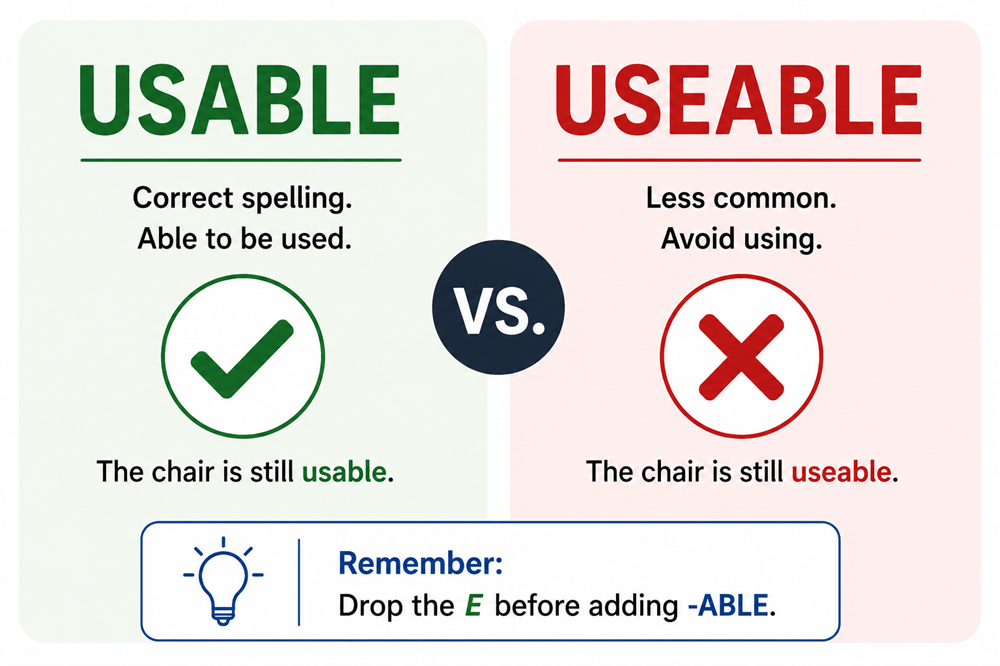
If you are choosing between useable or usable, the standard spelling is usable. It means something can be used, is practical, or works well enough for its purpose. Useable is sometimes seen as a variant, but usable is the spelling most readers, editors, teachers, and style guides expect.
Useable or Usable: Which Spelling Is Correct?
The best choice in modern English is usable.
Useable is not completely impossible, but it is much less common. In polished writing, usable is the safer spelling. You should use it in essays, emails, business documents, product descriptions, instructions, website copy, schoolwork, and professional writing.
You should write:
Correct: The old laptop is still usable.
Less common: The old laptop is still useable.
Both spellings may be understood, but usable looks cleaner and more standard. If you want your writing to feel natural and correct, choose usable.
What Does Usable Mean?
Usable is an adjective. It describes something that can be used or is fit for use. Something does not have to be perfect to be usable. It simply has to work well enough for the job.
For example:
The phone screen is cracked, but the phone is still usable.
This means the phone has damage, but it still works.
You might also write:
The instructions were clear and usable for beginners.
Here, usable means practical, understandable, and helpful.
The word is often used when talking about tools, technology, design, furniture, software, information, products, documents, materials, and spaces. If something can serve its purpose, you can call it usable.
Why Useable Looks Like It Could Be Right
The spelling useable looks logical because it keeps the full word use before adding -able. Since the base word is use, your mind may expect:
use + able = useable
That seems reasonable at first. English often adds suffixes to words without changing the base too much. But with usable, the silent e is normally dropped before -able.
The standard pattern is:
use – e + able = usable
This same kind of change happens in many English words. When a word ends in a silent e, that e is often dropped before a vowel-starting suffix. Since -able begins with a vowel sound, use becomes us before the suffix is added.
The Simple Spelling Rule for Usable
The rule is simple:
Drop the silent E before adding -able.
That gives you:
use → usable
You can think of the word as:
us + able = usable
That may look strange if you are focusing on the base word use, but it is the standard spelling. The silent e does not need to stay because the pronunciation is still clear. You still say the word like yoo-zuh-bul, not like uss-able.
This is why usable may look shorter than expected. It has only one e, at the end of -able. The e from use disappears.
A Simple Way to Remember Usable
The easiest memory trick is:
Usable drops the E from use.
That sentence tells you exactly what happens. Start with use, remove the final e, and add able.
You can also remember:
If it is able to be used, it is usable.
This helps you connect the meaning with the spelling. The word usable means “able to be used,” but you do not need to keep the full word use inside it.
Another quick memory clue is:
Usable is shorter and standard.
If you are choosing between the longer useable and the shorter usable, choose the shorter one for normal writing.
Common Examples With Usable
Seeing usable in real sentence patterns can help the spelling feel natural.
The app is simple, fast, and usable.
This means the app is easy enough to use.
The old chair is worn, but still usable.
This means the chair is not perfect, but it can still be used.
The designer created a more usable website layout.
This means the layout is easier for visitors to understand and navigate.
The storm damaged the road, but one lane remained usable.
This means one lane could still be used safely enough.
The notes were messy, but usable for studying.
This means the notes were helpful despite not being neat.
In each sentence, usable describes something practical, working, or fit for use.
Useable vs Usable in Side-by-Side Examples
Side-by-side examples make the spelling difference easier to remember:
Correct: The file is usable after the update.
Less common: The file is useable after the update.
Correct: The water is not usable without filtering.
Less common: The water is not useable without filtering.
Correct: The room became usable after the repairs.
Less common: The room became useable after the repairs.
Correct: The tool is usable for small projects.
Less common: The tool is useable for small projects.
Correct: The website needs to be more usable on phones.
Less common: The website needs to be more useable on phones.
The meaning does not change much, but the standard spelling is usable.
What About Usability?
The word usability can also help you remember usable. Usability means how easy or practical something is to use. It is especially common in technology, product design, websites, apps, tools, and customer experience.
For example:
The company tested the website’s usability before launch.
You do not write useability in standard modern English. The usual spelling is usability, just as the usual adjective is usable.
This gives you a helpful pair:
usable → usability
Both words drop the e from use. If you can remember usability, you can remember usable.
How to Check Which Spelling You Need
Before writing the word, ask yourself whether you mean “able to be used.” If yes, choose usable.
Use usable for:
usable tools
usable space
usable data
usable software
usable furniture
usable instructions
usable roads
usable materials
usable information
In most cases, you do not need useable. Even though it may appear occasionally, it can look less polished or less familiar to many readers. Usable is the form that will almost always serve you better.
The Final Answer on Useable or Usable
The standard spelling is usable. It means something can be used, works well enough, or is practical for its purpose. Useable is a much less common variant, but it is not the best choice for most modern writing.
To remember the spelling, use this simple rule: usable drops the E from use. Think of the pattern use – e + able = usable. You can also connect it with usability, which follows the same spelling pattern.
So when you are describing a working tool, a practical design, a readable document, a helpful app, or anything that can still be used, write usable. It is the clean, standard, and reliable choice.