Hanged or Hung: Correct Past Tense Usage and Simple Ways to Remember
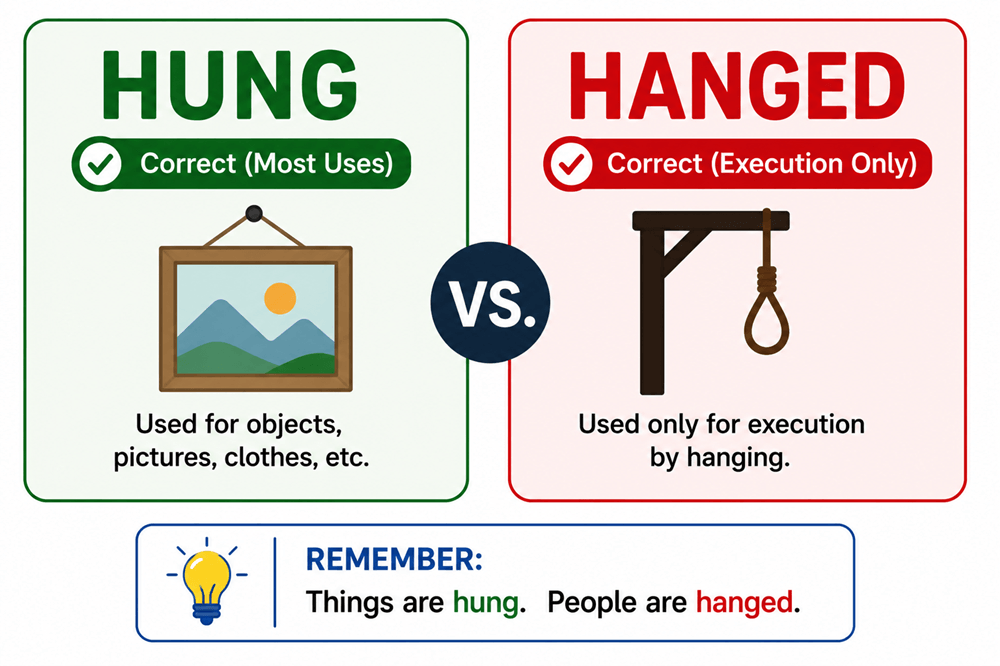
If you are choosing between hanged or hung, the correct word depends on the meaning. Hung is the usual past tense of hang for objects, decorations, pictures, clothes, and most everyday uses. Hanged is mainly used when referring to execution by hanging. The difference is specific, but once you learn the rule, it is easy to remember.
Hanged or Hung: What Is the Difference?
Hung is the standard past tense and past participle of hang in most situations. If you put a picture on a wall, placed clothes on a hook, suspended lights, or left something dangling, you usually use hung.
Hanged is used when a person was executed by hanging. That is the major exception.
You should write:
Correct: You hung the painting above the sofa.
Incorrect: You hanged the painting above the sofa.
But you should write:
Correct: The prisoner was hanged after the trial.
That sentence uses hanged because it refers to execution. In ordinary everyday sentences, however, hung is almost always the word you need.
What Does Hung Mean?
Hung is the common past tense of hang. It means something was suspended, attached, displayed, or placed so that it rested from above or against a surface.
For example:
You hung your coat by the door.
This means you placed your coat on a hook, hanger, or peg.
You might also write:
She hung the curtains in the bedroom.
Here, hung means she put the curtains up so they could hang from a rod.
Hung is used for pictures, mirrors, lights, signs, clothes, towels, decorations, shelves, and many other things. If the sentence is about placing, displaying, suspending, or attaching an object, hung is almost always correct.
What Does Hanged Mean?
Hanged is the special past tense used for execution by hanging. It is much narrower than hung. You normally do not use hanged for paintings, clothes, decorations, banners, or objects.
For example:
The convicted man was hanged.
This means the person was executed by hanging.
Because this word is tied to death and legal punishment, it appears mostly in history, law, crime writing, literature, and discussions of past punishments. It is not the word you need for most everyday uses of hang.
The key point is this: hanged is usually about a person being executed. Hung is for nearly everything else.
Why Hanged and Hung Are Easy to Confuse
The confusion happens because both words are past forms of hang. Most English verbs have one regular past tense, such as walked, jumped, or cleaned. But hang has two past forms with different uses.
This can feel strange because hanged looks regular. It simply adds -ed to hang. Your mind may expect that to be the normal past tense for every meaning.
But English kept hung as the common form for ordinary hanging. That is why you say:
You hung the lights.
Not:
You hanged the lights.
The form hanged stayed mainly for the serious, specific meaning of execution. That special meaning is what separates the two words.
A Simple Way to Remember Hung
The easiest memory trick is:
Things are hung.
If you are talking about a thing, object, decoration, or item, choose hung.
For example:
You hung a picture.
You hung your jacket.
You hung the towels outside.
You hung the sign near the entrance.
You hung the holiday lights around the porch.
In all these sentences, the word refers to objects being placed, displayed, or suspended. That means hung is correct.
You can also remember this phrase:
Hung is the usual one.
That simple reminder works because hung is the word you will need most often.
A Simple Way to Remember Hanged
To remember hanged, connect it only with execution.
A person was hanged as a punishment.
This sentence shows the narrow use of the word. Hanged is not for ordinary hanging. It is mostly for a person being put to death by hanging.
You can remember it this way:
Hanged has a harsh ending for a harsh meaning.
The -ed form looks heavier and more formal, which can help you associate it with the serious historical or legal meaning. It is not a perfect grammar rule, but it is a useful memory clue.
If the sentence is not about execution, you probably do not need hanged.
Common Examples With Hung
Here are common sentences where hung is the correct choice:
You hung the mirror near the front door.
They hung the banner across the hallway.
She hung her dress in the closet.
The clouds hung low over the mountains.
A strange silence hung in the room.
He hung up the phone before the conversation ended.
Notice that hung can be literal or figurative. Clouds can hang low. Silence can hang in a room. A feeling can hang over a conversation. In all these everyday or figurative uses, hung is correct.
Common Examples With Hanged
Here are examples where hanged is the expected word:
The criminal was hanged in the old historical account.
The law once allowed certain prisoners to be hanged.
The story describes a man who was hanged after being found guilty.
Several people were hanged during that period of unrest.
These sentences all refer to execution. That is why hanged is correct.
If the subject is a person but the meaning is not execution, hung may still be correct.
For example:
The child hung from the monkey bars.
This means the child was suspended by holding onto the bars. It does not mean execution, so hung is correct.
Hanged vs Hung in Side-by-Side Examples
Side-by-side examples make the rule easier to see:
Correct: You hung the picture on the wall.
Incorrect: You hanged the picture on the wall.
Correct: She hung her coat in the hallway.
Incorrect: She hanged her coat in the hallway.
Correct: The prisoner was hanged.
Incorrect in standard usage: The prisoner was hung.
Correct: The lights were hung around the patio.
Incorrect: The lights were hanged around the patio.
Correct: He hung from the branch for a few seconds.
Incorrect: He hanged from the branch for a few seconds.
The pattern is clear: hung is for ordinary suspension, display, attachment, and figurative use. Hanged is for execution.
What About “Hung Up”?
The phrase hung up has several meanings, and it always uses hung, not hanged.
Hung up the phone means ended a call.
She hung up before you could answer.
Hung up a coat means placed a coat on a hook or hanger.
You hung up your coat when you came inside.
Hung up on something can mean emotionally stuck, overly focused, or bothered by an issue.
He is still hung up on that old argument.
In all these phrases, hung is correct. You would not write hanged up the phone or hanged up your jacket.
What About a Hung Jury?
A hung jury is a jury that cannot agree on a verdict. This phrase also uses hung, not hanged.
For example:
The trial ended with a hung jury.
This does not mean the jury was suspended or executed. It means the jurors were unable to reach a decision. This is a fixed legal phrase, and the correct form is hung jury.
This phrase can help you remember that hung has more than one everyday or legal use, while hanged stays narrow and specific.
How to Check Which Word You Need
Before choosing between hanged and hung, ask one simple question:
Is this about execution by hanging?
If yes, use hanged.
The prisoner was hanged.
If no, use hung.
You hung the poster.
The towels hung on the line.
The smell of smoke hung in the air.
She hung up the phone.
This quick check solves almost every sentence. The word hanged has a very limited job. The word hung does most of the ordinary work.
The Final Answer on Hanged or Hung
Hung is the usual past tense and past participle of hang. Use it for pictures, clothes, decorations, signs, lights, phones, clouds, silence, feelings, and most everyday uses.
Hanged is mainly used when referring to execution by hanging. It is a special form with a narrow meaning.
To remember the difference, use these two phrases: things are hung and people are hanged when the meaning is execution. If you are talking about ordinary hanging, choose hung. If you are talking about legal or historical execution, choose hanged.