Mouse vs Rat: What’s the Difference?
A mouse and a rat are both small rodents, but they are not the same animal.
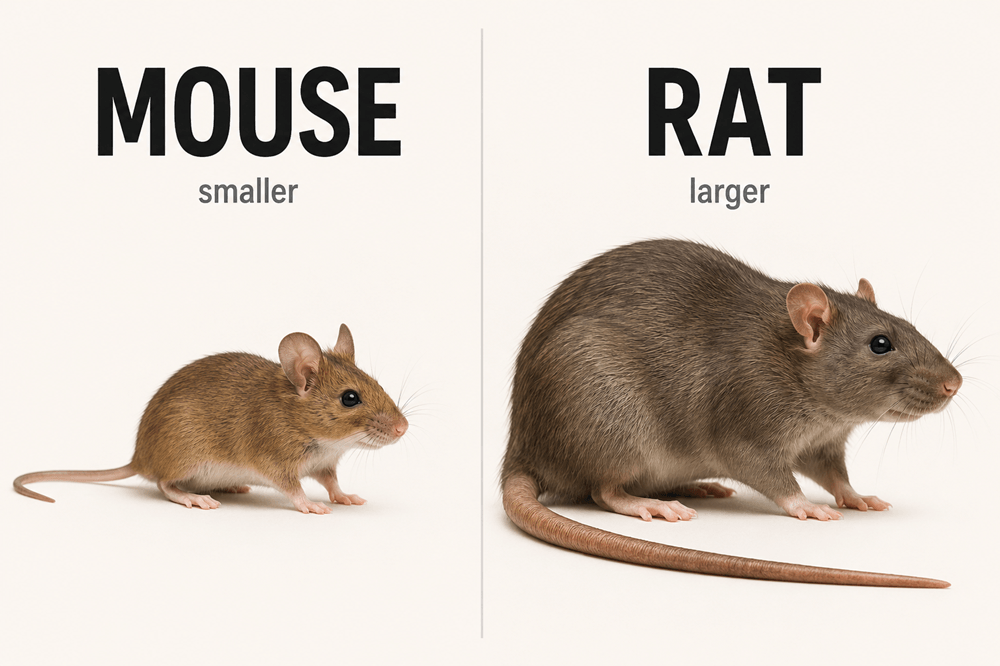
The main difference is size: rats are usually larger, while mice are usually smaller. Rats also tend to have thicker bodies, longer-looking heads, and heavier tails. Mice usually have smaller bodies, bigger-looking ears, and thinner tails.
In everyday English, people sometimes use mouse and rat loosely, especially when they see a small rodent running across the floor. But if you want to be accurate, a mouse and a rat are different animals.
Quick Answer
A mouse is usually small, light, and delicate-looking.
A rat is usually larger, heavier, and more robust.
Examples:
- A tiny mouse ran behind the cabinet.
- A large rat was seen near the alley.
- The cat chased a mouse across the kitchen.
- The city had a problem with rats near the garbage bins.
The easiest way to remember the difference is:
Mouse = small rodent
Rat = larger rodent
What Is a Mouse?
A mouse is a small rodent with a pointed nose, rounded ears, small feet, and a long thin tail.
Mice are often seen in homes, fields, barns, gardens, and storage areas. They are known for being quick, quiet, and able to fit through very small openings.
Examples:
- A mouse chewed through the cereal box.
- We found mouse droppings in the pantry.
- The children saw a field mouse in the grass.
- She bought a small white mouse as a pet.
The plural of mouse is mice.
Example:
- One mouse was in the garage.
- Three mice were in the garage.
This plural form is important because mouses is not usually correct when talking about animals. However, mouses can sometimes be used for computer devices, though many people still use mice for that meaning too.
What Is a Rat?
A rat is a larger rodent with a heavier body, a longer face, larger feet, and a thicker tail.
Rats are often associated with cities, sewers, garbage areas, warehouses, farms, and abandoned buildings. They are intelligent animals and can be very adaptable.
Examples:
- A rat ran behind the trash cans.
- The basement had a rat problem.
- The farmer set traps for rats near the grain.
- Scientists often use laboratory rats in research.
The plural of rat is rats.
Example:
- One rat was under the porch.
- Several rats were near the dumpster.
Unlike mouse, the word rat has a regular plural form. You simply add s.
Mouse vs Rat: The Main Differences
The simplest difference is size.
A mouse is usually smaller. A rat is usually bigger.
But size is not the only clue. You can also look at the body shape, ears, tail, and behavior.
A mouse usually has:
- a smaller body
- a pointed nose
- large-looking ears for its body size
- a thin tail
- small feet
- quick, light movements
A rat usually has:
- a larger body
- a thicker, heavier shape
- a longer or blunter face
- smaller-looking ears compared with its body
- a thicker tail
- larger feet
So if the rodent looks tiny, delicate, and quick, people are more likely to call it a mouse. If it looks bigger, stronger, and heavier, people are more likely to call it a rat.
Do Mouse and Rat Mean the Same Thing?
No. Mouse and rat do not mean exactly the same thing.
They are both rodents, but they refer to different types of rodents.
In casual speech, someone might say “mouse” for any tiny rodent or “rat” for any scary-looking rodent. But in accurate writing, the words should not be used as if they are identical.
Correct:
- A mouse is smaller than a rat.
- The apartment had mice, not rats.
- The alley had rats, not small house mice.
If you are writing an article, story, school paper, or pest-control guide, choose the word that matches the animal more accurately.
How to Remember the Difference
A simple memory trick:
Mouse sounds softer and smaller.
Rat sounds short, sharp, and rough.
That can help you connect the words with their usual image:
mouse = tiny and quick
rat = bigger and tougher
You can also remember:
Mice are mini. Rats are robust.
The letter m in mouse can remind you of mini.
The letter r in rat can remind you of robust.
This is not a scientific rule, but it is a useful memory shortcut for everyday writing.
Mouse vs Rat in Sentences
Use mouse when the animal is small:
- A mouse squeezed through a crack in the wall.
- The mouse hid behind the refrigerator.
- We heard a mouse scratching in the cupboard.
- The barn cat caught a mouse.
Use rat when the animal is larger:
- A rat ran across the alley.
- The restaurant had a serious rat problem.
- The old building attracted rats.
- The rat was much bigger than a mouse.
Mouse, Mice, Rat, and Rats
The plural forms are different.
Mouse becomes mice.
Examples:
- one mouse
- two mice
- many mice
Rat becomes rats.
Examples:
- one rat
- two rats
- many rats
This is one of the easiest ways to make your writing sound correct.
Incorrect:
- We saw three mouses in the attic.
Correct:
- We saw three mice in the attic.
Correct:
- We saw three rats near the trash cans.
Mouse as a Computer Word
The word mouse also has another common meaning. A mouse can be a small computer device used to move the pointer on a screen.
Examples:
- My wireless mouse stopped working.
- Move the mouse to click the icon.
- She bought a new computer mouse.
This meaning has nothing to do with a rat. The device is called a mouse because its shape and cord once looked a little like a small mouse with a tail.
For the plural, both mice and mouses may appear for computer devices, but mice is still very common.
Examples:
- The office bought new wireless mice.
- The store sells gaming mouses.
For animals, use mice, not mouses.
Rat as a Slang Word
The word rat can also be used as slang.
A rat can mean a person who betrays someone, informs on someone, or acts dishonestly.
Examples:
- He called his friend a rat for telling the secret.
- In the movie, the criminal was afraid of a rat in the group.
This is a negative meaning. It does not refer to the animal directly, but it comes from the bad reputation rats have in some cultures.
The word mouse can also describe a quiet or timid person, but this use is less harsh.
Example:
- She used to be shy as a mouse.
So in figurative language:
mouse often suggests quietness or timidity.
rat often suggests betrayal or unpleasant behavior.
Common Mistakes
Mistake 1: Calling every small rodent a rat
Incorrect:
- A tiny rat ran across the kitchen floor.
Better:
- A tiny mouse ran across the kitchen floor.
If the animal is very small, mouse is usually more likely.
Mistake 2: Calling a large rodent a mouse
Incorrect:
- A huge mouse was digging through the garbage.
Better:
- A huge rat was digging through the garbage.
If the animal is large and heavy-looking, rat is usually the better word.
Mistake 3: Using mouses for animal plurals
Incorrect:
- The barn had several mouses.
Correct:
- The barn had several mice.
For animals, the plural of mouse is mice.
Final Answer: Mouse vs Rat
A mouse is a small rodent. A rat is a larger rodent.
Mice usually look smaller, lighter, and more delicate. Rats usually look bigger, heavier, and stronger.
Use mouse for one small animal and mice for more than one. Use rat for one larger animal and rats for more than one.
The easiest way to remember the difference is:
Mouse = mini rodent
Rat = robust rodent
Both are rodents, but they are not the same animal.