Another Word for For Example: Better Alternatives With Examples
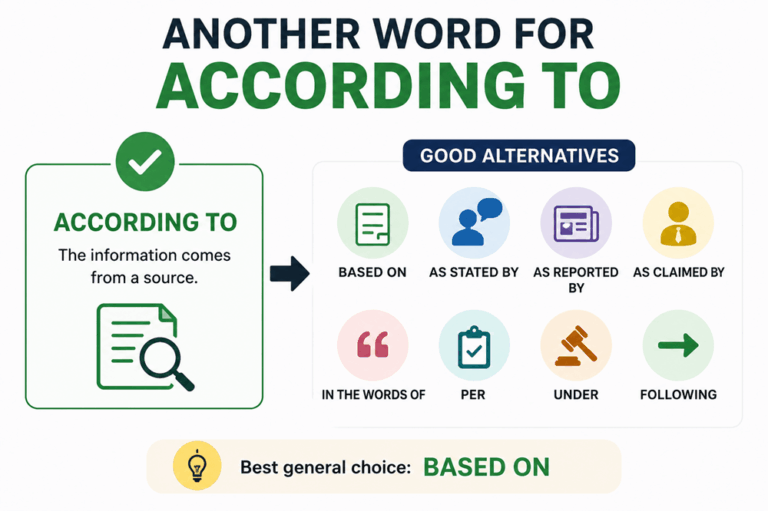
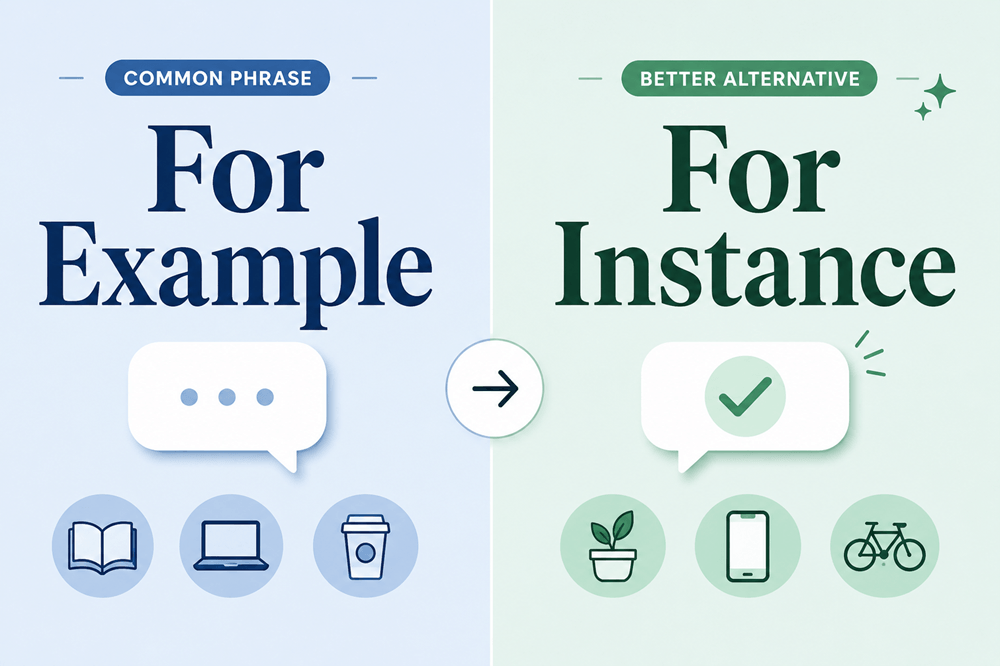
If you need another word for for example, the best choice is usually for instance.
For example is used when you want to give an example that explains, supports, or proves your point.
Examples:
- Some fruits are rich in vitamin C. For example, oranges and strawberries are good choices.
- You can improve your writing in many ways. For example, you can use clearer verbs.
- Many animals migrate. For example, birds often fly south in winter.
The phrase for example is correct and useful, but it can sound repetitive if you use it too often. Good alternatives include for instance, such as, including, like, namely, to illustrate, and as an example.
Quick Answer
Good alternatives for for example include:
- for instance
- such as
- including
- like
- namely
- to illustrate
- as an example
- as an illustration
- in particular
- especially
- one example is
- e.g.
The best general replacement is:
for instance
Example:
- Some words are often confused. For instance, “affect” and “effect” sound similar.
For formal writing, use:
- for instance
- to illustrate
- such as
- namely
For casual writing, use:
- like
- including
- one example is
What Does For Example Mean?
For example introduces a specific case that helps explain a larger idea.
Example:
- Many vegetables are healthy. For example, spinach is rich in nutrients.
The larger idea is that many vegetables are healthy. The specific example is spinach.
Another example:
- Some words have silent letters. For example, the k in “knife” is silent.
Here, “knife” is used to explain the idea of silent letters.
You can use for example in essays, articles, emails, reports, speeches, and everyday explanations.
For Instance
For instance means almost the same thing as for example.
It is one of the easiest replacements.
Examples:
- Some habits can improve sleep. For instance, reading before bed may help you relax.
- Many jobs require patience. For instance, teachers and nurses use patience every day.
- Some English words are hard to spell. For instance, “necessary” often causes mistakes.
For instance works well in formal and informal writing. It sounds natural and clear.
If you are tired of repeating for example, for instance is usually the best alternative.
Such As
Such as is used inside a sentence to introduce examples.
Examples:
- Fruits such as apples, bananas, and grapes are easy to pack.
- Outdoor activities such as hiking and biking can improve fitness.
- Some words, such as “their” and “there,” are often confused.
Use such as when the example is part of the same sentence.
Compare:
- Some animals are nocturnal. For example, owls are active at night.
- Some animals, such as owls, are nocturnal.
Both are correct. The structure is different.
Including
Including is another strong replacement for for example.
Examples:
- The store sells school supplies, including notebooks, pencils, and folders.
- The course covers several topics, including grammar and punctuation.
- Many people attended, including students, parents, and teachers.
Including is useful when you are adding examples as part of a group.
It often sounds practical and direct.
Example:
- Several cities, including Paris and Rome, attract millions of tourists.
This means Paris and Rome are examples, not necessarily the full list.
Like
Like is a casual alternative to for example.
Examples:
- I enjoy simple foods like soup and pasta.
- She likes creative hobbies like painting and writing.
- Some pets, like cats and dogs, need daily care.
Like is common in everyday speech and relaxed writing.
However, in formal writing, such as or for example may sound more polished.
Casual:
- I like sports like soccer and tennis.
More formal:
- I like sports such as soccer and tennis.
Namely
Namely is used when you are naming something specific.
Examples:
- The plan has one main problem, namely cost.
- Three students were absent, namely Jack, Maya, and Ben.
- She focused on two skills, namely reading and writing.
Namely is more exact than for example.
Use for example when you are giving one or more examples.
Use namely when you are identifying the exact thing or complete list.
Compare:
- Some cities are expensive. For example, New York is costly.
- One city was selected, namely New York.
The first gives an example. The second names the exact city.
To Illustrate
To illustrate is a formal alternative to for example.
It means “to show this more clearly.”
Examples:
- Many small choices affect health. To illustrate, walking daily can improve fitness over time.
- Word choice changes tone. To illustrate, “childlike” sounds more positive than “childish.”
- Clear instructions reduce confusion. To illustrate, a numbered list can make steps easier to follow.
To illustrate is useful in essays, reports, and educational writing.
It sounds more formal than for example and works well when your example helps explain an idea deeply.
As an Example
As an example is a simple phrase that directly introduces an example.
Examples:
- As an example, consider the word “beautiful.”
- As an example, a company may offer free shipping to attract customers.
- As an example, a teacher might use pictures to explain new vocabulary.
This phrase is clear, but it can sound slightly wordy. In many cases, for example or for instance is smoother.
Still, as an example can work well when you want to slow down and clearly introduce a case.
In Particular
In particular is used when you want to focus on one specific example.
Examples:
- Many students struggle with punctuation, in particular commas.
- She enjoys classic literature, in particular Jane Austen’s novels.
- Several costs increased, in particular rent and insurance.
In particular does not simply mean “for example.” It means the example is especially important or worth attention.
Use it when the example deserves special focus.
Especially
Especially highlights an important example.
Examples:
- Many fruits are healthy, especially berries.
- The rule is useful, especially for beginners.
- Some animals need extra care, especially young puppies.
Especially means the example is more important, more noticeable, or more strongly included than others.
Compare:
- I like fruits, for example apples and oranges.
- I like fruits, especially apples and oranges.
The second sentence suggests apples and oranges may be favorites or especially important examples.
E.g.
E.g. is an abbreviation that means for example.
Examples:
- Use common verbs, e.g., make, take, give, and get.
- Bring warm clothing, e.g., a coat, gloves, and a scarf.
- Choose a simple greeting, e.g., hi or hello.
E.g. is common in academic, technical, and note-style writing.
However, it can look too formal or too compressed in everyday writing. For general readers, for example or for instance is often clearer.
Formal Alternatives to For Example
For formal writing, use:
- for instance
- such as
- to illustrate
- as an illustration
- namely
- in particular
- e.g.
Examples:
- Several factors influence the result. For instance, timing can change the outcome.
- Some fields, such as medicine and law, require advanced training.
- To illustrate, the data shows a clear increase after 2020.
These alternatives work well in essays, reports, academic writing, and professional explanations.
Casual Alternatives to For Example
For casual writing, use:
- like
- including
- one example is
- say
- things like
Examples:
- I like relaxing activities like reading and walking.
- Bring snacks, including chips and fruit.
- One example is the way people use “hi” instead of “hello.”
These sound more natural in blog posts, conversations, and friendly explanations.
Common Mistakes
Mistake 1: Using too many example phrases together
Incorrect:
- Some foods, for example, such as apples and bananas, are easy to pack.
Correct:
- Some foods, such as apples and bananas, are easy to pack.
Also correct:
- Some foods are easy to pack. For example, apples and bananas travel well.
Choose one example phrase.
Mistake 2: Using namely for incomplete examples
Less clear:
- I enjoy sports, namely soccer and tennis.
This sounds like soccer and tennis are the exact sports you enjoy.
Better:
- I enjoy sports such as soccer and tennis.
- I enjoy sports, including soccer and tennis.
Use namely only when you are being exact.
Mistake 3: Using like in very formal writing
Casual:
- Topics like grammar and spelling are important.
More formal:
- Topics such as grammar and spelling are important.
Final Answer: Another Word for For Example
Good alternatives for for example include for instance, such as, including, like, namely, to illustrate, as an example, in particular, and especially.
The best replacement depends on tone:
For instance = best general replacement
Such as = best inside a sentence
Including = adds examples to a group
Like = casual and conversational
Namely = names exact items
To illustrate = formal and explanatory
In particular = focuses on one example
Especially = highlights an important example
For most writing, the safest alternative is:
for instance