Another Word for Information: Best Synonyms and Examples
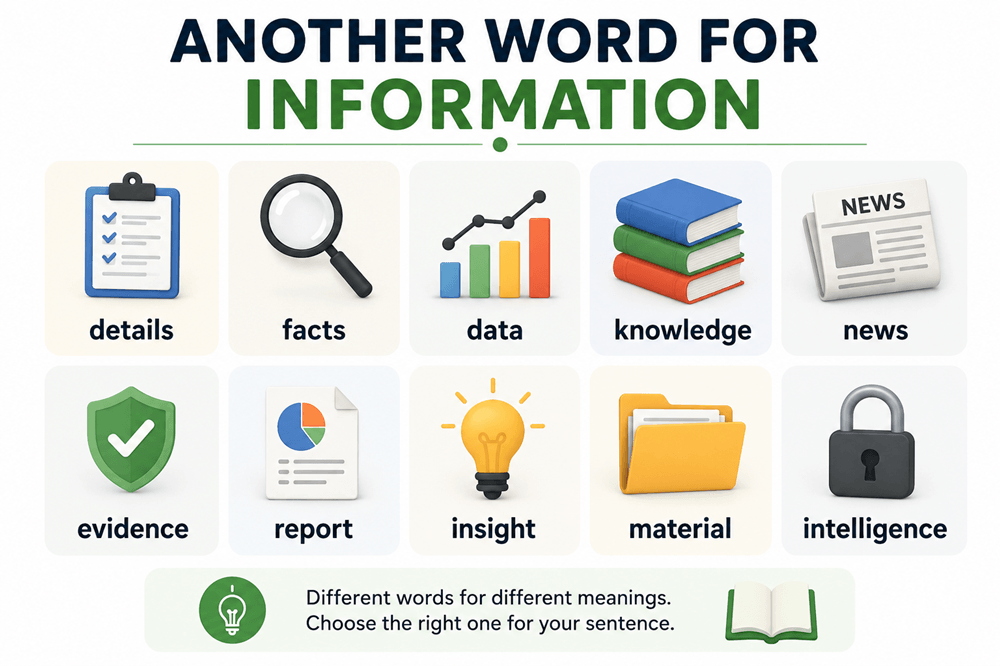
Another word for information is details. You can also use facts, data, knowledge, news, evidence, report, insight, material, or intelligence, depending on the sentence.
Information means facts, details, or knowledge about something.
Examples:
I need more information about the class.
I need more details about the class.
The report includes useful information.
The report includes useful data.
She gave me important information about the meeting.
She gave me important facts about the meeting.
The best replacement depends on what kind of information you mean.
Best Synonyms for Information
Here are some common synonyms for information:
| Word | Best For |
|---|---|
| details | Specific facts or small pieces of information |
| facts | True statements or proven information |
| data | Numbers, results, or collected information |
| knowledge | What someone knows |
| news | New or recent information |
| evidence | Information that supports a claim |
| report | Organized information |
| insight | Deeper understanding |
| material | Information used for writing, research, or study |
| intelligence | Secret, official, or strategic information |
Each synonym has a slightly different meaning, so choose the word that fits your sentence.
Details
Details is one of the most useful replacements for information. It means specific pieces of information.
Examples:
Please send me the details.
The email includes all the details about the event.
We need more details before making a decision.
Use details when you are asking for specific things such as time, date, place, price, names, steps, or instructions.
Compare:
I need more information.
I need more details.
The second sentence sounds more specific.
Facts
Facts are pieces of information that are true or can be proven.
Examples:
The article lists several important facts.
Before you decide, check the facts.
The teacher asked students to separate opinions from facts.
Use facts when the information is about truth, accuracy, or proof.
Compare:
The website has useful information.
The website has useful facts.
Both are correct, but facts emphasizes that the information is true or reliable.
Data
Data is information collected for study, research, records, or analysis. It often includes numbers, measurements, results, or statistics.
Examples:
The study collected data from 500 people.
The chart shows sales data from last year.
We need more data before drawing a conclusion.
Use data in business, science, research, technology, and reports.
A simple rule:
Use information for general facts or details.
Use data for collected facts, numbers, or results.
Knowledge
Knowledge means information, understanding, or awareness that someone has learned.
Examples:
Reading builds your knowledge.
She has a lot of knowledge about history.
The course gave students practical knowledge.
Use knowledge when talking about what a person knows, learns, or understands.
Compare:
The book contains useful information.
The book helped me gain useful knowledge.
Information is what the book gives. Knowledge is what the reader gains.
News
News means new or recent information, especially about events.
Examples:
Did you hear the news?
The company shared important news this morning.
We watched the evening news after dinner.
Use news when the information is recent, public, or newly announced.
However, news is not always a good replacement for information. For example:
Correct: I need information about the application.
Awkward: I need news about the application.
Use news only when something new has happened or been announced.
Evidence
Evidence is information that helps prove or support something.
Examples:
The police found new evidence.
The study gives strong evidence for the theory.
There is no evidence that the claim is true.
Use evidence when the information supports an argument, claim, case, or conclusion.
Compare:
The report includes information about the problem.
The report includes evidence of the problem.
The second sentence suggests that the report helps prove the problem exists.
Report
A report is organized information, usually written or spoken for a specific purpose.
Examples:
The manager sent a weekly report.
The student wrote a report about climate change.
The medical report explained the test results.
Use report when the information is collected, organized, and presented in a formal way.
Insight
Insight means deep understanding or helpful information that explains something clearly.
Examples:
Her comment gave me new insight.
The interview offers insight into his childhood.
The book gives useful insight into human behavior.
Use insight when the information helps someone understand a subject better.
Compare:
The article gives information about stress.
The article gives insight into why people feel stressed.
Insight sounds deeper than general information.
Material
Material can mean information used for writing, research, teaching, or study.
Examples:
The teacher prepared reading material.
The journalist gathered material for the article.
The course includes study materials.
Use material when the information is part of a lesson, article, book, presentation, or project.
Intelligence
Intelligence can mean information collected for official, military, government, business, or strategic purposes.
Examples:
The agency gathered intelligence.
The company used market intelligence to plan its strategy.
Military intelligence helped guide the decision.
Use intelligence only in specific contexts. It is not a normal replacement for everyday information.
For example:
Normal: Can you send me the information?
Too formal or strange: Can you send me the intelligence?
Formal Synonyms for Information
For essays, reports, research papers, and business writing, these are good formal alternatives:
- data
- evidence
- findings
- details
- report
- material
- documentation
- insight
- intelligence
Examples:
The study provides useful data.
The results offer strong evidence.
The report includes important findings.
The document contains all necessary details.
Use formal synonyms when you want your writing to sound more precise.
Casual Synonyms for Information
For everyday writing, messages, and conversation, these words usually sound natural:
- details
- facts
- news
- info
- update
- answer
- message
Examples:
Send me the details when you can.
Do you have any news?
Thanks for the info.
I need an update on the plan.
A quick note: info is short for information. It is common in casual writing, but it may be too informal for essays or professional documents.
Common Mistakes
One common mistake is using data when you only mean general information.
Awkward: Can you give me the data about the party?
Better: Can you give me the details about the party?
Better: Can you give me the information about the party?
Use data for collected facts, numbers, research, or records.
Another mistake is using evidence when nothing is being proven.
Awkward: The brochure has evidence about hotel rooms.
Better: The brochure has information about hotel rooms.
Better: The brochure has details about hotel rooms.
Use evidence when the information supports a claim.
Final Answer
Another word for information is details.
Other good synonyms include facts, data, knowledge, news, evidence, report, insight, material, and intelligence.
Use details when you mean specific information.
Use facts when the information is true or proven.
Use data for numbers, records, or research.
Use knowledge when talking about what someone knows.
Use evidence when the information supports a claim.
The best synonym for information depends on whether you mean general details, proven facts, collected data, new updates, or deeper understanding.