Another Word for Which: Best Alternatives and Examples
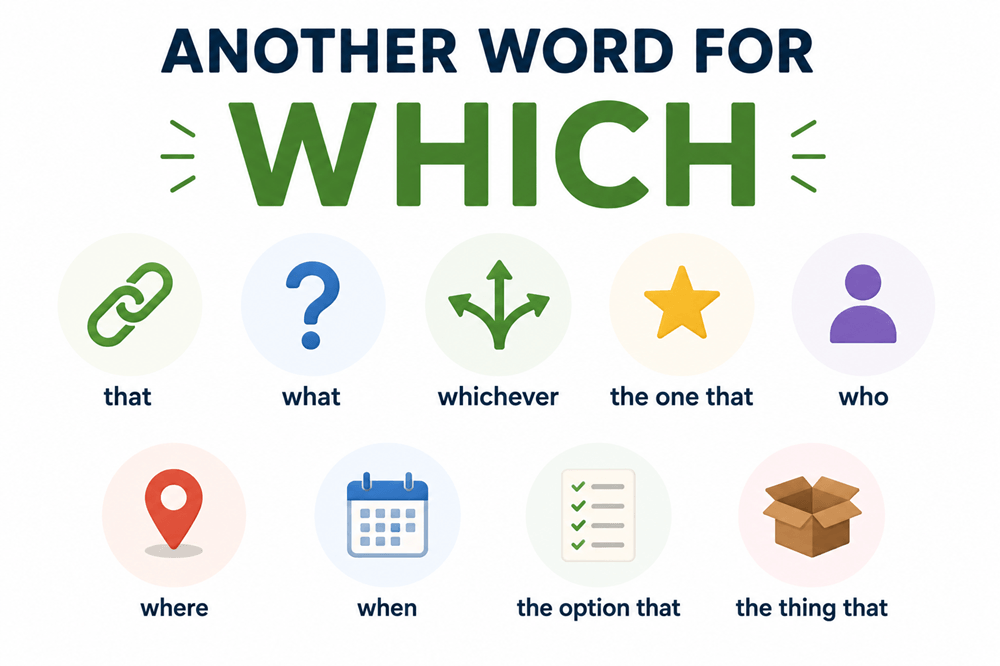
Another word for which is that in some sentences. You can also use what, whichever, the one that, who, where, when, or a more specific noun, depending on the sentence.
Which is used to ask about a choice, add information, or refer to a thing already mentioned.
Examples:
Which color do you like?
What color do you like?
The book, which I bought yesterday, is excellent.
The book that I bought yesterday is excellent.
Choose which one you want.
Choose whichever one you want.
The best replacement depends on how which is used in the sentence.
Best Alternatives for Which
Here are some common alternatives for which:
| Alternative | Best For |
|---|---|
| that | Referring to a thing in a defining clause |
| what | Asking about information or choices |
| whichever | Any one from a group |
| the one that | Clarifying a specific choice |
| who | Referring to a person |
| where | Referring to a place |
| when | Referring to a time |
| the item that | Referring to a specific object |
| the option that | Referring to a choice |
| the thing that | Casual replacement for a thing |
Each alternative has a different use, so the meaning of the sentence matters.
That
That can replace which when the clause is necessary to identify the thing.
Examples:
The phone which I bought is expensive.
The phone that I bought is expensive.
The rule which matters most is simple.
The rule that matters most is simple.
The movie which won the award was excellent.
The movie that won the award was excellent.
In modern English, that often sounds more natural when the information is essential.
A simple rule:
Use that when the information is needed.
Use which after a comma when the information is extra.
Examples:
The car that has the red door is mine.
My car, which has a red door, is mine.
In the first sentence, that has the red door identifies the car. In the second sentence, which has a red door adds extra information.
What
What can replace which in some questions, especially when the choices are broad or not limited.
Examples:
Which color do you want?
What color do you want?
Which book are you reading?
What book are you reading?
Which movie did you watch?
What movie did you watch?
The difference is small, but there is a useful pattern:
Use which when the choices are limited or known.
Use what when the choices are open or unknown.
Examples:
Which shirt do you want, the blue one or the white one?
What shirt do you want to wear today?
Whichever
Whichever means “any one that” or “the one that.” It is useful when the exact choice does not matter.
Examples:
Choose which one you like.
Choose whichever one you like.
Take which seat is open.
Take whichever seat is open.
Use whichever when someone may choose freely from several options.
The One That
The one that can replace which when you want to clarify a specific choice.
Examples:
I do not know which is yours.
I do not know the one that is yours.
Tell me which you prefer.
Tell me the one that you prefer.
This phrase can sound wordy, but it is useful when you want to make the sentence clearer.
Who
Use who instead of which when referring to a person.
Examples:
Incorrect: The teacher which helped me was kind.
Correct: The teacher who helped me was kind.
Incorrect: She is the woman which called earlier.
Correct: She is the woman who called earlier.
Use which for things or animals in many cases. Use who for people.
Where
Use where when referring to a place.
Examples:
Awkward: This is the school which I studied.
Better: This is the school where I studied.
Awkward: That is the city which we met.
Better: That is the city where we met.
You can also write:
This is the school that I studied at.
That is the city where we met.
Use where when the meaning is “in which place.”
When
Use when when referring to time.
Examples:
Awkward: Monday is the day which we meet.
Better: Monday is the day when we meet.
Awkward: Summer is the season which we travel most.
Better: Summer is the season when we travel most.
Use when when the meaning is “at which time.”
A Specific Noun
Sometimes the clearest replacement for which is a specific noun.
Examples:
Vague: I do not know which is better.
Clear: I do not know which option is better.
Clear: I do not know which answer is better.
Vague: Choose which works best.
Clear: Choose the method that works best.
Clear: Choose the option that works best.
Using a noun after which often makes writing clearer.
Which vs That
Which and that are often confused.
Use that for essential information.
Use which for extra information, often after a comma.
Examples:
The laptop that has the cracked screen needs repair.
My laptop, which has a cracked screen, needs repair.
The first sentence identifies the laptop. The second sentence adds extra information about the laptop.
More examples:
The article that explains the rule is helpful.
The article, which explains the rule, is helpful.
The sentence that sounds natural is better.
The sentence, which sounds natural, is better.
In American English, this difference is especially common in formal writing.
Which vs What
Use which when choosing from a known group.
Use what when asking more generally.
Examples:
Which drink do you want, tea or coffee?
What drink do you want?
Which answer is correct, A or B?
What answer did you write?
Which road should we take?
What road are we on?
If the choices are limited, which is usually better. If the choices are open, what often sounds more natural.
Formal Alternatives for Which
For formal writing, these alternatives can work well:
- that
- whichever
- the one that
- in which
- for which
- through which
- by which
- the option that
- the method that
- the result that
Examples:
The method by which the data was collected matters.
The reason for which she left was unclear.
The system in which the rule appears is complex.
The option that works best should be selected.
Phrases like in which, for which, and by which are formal. They are useful in academic, legal, and professional writing.
Casual Alternatives for Which
For everyday writing and conversation, these alternatives sound natural:
- what
- that
- whichever
- which one
- the one that
- the thing that
- the option that
Examples:
What one do you want?
Which one do you want?
Pick whichever you like.
That is the thing that confused me.
Use casual alternatives when you want the sentence to sound simple and natural.
Common Mistakes
One common mistake is using which for people.
Incorrect: The person which helped me was nice.
Correct: The person who helped me was nice.
Another common mistake is using what when which is clearer.
Less clear: What answer is correct, A or B?
Better: Which answer is correct, A or B?
Use which when the choices are already known.
Another mistake is using which without a clear noun.
Vague: I do not know which is right.
Clear: I do not know which answer is right.
Clear: I do not know which option is right.
Adding a noun can make the sentence easier to understand.
Final Answer
Another word for which is that in some sentences.
Other useful alternatives include what, whichever, the one that, who, where, when, the option that, and the thing that.
Use that when referring to a thing in an essential clause.
Use what for open questions.
Use whichever when any choice is acceptable.
Use who for people.
Use where for places.
Use when for times.
The best replacement for which depends on whether the sentence is asking a question, identifying a thing, adding extra information, or referring to a person, place, or time.