Who or Whom: Simple Grammar Rule, Correct Usage, and Easy Examples for Writers
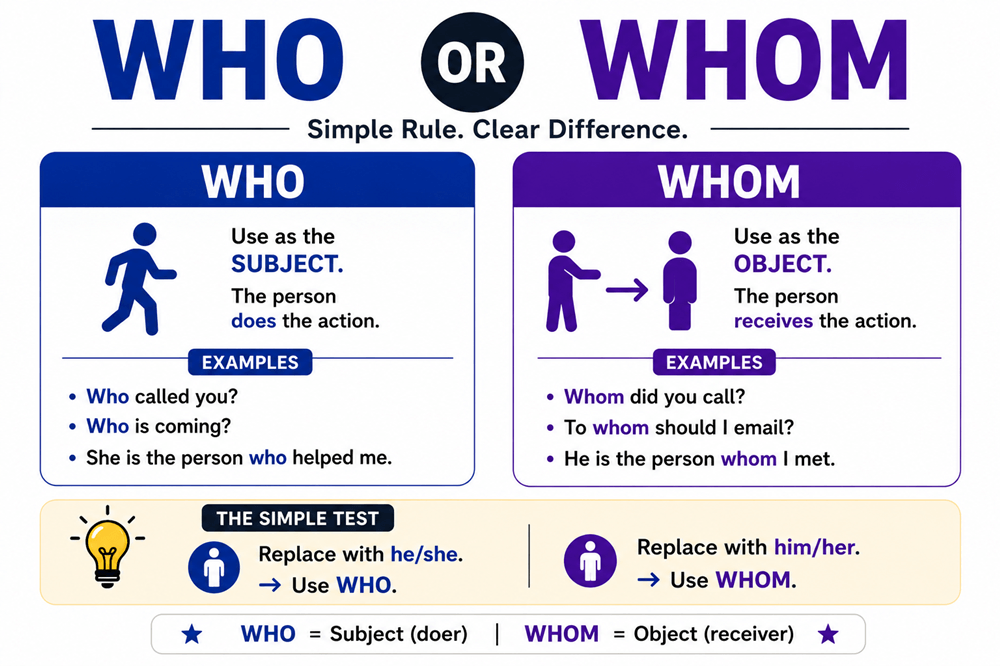
Who and whom are easy to confuse because both words refer to people. The quick rule is this: use who when the person is doing the action, and use whom when the person is receiving the action. A simple test can help: if you can answer with he or she, use who. If you can answer with him or her, use whom.
Quick Answer
Use who as the subject of a sentence or clause.
- Who called you?
- Who is coming to dinner?
- She is the person who helped me.
Use whom as the object of a verb or preposition.
- Whom did you call?
- To whom should I send the email?
- He is the person whom I met yesterday.
The easiest shortcut is: who matches he or she, and whom matches him or her.
Who or Whom: What Is the Difference?
The difference between who and whom is grammatical. Both words refer to people, but they play different roles in a sentence.
Who is used when the person is the subject. The subject is the person doing the action or being described.
Whom is used when the person is the object. The object is the person receiving the action or coming after a preposition such as to, for, with, by, or about.
| Word | Use | Simple Meaning | Example |
|---|---|---|---|
| Who | Subject | The person doing the action | Who sent the message? |
| Whom | Object | The person receiving the action | Whom did you message? |
In everyday speech, many people use who in places where formal grammar would use whom. That is why whom can sound formal, old-fashioned, or stiff in casual conversation. Still, it is useful in formal writing, professional emails, academic writing, and sentences that begin with prepositions.
What Does Who Mean?
Who refers to a person who is doing something or being something in the sentence. It works like he, she, or they.
Examples:
- Who made this cake?
- Who wants more coffee?
- Who left the door open?
- Who is responsible for this report?
- Who knows the answer?
In each example, who is doing the action. Someone made the cake. Someone wants coffee. Someone left the door open. Someone knows the answer.
You can test these sentences by answering with he, she, or they.
- Who made this cake? She made this cake.
- Who left the door open? He left the door open.
- Who knows the answer? They know the answer.
Because the answer uses a subject word, who is correct.
What Does Whom Mean?
Whom refers to a person who receives an action or comes after a preposition. It works like him, her, or them.
Examples:
- Whom did you invite?
- Whom should I contact?
- Whom did she choose?
- Whom are you calling?
- Whom did they recommend?
In these sentences, the person is receiving the action. You invited someone. You should contact someone. She chose someone. You are calling someone. They recommended someone.
You can test these sentences by answering with him, her, or them.
- Whom did you invite? I invited her.
- Whom should I contact? You should contact him.
- Whom did they recommend? They recommended them.
Because the answer uses an object word, whom is correct.
The He/Him Test for Who and Whom
The easiest way to choose between who and whom is to use the he/him test.
Use who if the answer would be he or she.
Use whom if the answer would be him or her.
| If the answer is… | Use… | Example |
|---|---|---|
| He or she | Who | Who called? He called. |
| Him or her | Whom | Whom did you call? I called him. |
This test works because who is a subject form, like he and she. Whom is an object form, like him and her.
Examples of Who in Sentences
Here are clear examples of who used correctly:
- Who wrote this article?
- Who is leading the meeting?
- Who forgot to lock the door?
- Who wants to join the group?
- Who will answer the question?
- The teacher who helped me was very kind.
- Anyone who wants a copy should email me.
- She is the student who won the award.
In each sentence, who refers to the person doing the action or being described.
Examples of Whom in Sentences
Here are clear examples of whom used correctly:
- Whom did you see at the store?
- Whom should we ask for help?
- Whom did the manager hire?
- Whom are you waiting for?
- The client whom we contacted replied quickly.
- The friend whom I trusted moved away.
- She is the person whom I mentioned earlier.
- Several employees, whom the company trained last year, were promoted.
In these sentences, whom receives the action or functions as the object.
Who or Whom After a Preposition
Whom is commonly used after prepositions, especially in formal writing. Prepositions include words such as to, for, with, by, from, and about.
Examples:
- To whom should I address the letter?
- For whom is this package?
- With whom are you meeting?
- By whom was the decision made?
- About whom are you speaking?
These sentences are grammatically formal. In casual speech, people often move the preposition to the end and use who instead.
| Formal | Casual |
|---|---|
| To whom should I send this? | Who should I send this to? |
| With whom are you going? | Who are you going with? |
| For whom did you buy this? | Who did you buy this for? |
Both versions can be understood, but the formal version is better for polished writing. The casual version sounds more natural in everyday conversation.
Is Whom Still Used?
Whom is still used, but it is more common in formal writing than casual speech. Many people avoid it in everyday conversation because it can sound stiff or overly proper.
For example, most people would say:
- Who are you talking to?
In formal grammar, the stricter version is:
- To whom are you talking?
The formal version is correct, but it may sound unnatural in casual settings. For WordBriefs-style writing, the best advice is simple: know the rule, use whom when formal accuracy matters, and do not force it into casual sentences where it sounds awkward.
Who or Whom in Relative Clauses
Who and whom can also appear in the middle of a sentence to introduce more information about a person.
Use who when the person is doing the action in that part of the sentence.
- The woman who lives next door is a doctor.
- The student who answered first was correct.
- The manager who approved the plan is on vacation.
Use whom when the person is receiving the action in that part of the sentence.
- The woman whom I met yesterday is a doctor.
- The student whom the teacher praised was smiling.
- The manager whom we contacted is on vacation.
To check the difference, focus only on the clause after the word.
- who lives next door = she lives next door
- whom I met yesterday = I met her yesterday
If the person is doing the action, use who. If the person is receiving the action, use whom.
Common Mistakes to Avoid
One common mistake is using whom just because it sounds formal. Formal does not always mean correct.
Incorrect:
- Whom is calling?
Correct:
- Who is calling?
The person is doing the action of calling, so who is correct.
Another common mistake is using who after a preposition in very formal writing.
Less formal:
- To who should I send the report?
Better:
- To whom should I send the report?
Because the word follows the preposition to, whom is the standard formal choice.
A third mistake is applying the rule to the wrong part of the sentence. In longer sentences, look at the role of who or whom inside its own clause, not just the sentence as a whole.
How to Remember Who or Whom
Use this memory trick:
Who goes with he.
Whom goes with him.
Both whom and him end with the letter m, which makes them easy to connect.
Examples:
- Who called? He called.
- Whom did you call? You called him.
If he sounds right, choose who. If him sounds right, choose whom.
Final Answer
Who is used for the person doing the action, while whom is used for the person receiving the action or following a preposition. Use the he/him test: if the answer is he or she, use who. If the answer is him or her, use whom.