Is Irregardless a Word? Irregardless vs. Regardless Explained
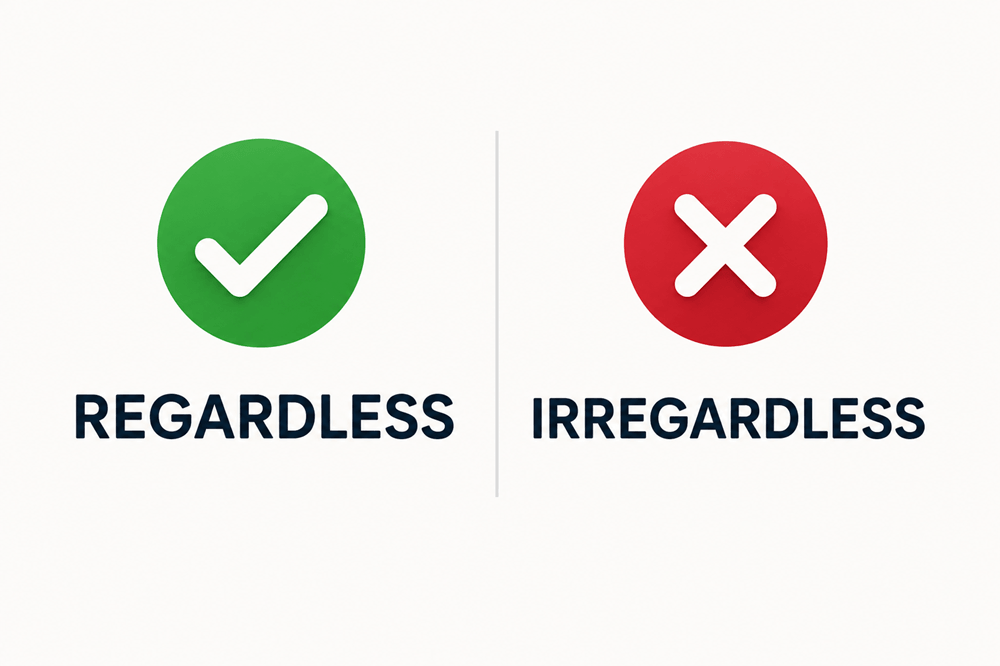
Yes, irregardless is a word, but it is widely considered nonstandard.
It is commonly used to mean the same thing as regardless:
- without considering the circumstances
- despite everything
- anyway
Although many dictionaries recognize irregardless, most teachers, editors, and style guides recommend using regardless instead—especially in formal writing.
Correct and preferred:
- We will continue regardless of the weather.
Common but nonstandard:
- We will continue irregardless of the weather.
Quick Answer
Irregardless exists as a word, but regardless is the better choice.
Both are used to mean:
- despite that
- without being affected by something
- anyway
Use regardless in:
- school assignments
- professional emails
- academic writing
- news articles
- formal conversations
A simple memory rule is:
Regardless already means “without regard,” so it does not need ir-.
What Does Irregardless Mean?
Irregardless is used to mean regardless or without regard to the situation.
Examples:
- Irregardless of the cost, they wanted to proceed.
- She attended the event irregardless of the weather.
- He continued irregardless of the criticism.
Most readers will understand these sentences. However, many will consider the word awkward, incorrect, or overly informal.
The preferred versions are:
- Regardless of the cost, they wanted to proceed.
- She attended the event regardless of the weather.
- He continued regardless of the criticism.
Is Irregardless a Real Word?
Yes. A word can be considered real if it is widely used and understood.
Irregardless has appeared in spoken and written English for many years. Because of that continued use, major dictionaries record it.
However, dictionary recognition does not always mean a word is recommended for every situation.
Dictionaries may label words as:
- informal
- nonstandard
- dialectal
- slang
- offensive
- outdated
Irregardless is generally treated as a nonstandard form of regardless.
Therefore, it is a real word, but it is not usually the best word to use.
Is Irregardless Grammatically Correct?
That depends on what is meant by correct.
The word is established enough to be understood and listed in dictionaries. In that sense, it is part of English usage.
However, it is still rejected by many speakers, teachers, and editors because its construction appears unnecessary or contradictory.
In formal standard English, regardless is strongly preferred.
Instead of:
- Irregardless of what happens, we will finish.
Write:
- Regardless of what happens, we will finish.
This avoids distracting readers who may object to the nonstandard form.
Why Do People Dislike Irregardless?
Many people object to irregardless because of its structure.
The word appears to contain:
- the prefix ir-, meaning not
- the word regard
- the suffix -less, meaning without
The word regardless already means:
without regard
Adding ir- can seem as though it creates:
not without regard
That sounds like the opposite of the intended meaning.
For this reason, people sometimes describe irregardless as a double negative.
However, speakers who use it do not intend the opposite meaning. They use it as an emphasized form of regardless.
Is Irregardless a Double Negative?
It looks like one, but its actual use is more complicated.
The parts ir- and -less can both suggest negation:
- ir- = not
- -less = without
This makes the word seem logically contradictory.
However, language does not always develop according to strict mathematical logic. People may combine familiar patterns because the result sounds natural or emphatic.
Irregardless may have developed partly through the influence of words such as:
- irrespective
- regardless
It appears to blend the beginning of irrespective with the ending of regardless.
Even so, the simpler form regardless communicates the meaning more clearly.
Irregardless vs. Regardless
Both words are used with the same intended meaning, but their status is different.
| Word | Status | Best Use |
|---|---|---|
| Regardless | Standard and widely accepted | All forms of writing |
| Irregardless | Nonstandard and controversial | Informal speech, if used at all |
Compare:
- Regardless of the delay, we arrived on time.
- Irregardless of the delay, we arrived on time.
The sentences are intended to mean the same thing.
The first is clearer and more widely accepted.
What Does Regardless Mean?
Regardless means without being affected by something or without considering it.
Examples:
- We went outside regardless of the rain.
- She continued regardless of the criticism.
- The rule applies to everyone regardless of age.
- He plans to attend regardless.
It can appear by itself:
- I’m going regardless.
It can also be followed by of:
- regardless of the weather
- regardless of cost
- regardless of opinion
- regardless of age
Irregardless in a Sentence
Although the following sentences are understandable, most editors would replace irregardless with regardless:
- Irregardless of the result, I am proud of you.
- We must follow the policy irregardless of our personal opinions.
- She completed the task irregardless of the difficulty.
- Irregardless, the meeting will continue.
Preferred:
- Regardless of the result, I am proud of you.
- We must follow the policy regardless of our personal opinions.
- She completed the task regardless of the difficulty.
- Regardless, the meeting will continue.
Should You Use Irregardless?
In most situations, no.
Use regardless instead because it is:
- shorter
- clearer
- standard
- accepted in formal writing
- less likely to distract readers
Using irregardless may cause readers to focus on the word rather than your message.
This is especially important in:
- job applications
- business documents
- essays
- reports
- professional presentations
- published articles
The word may be acceptable in dialogue if you are accurately representing how a character speaks.
Is Irregardless Acceptable in Informal Speech?
It is common in informal speech, and most people understand it.
For example, someone may say:
- I’m going irregardless.
The meaning is clear.
However, some listeners may immediately notice the word and consider it incorrect. Therefore, even in conversation, regardless is the safer option.
Is Irregardless in the Dictionary?
Yes. The word appears in several major dictionaries.
This often surprises people who were taught that it is “not a word.”
However, dictionaries describe how people actually use language. They include nonstandard and informal forms as well as formal ones.
A dictionary entry does not necessarily mean:
- the word is suitable for formal writing
- every editor accepts it
- teachers will recommend it
- it is interchangeable with the preferred form in every context
Dictionary labels are important. For irregardless, the label is often more useful than the fact that the word has an entry.
Is Irregardless American English?
Irregardless is especially associated with informal American English, although it may be understood elsewhere.
In both American and British formal writing, regardless is the preferred form.
This is not a standard regional difference like:
- color and colour
- center and centre
- traveled and travelled
Instead, the difference concerns standard versus nonstandard usage.
Irregardless or Irrespective?
Irrespective is a standard word.
It means the same thing as regardless.
Examples:
- The rule applies irrespective of age.
- The rule applies regardless of age.
Both are correct.
Compare the forms:
- regardless of
- irrespective of
- irregardless of
The first two are standard. The third is nonstandard.
Because irregardless may have developed through a blend of irrespective and regardless, keeping the standard options separate can help you remember them.
Regardless Of or Regardless To?
The correct phrase is:
regardless of
Examples:
- regardless of the weather
- regardless of what happens
- regardless of cost
- regardless of age
Do not normally write:
- regardless to
- irregardless to
Correct:
- We will continue regardless of the problems.
Is It “Regardless” or “Regardless of”?
Both forms can be correct.
Use regardless of before a noun or noun phrase:
- We left regardless of the rain.
- She applied regardless of the requirements.
Use regardless by itself when the object is understood:
- It may rain, but we are going regardless.
- He was warned but continued regardless.
Common Mistakes
Believing irregardless has no meaning
It does have an understood meaning. People use it to mean regardless.
The issue is that it is nonstandard, not meaningless.
Using irregardless in formal writing
Less suitable:
- Irregardless of the evidence, the conclusion remains the same.
Better:
- Regardless of the evidence, the conclusion remains the same.
Writing irregardlessly
Irregardlessly is extremely awkward and should be avoided.
Use:
- regardless
- anyway
- nevertheless
Confusing regardless with regarding
Regardless means without considering something.
Regarding means concerning or about something.
Examples:
- Regarding the schedule, we need more time.
- We will proceed regardless of the schedule.
Better Alternatives to Irregardless
Depending on the sentence, use:
- regardless
- irrespective
- anyway
- nevertheless
- despite that
- no matter what
- in any case
Examples:
- Regardless, we must continue.
- In any case, we must continue.
- No matter what, we must continue.
- Nevertheless, we must continue.
For most sentences, regardless is the closest and simplest replacement.
How to Remember the Correct Word
Focus on the ending -less.
Regardless means:
without regard
Because -less already means without, no extra negative prefix is needed.
Think:
- hopeless = without hope
- careless = without care
- fearless = without fear
- regardless = without regard
A simple memory sentence is:
Regardless is already negative enough.
You can also remember:
Use either irrespective or regardless—do not combine them into irregardless.
Is It Rude to Correct Someone Who Says Irregardless?
Not necessarily, but context matters.
Correcting someone publicly during a casual conversation may sound unnecessary or impolite, especially when the meaning is clear.
A correction may be helpful when:
- reviewing an essay
- editing a report
- teaching standard usage
- helping someone prepare professional writing
A respectful explanation is:
“Irregardless is used, but regardless is the standard form.”
This is more accurate than simply saying the word does not exist.
Final Answer
Yes, irregardless is a word, but it is considered nonstandard and is often criticized.
It is used to mean the same thing as regardless:
- without considering something
- despite the circumstances
- anyway
For clear and formal writing, use:
regardless
Example:
- We will continue regardless of the weather.
Remember:
Regardless already means “without regard,” so the extra ir- is unnecessary.