Is Good Morning One Word? Good Morning vs. Goodmorning Explained
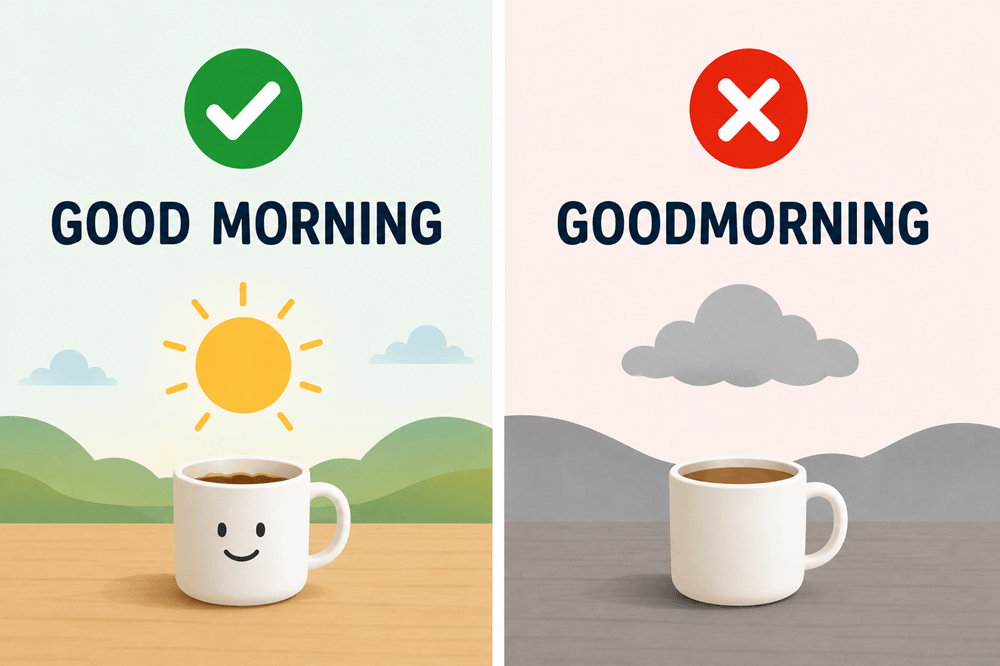
Good morning is written as two words.
It is a common greeting used during the morning.
Correct:
- Good morning, everyone.
- I said good morning to my neighbor.
- She sent a good morning message.
The spelling goodmorning is incorrect in standard English.
Quick Answer
Use:
good morning
Do not use:
goodmorning
Examples:
- Good morning!
- I hope you have a good morning.
- He wished everyone good morning.
A simple memory rule is:
Good describes morning, so the two words stay separate.
Is Good Morning One Word or Two?
Good morning is always written as two words in standard English.
Correct:
- good morning
- Good morning!
- a good morning greeting
- a good morning message
Incorrect:
- goodmorning
- good-morning, in ordinary use
The phrase contains the adjective good and the noun morning.
Because the words keep their separate grammatical roles, they are not joined.
What Does Good Morning Mean?
Good morning is a polite greeting used in the early part of the day.
People commonly say it:
- when meeting someone
- when answering the phone
- when starting a class
- when entering a workplace
- at the beginning of an email
- when sending a morning message
Examples:
- Good morning, Sarah.
- The teacher said good morning to the class.
- He called to wish his parents good morning.
- Good morning, and thank you for joining us.
The expression may be formal, friendly, warm, or casual depending on the situation.
Why Is Good Morning Two Words?
The phrase follows a simple adjective-and-noun pattern.
- good describes the morning
- morning names the time of day
English usually keeps this type of phrase separate.
Compare:
- good afternoon
- good evening
- good night
- good luck
- good job
We do not normally write:
- goodafternoon
- goodevening
- goodluck
In the same way, good morning remains two words.
Is Goodmorning a Word?
No. Goodmorning is not the standard spelling.
You may see it in:
- usernames
- hashtags
- brand names
- casual social media posts
- typing mistakes
For example, a hashtag may appear as:
#GoodMorning
Hashtags cannot contain spaces, so the words are joined for technical reasons.
That does not change the correct spelling in a normal sentence.
Correct sentence:
- Good morning, everyone.
Possible hashtag:
- #GoodMorning
Is Good Morning Hyphenated?
No. The standard phrase is not hyphenated.
Correct:
- good morning
Incorrect:
- good-morning
Even before another noun, writers usually leave the phrase open:
- good morning message
- good morning greeting
- good morning text
A hyphen is usually unnecessary because the meaning is already clear.
Good Morning in a Sentence
Examples:
- Good morning, how are you?
- She smiled and said good morning.
- I sent him a good morning text.
- The host opened the program with a cheerful good morning.
- He always says good morning to his coworkers.
- We received a friendly good morning message.
- Good morning, and welcome to the meeting.
- The children shouted good morning to their teacher.
In each example, the words remain separate.
Should Good Morning Be Capitalized?
Capitalize good morning at the beginning of a sentence or greeting.
Correct:
- Good morning, everyone.
- Good morning!
- Good morning, Mrs. Lee.
Use lowercase when the phrase appears in the middle of a sentence.
Correct:
- I said good morning to the receptionist.
- She sent me a good morning message.
- He wished everyone good morning.
Do not capitalize both words automatically unless the phrase begins a sentence or appears in a title.
Is It “Good Morning” or “Goodmorning” in a Text?
The correct spelling in a text message is still:
good morning
Examples:
- Good morning! Hope you slept well.
- Good morning, have a great day.
- Good morning ❤️
Informal writing does not change the standard spacing.
Although someone may type goodmorning quickly, it is still considered a spelling error in normal written English.
Is It “Good Morning” or “Morning”?
Both are correct greetings.
Good morning sounds more complete and polite.
Example:
- Good morning, everyone.
Morning is shorter and more casual.
Example:
- Morning! How are you?
Use good morning in:
- formal emails
- business settings
- school
- professional meetings
- polite introductions
Use morning in relaxed conversations with people you know.
Is It Good Morning or Goodmorning in an Email?
Use Good morning as two words.
Examples:
- Good morning, Daniel,
- Good morning, everyone,
- Good morning, Ms. Carter,
A comma usually follows the greeting before the person’s name.
Correct:
- Good morning, James.
Less polished:
- Goodmorning James.
For professional emails, use standard spacing and punctuation.
Good Morning in an Email Greeting
A professional email may begin with:
- Good morning, Anna,
- Good morning, team,
- Good morning, everyone,
You can also write:
- Hello, Anna,
- Hi, team,
- Dear Mr. Harris,
Good morning is polite, but it may be less suitable if the recipient could read the message much later in the day.
In that situation, Hello or Hi may be more flexible.
Is It “A Good Morning” or Just “Good Morning”?
Both forms are possible, but they are used differently.
Good morning
Used as a greeting:
- Good morning!
- I said good morning.
A good morning
Used to describe a pleasant morning:
- We had a good morning at the park.
- It was a good morning for a walk.
The article a changes the phrase from a greeting to a description.
Is Good Morning a Compound Word?
No. Good morning is not a closed compound word.
A closed compound is written as one word:
- sunlight
- classroom
- breakfast
Good morning is an open phrase because the two words remain separate.
It may function as a fixed greeting, but that does not make it one word.
Good Morning vs. Goodnight
These phrases do not follow exactly the same spelling pattern.
Good morning is always two words.
Good night is also commonly written as two words when used as a greeting or farewell:
- Good night, everyone.
However, goodnight can also appear as a noun or adjective in some uses:
- a goodnight kiss
- she said her goodnights
The same one-word option does not normally apply to good morning.
Do not assume that because goodnight may be one word, goodmorning can be one word too.
Is It Good Morning Everyone or Good Morning, Everyone?
The better punctuation is:
Good morning, everyone.
The comma separates the greeting from the people being addressed.
Other examples:
- Good morning, class.
- Good morning, team.
- Good morning, ladies and gentlemen.
- Good morning, Sarah.
This comma is called a comma of direct address.
Is It Good Morning All or Good Morning, All?
The clearer form is:
Good morning, all.
However, Good morning, everyone often sounds more natural.
Examples:
- Good morning, all.
- Good morning, everyone.
- Good morning, team.
In each version, good morning remains two words.
Common Mistakes
Writing goodmorning as one word
Incorrect:
- Goodmorning, everyone.
Correct:
- Good morning, everyone.
Adding a hyphen
Incorrect:
- Good-morning, everyone.
Correct:
- Good morning, everyone.
Forgetting the comma in direct address
Less polished:
- Good morning everyone.
Better:
- Good morning, everyone.
Capitalizing the phrase in the middle of a sentence
Incorrect:
- She said Good Morning to me.
Correct:
- She said good morning to me.
Why Do People Write Goodmorning?
The mistake usually happens because the phrase is spoken quickly.
When people say good morning, the two words may sound connected.
The joined spelling also appears frequently in:
- hashtags
- usernames
- decorative captions
- informal posts
Repeated exposure to #GoodMorning may make goodmorning look normal, but hashtags follow different formatting rules from ordinary sentences.
How to Remember the Spelling
Compare good morning with other greetings:
- good afternoon
- good evening
- good night
All of these begin with good followed by a separate time-of-day word.
A useful memory sentence is:
A good morning has room between the words.
You can also remember:
Good describes morning, so do not join them.
Final Answer
Good morning is written as two words.
Correct:
- Good morning, everyone.
- I sent her a good morning message.
- He wished me good morning.
Incorrect:
- goodmorning
- good-morning
Use a comma when directly addressing someone:
- Good morning, Sarah.
Remember:
Good morning always needs a space.