Is Anymore One Word? Anymore vs. Any More Explained
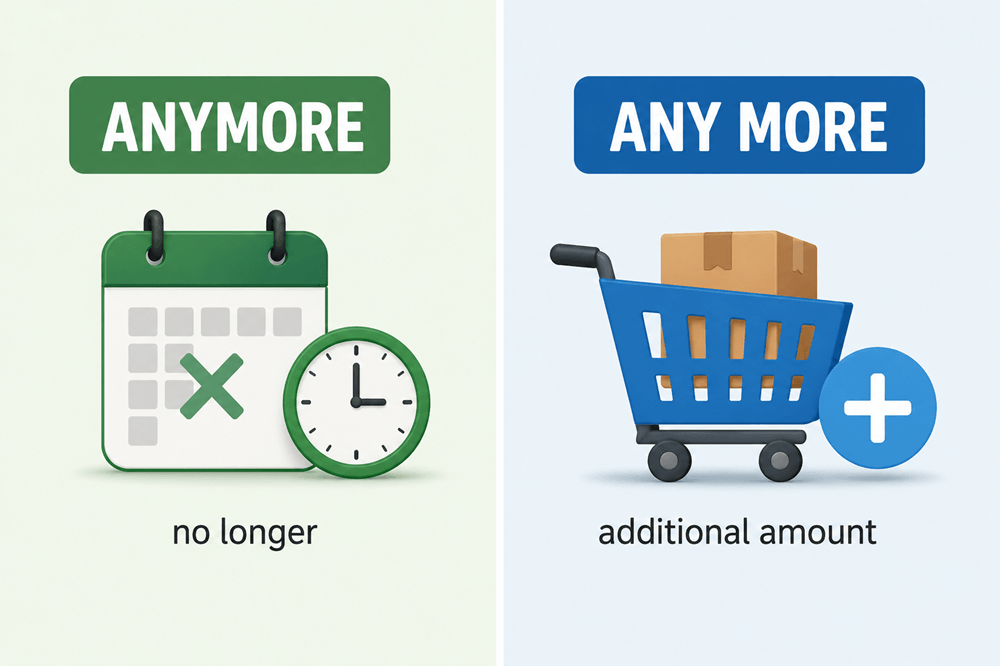
Anymore is written as one word when it means any longer or nowadays, especially in American English.
Examples:
- I do not live there anymore.
- She rarely watches television anymore.
- We are not accepting applications anymore.
Any more is written as two words when it refers to an additional amount or quantity.
Examples:
- Do you need any more water?
- We cannot spend any more money.
- Are there any more questions?
A simple memory rule is:
Anymore relates to time. Any more relates to quantity.
Quick Answer
Use anymore when you could replace it with any longer:
- He does not work here anymore.
- He does not work here any longer.
Use any more when you mean an additional amount:
- I do not want any more coffee.
- I do not want additional coffee.
The two forms sound the same, but their meanings and grammatical roles are different.
What Does Anymore Mean?
Anymore is an adverb meaning:
- any longer
- from now on
- nowadays
It commonly appears in negative sentences, questions, and sentences expressing change.
Examples:
- We do not speak anymore.
- Does this store sell books anymore?
- She cannot run as quickly anymore.
- Nobody writes letters like that anymore.
In each example, anymore refers to time or a situation that has changed.
Is Anymore One Word or Two?
The answer depends on the meaning.
Use one word:
anymore
when the phrase means any longer.
Use two words:
any more
when more refers to an additional number, amount, or degree.
Compare:
- I do not visit that restaurant anymore.
I no longer visit it. - I do not want any more food.
I do not want additional food.
The first sentence concerns time. The second concerns quantity.
Anymore vs. Any More
| Form | Meaning | Example |
|---|---|---|
| Anymore | Any longer or nowadays | She does not call anymore. |
| Any more | An additional amount | Do you need any more help? |
Another useful comparison:
- We do not sell those shoes anymore.
- We do not have any more of those shoes.
The first means the store has stopped selling them.
The second means the store has no additional pairs available.
Anymore Meaning “Any Longer”
The most common use of anymore is to describe something that no longer happens or is no longer true.
Examples:
- He does not drive anymore.
- The children do not play outside anymore.
- I cannot remember the password anymore.
- That building is not used anymore.
- We are not friends anymore.
Try replacing anymore with any longer:
- He does not drive any longer.
- We are not friends any longer.
If the replacement works, the one-word form is usually correct in American English.
Any More Meaning “Additional”
Use any more when asking about or referring to an additional amount.
Examples:
- Would you like any more cake?
- Do we have any more paper?
- I cannot accept any more delays.
- She does not need any more advice.
- Are there any more tickets available?
In these sentences, more describes a noun:
- more cake
- more paper
- more delays
- more advice
- more tickets
The word any modifies more, so the words remain separate.
Is It “Not Anymore” or “Not Any More”?
Both forms may appear, but the meaning and regional style matter.
In American English, use not anymore when you mean not any longer:
- I do not work there anymore.
- She is not upset anymore.
Use not any more when referring to an additional amount:
- I do not want any more.
- We cannot order any more supplies.
The noun may be omitted when it is understood:
- Would you like more coffee?
- No, I do not want any more.
Here, any more still refers to an additional quantity of coffee.
Is It “Do You Work Here Anymore?”
Yes.
The correct American spelling is:
- Do you work here anymore?
This asks whether the person still works there.
You could rewrite it as:
- Do you still work here?
- Do you work here any longer?
Because the sentence concerns whether something continues over time, use one word.
Is It “Do You Want Anymore?”
The spelling depends on the intended meaning.
If you mean an additional amount, write:
- Do you want any more?
For example, the speaker may be offering more food or drink.
The noun is understood:
- Do you want any more coffee?
- Do you want any more?
The one-word form would normally be incorrect in this sentence because the question concerns quantity, not time.
Positive Anymore
In many parts of the United States, anymore can appear in positive sentences and mean nowadays or these days.
Examples:
- People shop online anymore.
- Gas is expensive anymore.
- Everyone carries a phone anymore.
This usage is called positive anymore. It is common in some American regions but may sound unusual or nonstandard to other readers.
For broad or formal writing, use:
- nowadays
- these days
- now
Example:
Regional:
- Everything is expensive anymore.
More widely accepted:
- Everything is expensive these days.
American and British English
American English often distinguishes between:
- anymore for time
- any more for quantity
Examples:
- I do not go there anymore.
- I do not need any more information.
In British English, any more is commonly written as two words in both uses:
- I do not go there any more.
- I do not need any more information.
Therefore, the one-word form is especially associated with American English.
When writing for a particular publication, follow its regional spelling or style guide.
Anymore in a Sentence
Examples:
- I do not use that application anymore.
- She does not live nearby anymore.
- We cannot delay the decision anymore.
- Does anyone read that magazine anymore?
- He is not interested in the project anymore.
- They rarely visit us anymore.
- The old road is not safe anymore.
- I do not believe that story anymore.
Each sentence concerns time or continuation.
Any More in a Sentence
Examples:
- Do you have any more questions?
- We do not need any more chairs.
- She cannot take any more criticism.
- Is there any more milk?
- I will not spend any more money.
- They did not provide any more details.
- Would you like any more time?
- We cannot accept any more orders.
Each sentence refers to an additional quantity, amount, or degree.
Is Anymore Hyphenated?
No.
Correct:
- anymore
- any more
Incorrect:
- any-more
The correct choice is either one closed word or two separate words, depending on the meaning.
Common Mistakes
Using anymore for quantity
Incorrect:
- Do you need anymore pencils?
Correct:
- Do you need any more pencils?
The sentence asks about additional pencils.
Using any more for time in American English
Less common in American writing:
- She does not work here any more.
Preferred American form:
- She does not work here anymore.
The two-word spelling remains normal in British English.
Confusing “anymore” with “any more than”
Use two words in comparisons involving quantity or degree:
- I cannot carry any more than twenty pounds.
- She did not pay any more than the listed price.
Here, more is part of a comparison.
Adding a hyphen
Incorrect:
- I do not go there any-more.
Correct:
- I do not go there anymore.
How to Remember the Difference
Use the time-or-quantity test.
Time
If the sentence means any longer, use one word:
- I do not live there anymore.
- I do not live there any longer.
Quantity
If the sentence means additional, use two words:
- I do not need any more time.
- I do not need additional time.
Another memory sentence is:
No longer takes one word; additional takes two.
Final Answer
Anymore is one word when it means any longer, especially in American English.
Examples:
- I do not work there anymore.
- She does not call anymore.
- We cannot wait anymore.
Any more is two words when it refers to an additional amount or quantity.
Examples:
- Do you need any more help?
- We do not have any more tickets.
- I cannot spend any more money.
Remember:
Anymore relates to time. Any more relates to quantity.