Further or Farther: Correct Meaning, Difference, Usage, and Examples for Clear Writing
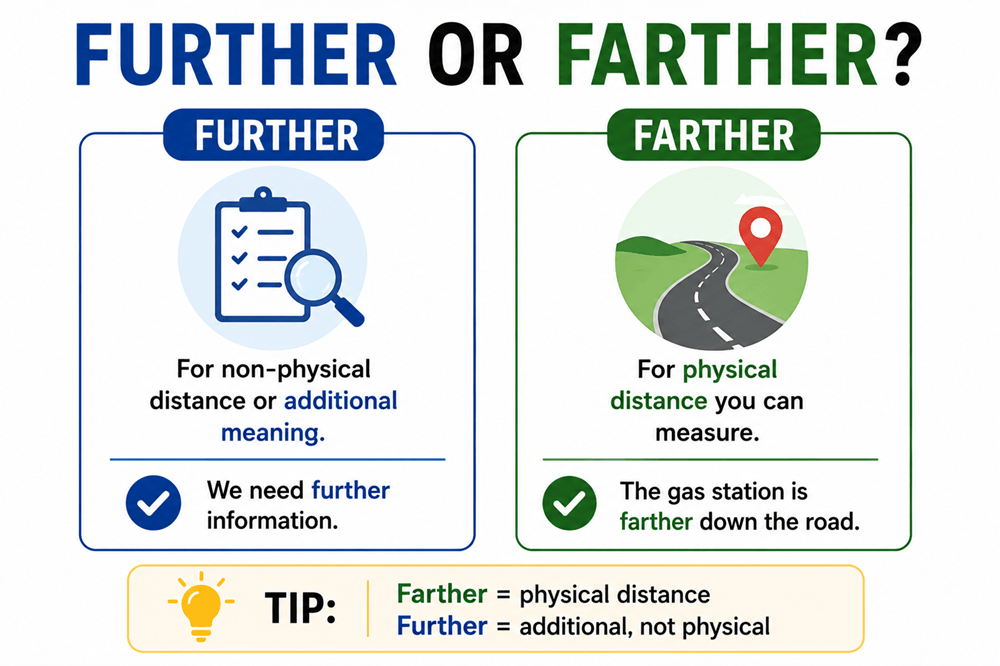
Further and farther both relate to distance, but they are not always used the same way. Use farther for physical distance that can be measured. Use further for figurative distance, progress, degree, or additional information. The easiest rule is this: farther is for real distance, while further is for everything else.
Quick Answer
Use farther when you are talking about physical distance.
- Correct: The gas station is farther down the road.
- Correct: She can throw the ball farther than her brother.
- Correct: We walked farther than we planned.
Use further when you mean more, additional, deeper, later, or more advanced in a nonphysical sense.
- Correct: We need further information before deciding.
- Correct: The discussion went further than expected.
- Correct: This course will further your understanding of grammar.
The simple rule is this: if you can measure the distance in miles, feet, meters, or steps, farther is usually best. If you mean additional progress, detail, effort, or development, use further.
Further or Farther: What Is the Difference?
The difference between further and farther is mostly about physical versus figurative distance. Farther is usually used when something is literally more distant. It points to space, travel, movement, or measurable distance.
Further is usually used when the distance is not literal. It can mean more, additional, extra, deeper, greater, or more advanced. You might ask for further details, take further action, make further progress, or further your career.
| Word | Main Use | Example |
|---|---|---|
| Farther | Physical distance | The cabin is farther from town. |
| Further | Figurative distance, progress, or additional amount | We need further discussion. |
In everyday speech, many people use further and farther interchangeably when talking about distance. That means “walk further” and “walk farther” may both sound normal. However, in careful writing, the traditional distinction is useful: use farther for physical distance and further for figurative or additional meaning.
What Does Farther Mean?
Farther means at a greater physical distance. It is used when something is more distant in space or when someone or something moves a longer measurable distance.
Examples:
- The beach is farther away than the lake.
- He ran farther than anyone else on the team.
- The blue house is farther down the street.
- Move the chair farther from the wall.
In each sentence, the distance is physical. You could measure it with steps, miles, meters, blocks, or some other real-world unit. That is why farther is the better choice.
Farther often appears with words about movement and location, such as walk, run, drive, travel, away, down the road, from here, and distance.
- walk farther
- run farther
- drive farther
- travel farther
- farther away
- farther down the path
If your sentence is about actual space, farther is usually the cleanest spelling.
What Does Further Mean?
Further means more, additional, extra, deeper, or more advanced. It is often used when the “distance” is not physical. Instead, the sentence is about progress, development, discussion, knowledge, time, effort, or degree.
Examples:
- We need further research before making a decision.
- The teacher gave further explanation after class.
- The company took further action after the complaint.
- She wanted to further her education.
In these sentences, no one is moving across physical space. The word further means additional, deeper, or more advanced.
Further can also be a verb. When used as a verb, it means to help something progress or develop.
- The grant helped further the research.
- He took classes to further his career.
- The new policy may further the organization’s goals.
Farther is not normally used as a verb. You would not say “farther your career.” The correct phrase is further your career.
When to Use Farther
Use farther when you are comparing physical distances. If the sentence could involve a map, ruler, road, path, race, trip, or measurable space, farther is usually right.
Examples:
- The school is farther from your house than the library.
- We drove farther north before stopping for lunch.
- The hikers climbed farther up the mountain.
- Her new apartment is farther from the office.
You can test the sentence by asking whether the distance could be measured. If you can imagine answering with “two miles,” “ten feet,” “three blocks,” or “one kilometer,” use farther.
- How much farther is the hotel?
- It is three miles farther.
Because the answer involves real distance, farther fits.
When to Use Further
Use further when you mean additional, more, deeper, or more advanced. It is the better word for ideas, conversations, plans, studies, careers, problems, investigations, and development.
Examples:
- Please contact us if you need further assistance.
- The manager requested further details.
- The issue requires further investigation.
- The course helped her further her skills.
Further is also common in formal phrases:
- further information
- further notice
- further action
- further discussion
- further research
- further questions
These phrases do not involve physical distance. They involve more information, more action, more time, or more development. That is why further is correct.
Further Information or Farther Information?
The correct phrase is further information.
Correct:
- Please ask if you need further information.
- The report includes further information about the policy.
- Further information will be sent by email.
Incorrect:
- Please ask if you need farther information.
- The report includes farther information about the policy.
Information does not move across physical space. You are asking for more details, so further is the right word.
Further Away or Farther Away?
Farther away is usually better when you mean physical distance.
Correct:
- The store is farther away than I thought.
- Her house is farther away from school now.
- The airport is farther away than the train station.
Further away is also common in everyday speech, and many readers will not object to it. However, if you want to follow the traditional rule, use farther away for physical distance.
Use further away when the distance is figurative.
- That decision pushed us further away from our original goal.
- The argument moved them further away from a solution.
In these examples, the distance is emotional, strategic, or figurative, not physical.
Further Than or Farther Than?
Use farther than when comparing physical distance.
- She ran farther than I did.
- The hotel is farther than the restaurant.
- We traveled farther than expected.
Use further than when comparing figurative progress, degree, or development.
- The conversation went further than expected.
- The investigation went further than anyone predicted.
- His influence reached further than the company realized.
Sometimes the distinction can feel blurry. For example, “go further” can mean continue in a discussion, while “go farther” can mean travel a longer distance. The surrounding words usually make the meaning clear.
Common Mistakes With Further and Farther
The most common mistake is using farther for nonphysical ideas.
Incorrect:
- We need farther discussion.
- Please provide farther details.
- This program will farther your career.
Correct:
- We need further discussion.
- Please provide further details.
- This program will further your career.
Another common mistake is using further when farther would be more precise for physical distance.
Less precise:
- The station is further down the road.
- He threw the ball further this time.
More precise:
- The station is farther down the road.
- He threw the ball farther this time.
The first versions are common, especially in casual speech. The second versions are more careful if you want to emphasize measurable distance.
Further as a Verb
Further can be used as a verb, meaning to help something move forward, develop, grow, or improve. This is one of the clearest cases where farther cannot replace it.
Examples:
- She moved abroad to further her studies.
- The donation will further the museum’s mission.
- The training helped further his career.
- The new evidence may further the investigation.
In these sentences, further means advance or promote. It does not mean physical distance. You should not use farther in this way.
Examples of Farther in Sentences
Here are examples of farther used correctly:
- The trail goes farther into the woods.
- They moved farther from the city last year.
- The second campground is farther away.
- Can you swim farther than your cousin?
- The car can travel farther on a full tank.
- We parked farther from the entrance than usual.
- The island is farther south than it appears on the map.
In each sentence, farther refers to real, physical distance.
Examples of Further in Sentences
Here are examples of further used correctly:
- We need further evidence before making a claim.
- The school offered further support to new students.
- She took online classes to further her education.
- The matter will be discussed further tomorrow.
- No further action is required.
- Please wait for further instructions.
- The project cannot continue without further funding.
In each sentence, further means additional, more advanced, or more deeply developed.
How to Remember Further or Farther
A simple way to remember the difference is this:
- Farther contains far, so use it for physical distance.
- Further is for additional progress, meaning, or information.
You can also remember this sentence:
Farther is for how far; further is for how much more.
If you are asking “how far?” choose farther.
- How much farther is the station?
If you are asking “how much more?” choose further.
- Do you need further explanation?
This memory trick will work in most situations.
Final Answer
Further and farther are both correct words, but they are used differently in careful writing. Use farther for physical distance that can be measured, such as walking farther, driving farther, or moving farther away. Use further for figurative distance, additional information, extra action, deeper discussion, or progress.
The easiest rule is simple: farther is for physical distance, and further is for additional or figurative meaning. If you are unsure, further is often accepted broadly, but farther is the more precise choice for real distance.