Traveling or Travelling: Correct Spelling, Regional Difference, Usage, and Examples Clearly Explained
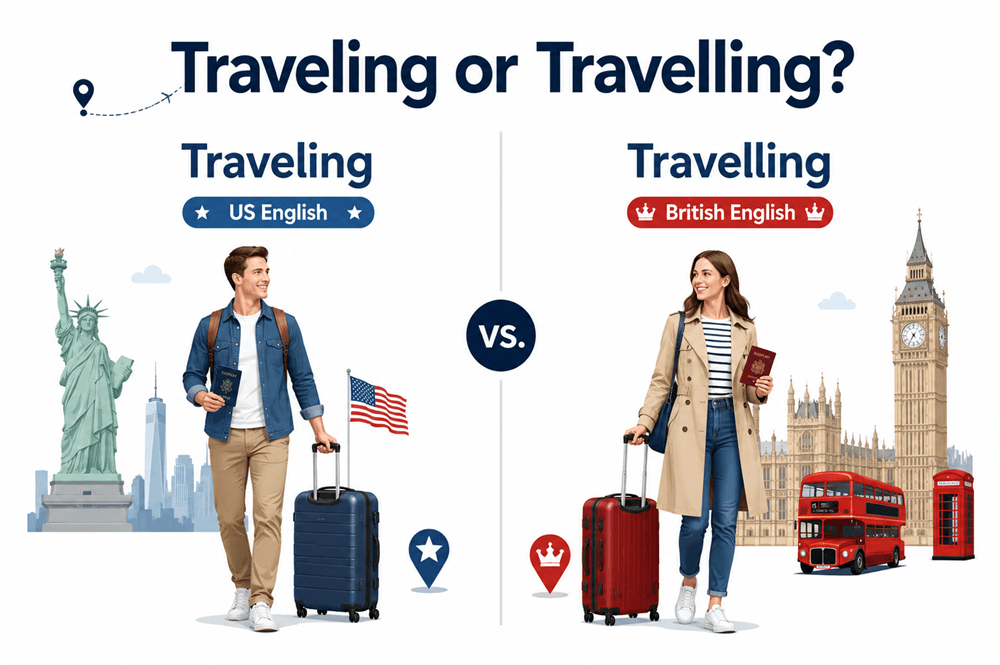
Traveling and travelling are both correct spellings, but they belong to different forms of English. Traveling is the preferred spelling in American English, while travelling is the preferred spelling in British English and many other varieties of English. The meaning is the same. The easiest rule is this: use traveling for U.S. writing and travelling for British-style writing.
Quick Answer
Use traveling with one l in American English.
- Correct: She is traveling to Chicago next week.
- Correct: Traveling alone can be exciting and peaceful.
- Correct: He spent the summer traveling across the country.
Use travelling with two ls in British English.
- Correct: She is travelling to London next week.
- Correct: Travelling alone can be exciting and peaceful.
- Correct: He spent the summer travelling across Europe.
The simple rule is this: traveling is American, and travelling is British. Both are correct, but you should choose one spelling style and stay consistent.
Traveling or Travelling: What Is the Difference?
The difference between traveling and travelling is spelling, not meaning. Both words are the -ing form of the verb travel. They mean going from one place to another, especially over a distance.
In American English, the final l is usually not doubled before adding -ing. That gives you traveling. In British English, the final l is usually doubled. That gives you travelling.
| Word | Best Use | Example |
|---|---|---|
| Traveling | American English | They are traveling by train. |
| Travelling | British English | They are travelling by train. |
If your website, article, school paper, or business document follows American spelling, use traveling. If it follows British spelling, use travelling.
What Does Traveling Mean?
Traveling means going from one place to another. It is the American English spelling of the present participle form of travel. You can use it when someone is taking a trip, moving between places, visiting another city or country, or spending time away from home.
Examples:
- She is traveling for work this month.
- Traveling by car gives you more freedom.
- He enjoys traveling to small towns.
- The family is traveling during the holidays.
Traveling can describe short trips, long journeys, vacations, business trips, road trips, international travel, or regular movement from place to place.
- traveling overseas
- traveling by plane
- traveling with children
- traveling for business
- traveling across the country
For American readers, traveling is the spelling that looks most natural and standard.
What Does Travelling Mean?
Travelling means the same thing as traveling. It also means going from one place to another. The only difference is that travelling uses two ls, which is the normal British English spelling.
Examples:
- She is travelling for work this month.
- Travelling by train is common in many European cities.
- He enjoys travelling with friends.
- The family is travelling during the summer break.
This spelling is common in British English, Australian English, and other English varieties that often follow British spelling patterns. If your writing uses words like colour, favour, centre, and organise, then travelling will usually fit better.
Is Travelling Wrong?
Travelling is not wrong. It is the standard spelling in British English. However, it may look less familiar to American readers because American English usually uses traveling with one l.
Compare these examples:
- American style: She is traveling across the United States.
- British style: She is travelling across the United Kingdom.
Both sentences are correct. The better choice depends on your audience and spelling style.
If you are writing for a U.S.-focused website, American school assignment, U.S. business email, or American publication, choose traveling. If you are writing for a British or international audience that expects British spelling, travelling may be better.
Is Traveling Wrong?
Traveling is not wrong. It is the preferred spelling in American English. In the United States, traveling is used in articles, books, school writing, travel blogs, business emails, advertisements, and everyday messages.
Examples:
- Traveling can teach you patience.
- She is traveling to Denver for a conference.
- They spent a year traveling around the world.
Some British readers may expect travelling, but traveling is still understandable. It simply follows American spelling rules.
Why Traveling Has One L in American English
Traveling has one l in American English because American spelling often avoids doubling the final consonant when the final syllable is not strongly stressed. In travel, the stress is usually on the first syllable: TRAV-el.
That is why American English usually writes:
- travel → traveling
- travel → traveled
- travel → traveler
This pattern is common in American spelling. The shorter forms are preferred:
- traveling
- traveled
- traveler
For American writing, these spellings are clear, standard, and expected.
Why Travelling Has Two Ls in British English
Travelling has two ls in British English because British spelling often doubles a final l before adding endings like -ing, -ed, and -er.
That gives you:
- travel → travelling
- travel → travelled
- travel → traveller
This same spelling pattern appears in other British-style words:
- cancel → cancelling
- label → labelling
- model → modelling
American English often uses shorter versions, while British English often keeps the doubled consonant. Neither system is wrong. They are simply different spelling conventions.
Traveling or Travelling in a Sentence
Both spellings work the same way in a sentence. The meaning does not change.
American English:
- She is traveling to New York.
- Traveling with a backpack can make trips easier.
- He was traveling when the storm arrived.
British English:
- She is travelling to London.
- Travelling with a backpack can make trips easier.
- He was travelling when the storm arrived.
The grammar is the same. Only the spelling changes.
Traveled or Travelled?
The same regional difference appears in the past tense: traveled or travelled.
Use traveled in American English.
- She traveled to Boston last year.
- They traveled by bus.
- He has traveled across the country.
Use travelled in British English.
- She travelled to Manchester last year.
- They travelled by bus.
- He has travelled across Europe.
The pattern is simple:
| American English | British English |
|---|---|
| traveling | travelling |
| traveled | travelled |
| traveler | traveller |
If you use traveling, you should also use traveled and traveler. If you use travelling, you should also use travelled and traveller.
Traveler or Traveller?
Traveler and traveller follow the same rule. Traveler is American English, and traveller is British English.
American English:
- She is an experienced traveler.
- The traveler checked into the hotel.
- Solo travelers should plan carefully.
British English:
- She is an experienced traveller.
- The traveller checked into the hotel.
- Solo travellers should plan carefully.
Again, the meaning is the same. The spelling depends on the form of English you are using.
Traveling as an Adjective
Traveling can also work like an adjective in American English. It can describe a person, group, show, team, or job that moves from place to place.
Examples:
- She joined a traveling theater group.
- The traveling nurse worked in several hospitals.
- A traveling salesman visited small towns across the state.
In British English, the spelling usually becomes travelling.
- She joined a travelling theatre group.
- The travelling nurse worked in several hospitals.
- A travelling salesman visited small towns across the region.
The role of the word stays the same. It describes something or someone that moves from place to place.
Common Mistakes With Traveling and Travelling
The most common mistake is mixing both spelling styles in the same article.
Inconsistent:
- She is traveling this summer. Her brother is travelling in autumn.
Better American consistency:
- She is traveling this summer. Her brother is traveling in the fall.
Better British consistency:
- She is travelling this summer. Her brother is travelling in autumn.
Another mistake is mixing related forms.
Inconsistent American-style writing:
- traveling, travelled, traveler
Better American-style writing:
- traveling, traveled, traveler
Better British-style writing:
- travelling, travelled, traveller
The spellings should match your chosen style. Consistency makes your writing look polished and intentional.
Examples of Traveling in Sentences
Here are examples of traveling used in American-style writing:
- She is traveling to California for a wedding.
- Traveling during winter can be stressful.
- He enjoys traveling by train instead of flying.
- The family is traveling with two young children.
- They spent six months traveling around the United States.
- The company hired a traveling sales representative.
- Traveling light makes the trip easier.
- She learned a lot while traveling alone.
In each sentence, traveling uses the American spelling with one l.
Examples of Travelling in Sentences
Here are examples of travelling used in British-style writing:
- She is travelling to Scotland for a wedding.
- Travelling during winter can be stressful.
- He enjoys travelling by train instead of flying.
- The family is travelling with two young children.
- They spent six months travelling around Europe.
- The company hired a travelling sales representative.
- Travelling light makes the trip easier.
- She learned a lot while travelling alone.
These examples mean the same thing as the American examples. The only difference is the doubled l.
How to Remember Traveling or Travelling
A simple way to remember the difference is this:
- Traveling = American English
- Travelling = British English
You can also remember the matching word families:
- American: traveling, traveled, traveler
- British: travelling, travelled, traveller
If your writing uses American spellings like color, center, and organize, use traveling. If your writing uses British spellings like colour, centre, and organise, use travelling.
Final Answer
Traveling and travelling are both correct spellings of the same word. They mean going from one place to another. The difference is regional: traveling is preferred in American English, while travelling is preferred in British English.
The easiest rule is simple: use traveling for U.S. writing and travelling for British-style writing. For a U.S.-focused website like WordBriefs, traveling is usually the safer default.