Paid or Payed: Correct Past Tense, Meaning, Usage, and Examples Explained Clearly
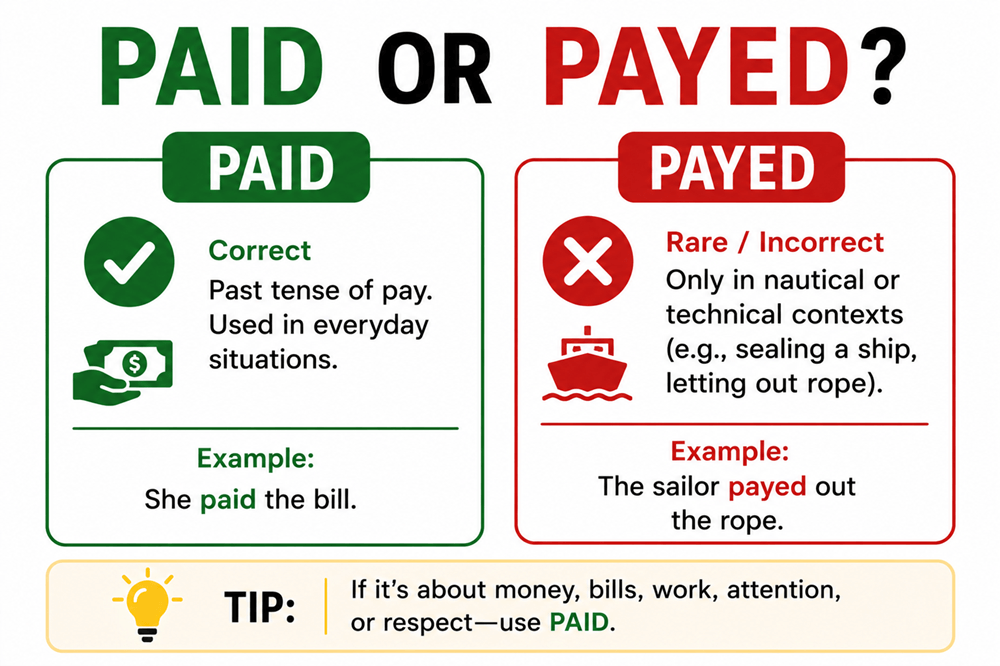
Paid is the correct past tense and past participle of pay in almost every everyday sentence. Use paid when talking about money, bills, wages, attention, respect, visits, debts, or consequences. Payed is a rare technical spelling used in a few nautical or specialized contexts, such as sealing a ship with tar or letting out rope. The easiest rule is this: if the sentence is about money or ordinary use, write paid.
Quick Answer
Use paid as the normal past tense of pay.
- Correct: She paid the bill yesterday.
- Correct: He paid for dinner.
- Correct: They paid attention during the lesson.
- Correct: The company paid its employees on Friday.
Payed is not the correct spelling for these common meanings.
- Incorrect: She payed the bill yesterday.
- Incorrect: He payed for dinner.
- Incorrect: They payed attention during the lesson.
The simple rule is this: paid is the standard spelling. Payed is rare and usually does not belong in everyday writing.
Paid or Payed: What Is the Difference?
The difference between paid and payed is usage. Paid is the standard past-tense form of the verb pay. It is the spelling you need when someone gives money, settles a debt, receives wages, gives attention, offers respect, or suffers a result.
Payed is a rare form with narrow technical meanings. It may appear in nautical or old-fashioned contexts, especially when talking about coating a ship with pitch or tar, or sometimes letting out a rope or cable. Most readers will never need this spelling in ordinary writing.
| Word | Main Use | Example |
|---|---|---|
| Paid | Standard past tense of pay | She paid the rent. |
| Payed | Rare technical or nautical use | The sailor payed out the rope. |
If you are talking about money, attention, respect, wages, bills, work, debts, or results, paid is correct.
What Does Paid Mean?
Paid is the past tense and past participle of pay. It means gave money in exchange for something, settled a bill, gave someone wages, or provided what was owed.
Examples:
- I paid for the coffee.
- She paid her phone bill.
- The customer paid in cash.
- The company paid the invoice late.
In each sentence, paid refers to money or payment. This is the most common use of the word.
Paid can also be used in expressions that are not directly about money.
- She paid attention to every detail.
- He paid respect to his former teacher.
- The mistake paid off in an unexpected way.
- They paid a heavy price for the delay.
These phrases still use paid, not payed. Even when no money is involved, the standard past tense remains paid.
What Does Payed Mean?
Payed is a rare spelling. It is not the normal past tense of pay in everyday English. It appears mainly in specialized contexts, especially older nautical or technical language.
One meaning of payed is to have coated or sealed something, especially part of a boat or ship, with tar, pitch, or a similar substance.
- The workers payed the seams with pitch.
- The deck was payed with a protective coating.
Payed may also appear in phrases about letting out rope, cable, or line, especially in boating or sailing contexts.
- The sailor payed out the rope slowly.
- The crew payed out more line as the boat moved away.
These uses are uncommon. In most modern writing, readers who see payed will assume it is a mistake unless the sentence clearly involves ships, ropes, tar, seams, or technical equipment.
Why Paid Is Usually Correct
Paid is usually correct because it is the standard past tense of pay. English has many verbs that form the past tense by adding -ed, such as walked, called, and opened. However, pay does not follow that regular pattern in ordinary use.
The correct forms are:
- Present: pay
- Past tense: paid
- Past participle: paid
- Present participle: paying
Examples:
- Present: I pay my rent online.
- Past: I paid my rent yesterday.
- Present perfect: I have paid my rent.
- Present participle: I am paying my rent now.
Because pay becomes paid, the spelling payed is wrong in normal sentences about payment.
When to Use Paid
Use paid whenever the sentence means someone gave money, settled a charge, received wages, or fulfilled an obligation.
Examples:
- She paid the restaurant bill.
- He paid the mechanic after the repair.
- The tenant paid rent on time.
- The client paid the deposit in advance.
Use paid when talking about salaries, wages, or work.
- The employees were paid every two weeks.
- She was paid fairly for her work.
- He got paid after finishing the job.
Use paid in common expressions.
- paid attention
- paid respect
- paid a visit
- paid the price
- paid off
- paid in full
In ordinary English, paid is the form you need almost every time.
When to Use Payed
Use payed only in rare technical contexts. It may refer to coating something with pitch, tar, or a similar material. It may also appear when talking about letting out rope, cable, or line.
Examples:
- The shipwright payed the seams to make them watertight.
- The crew payed out the cable from the stern.
- The sailor payed out the rope carefully.
These uses are specialized. Most people writing emails, school papers, articles, captions, resumes, invoices, stories, and business messages should not use payed.
If your sentence is not about nautical work, ropes, cables, tar, pitch, or sealing a ship, payed is probably wrong.
Paid the Bill or Payed the Bill?
The correct phrase is paid the bill.
Correct:
- She paid the bill before leaving.
- He paid the electric bill online.
- The customer paid the bill at the front desk.
Incorrect:
- She payed the bill before leaving.
- He payed the electric bill online.
- The customer payed the bill at the front desk.
When money is involved, always use paid.
Paid Attention or Payed Attention?
The correct phrase is paid attention.
Correct:
- The students paid attention during class.
- She paid close attention to the instructions.
- He paid attention to the small details.
Incorrect:
- The students payed attention during class.
- She payed close attention to the instructions.
- He payed attention to the small details.
Paid attention means listened, watched, or focused carefully. Even though this phrase is not about money, the correct spelling is still paid.
Paid Off or Payed Off?
The correct phrase is usually paid off.
Use paid off when a debt has been settled.
- She paid off her student loans.
- He finally paid off the car.
- The family paid off the mortgage early.
Use paid off when effort produces a good result.
- Her hard work paid off.
- The extra practice paid off during the game.
- The risk paid off in the end.
Payed off is not correct in these ordinary meanings.
- Incorrect: Her hard work payed off.
- Correct: Her hard work paid off.
Got Paid or Got Payed?
The correct phrase is got paid.
Correct:
- I got paid on Friday.
- She got paid for the extra hours.
- They got paid after completing the project.
Incorrect:
- I got payed on Friday.
- She got payed for the extra hours.
- They got payed after completing the project.
If the sentence is about receiving wages, money, or compensation, use paid.
Paid For or Payed For?
The correct phrase is paid for.
Correct:
- He paid for the tickets.
- She paid for lunch.
- The repairs were already paid for.
Incorrect:
- He payed for the tickets.
- She payed for lunch.
- The repairs were already payed for.
Paid for means money was given in exchange for something. This is one of the most common places where payed appears by mistake.
Paid in Full or Payed in Full?
The correct phrase is paid in full.
Correct:
- The invoice has been paid in full.
- The loan was paid in full last month.
- Please mark the account as paid in full.
Incorrect:
- The invoice has been payed in full.
- The loan was payed in full last month.
- Please mark the account as payed in full.
Paid in full means the complete amount has been paid. Since it is about payment, the correct spelling is paid.
Paid vs Payed in Business Writing
In business writing, paid is almost always the correct word. It appears in invoices, receipts, contracts, payroll notices, customer messages, accounting records, and payment confirmations.
Examples:
- The invoice was paid on June 3.
- Your order has been paid in full.
- The employee was paid for overtime.
- The deposit must be paid before work begins.
Using payed in business writing can look unprofessional because most business uses involve money, not nautical equipment or tarred ship seams.
For professional writing, the rule is simple: use paid.
Common Mistakes With Paid and Payed
The most common mistake is writing payed because many English verbs form the past tense with -ed. Since play becomes played and stay becomes stayed, it may seem natural to write pay as payed. But ordinary English uses paid.
Incorrect:
- She payed for the meal.
- He payed his rent late.
- The company payed its workers.
- I should have payed more attention.
Correct:
- She paid for the meal.
- He paid his rent late.
- The company paid its workers.
- I should have paid more attention.
Another mistake is assuming payed is always fake. It is not completely fake, but its correct use is so rare that most writers should avoid it unless the sentence is clearly technical or nautical.
Examples of Paid in Sentences
Here are examples of paid used correctly:
- She paid the parking fee.
- He paid for the groceries with a card.
- The company paid its employees early.
- I paid attention to the speaker.
- The loan was paid off after five years.
- They paid a high price for the mistake.
- She paid a visit to her grandmother.
- The invoice was paid in full.
In each sentence, paid is the standard past tense or past participle of pay.
Examples of Payed in Sentences
Here are examples of payed in its rare technical use:
- The worker payed the seams with pitch.
- The sailor payed out the rope slowly.
- The crew payed out the cable as the boat drifted.
These sentences are unusual because they involve technical actions. In everyday writing, paid is almost always the spelling you need.
How to Remember Paid or Payed
A simple way to remember the correct spelling is this:
- Pay usually becomes paid.
- Paid is for money, attention, respect, debts, and results.
- Payed is rare and mostly technical.
You can also remember this short sentence:
If money was paid, it was never payed.
This helps because the most common use of pay is about money. You paid rent, paid a bill, paid for dinner, got paid, paid off a loan, and paid in full.
For ordinary writing, choose paid every time.
Final Answer
Paid is the correct past tense and past participle of pay in almost every normal sentence. Use paid for money, bills, wages, attention, respect, visits, debts, costs, and results. Correct phrases include paid the bill, paid attention, paid for lunch, got paid, paid off, and paid in full.
Payed is a rare technical spelling used in limited nautical or specialized contexts, such as sealing seams or letting out rope. The easiest rule is simple: for everyday writing, use paid, not payed.