Moulding or Molding: Difference, Correct Usage, Regional Spelling, and Memory Tips Explained
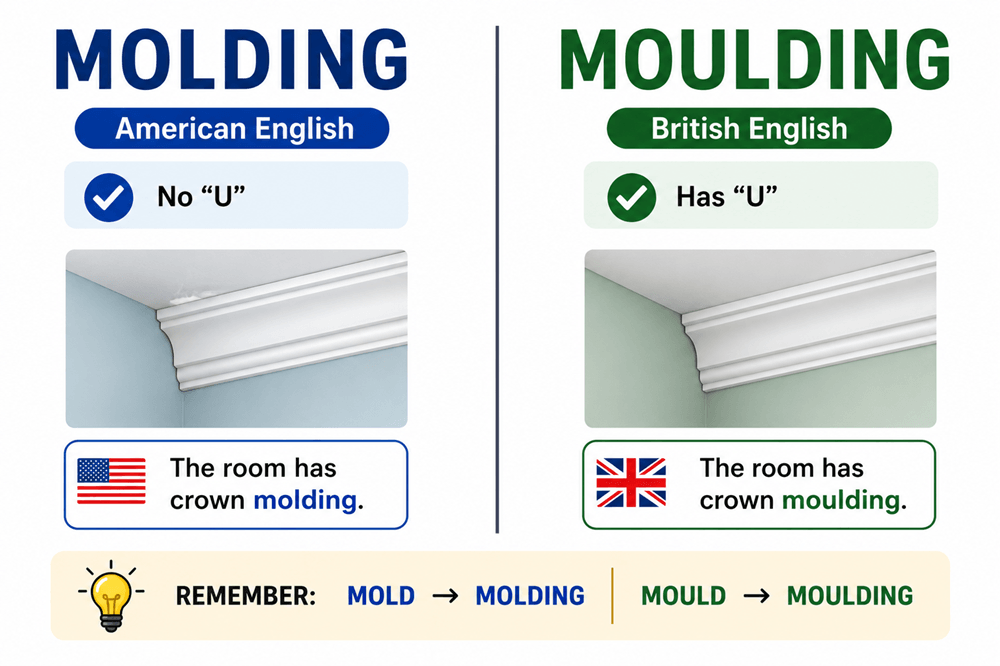
Molding and moulding are both correct, but they belong to different spelling styles. Molding is the standard American English spelling. Moulding is the standard British English spelling. Both can refer to decorative trim, the process of shaping something, or something formed in a mold or mould.
Quick Answer
Use molding in American English.
- The room has white crown molding.
- The factory is molding plastic parts.
- She repaired the wooden molding around the door.
Use moulding in British English.
- The room has white crown moulding.
- The factory is moulding plastic parts.
- She repaired the wooden moulding around the door.
The simple rule is: molding is American, while moulding is British.
Moulding or Molding: What Is the Difference?
The difference between moulding and molding is spelling, not meaning. Both words can describe the same thing. The choice depends mainly on whether you are using American English or British English.
| Spelling | English Style | Example |
|---|---|---|
| Molding | American English | The hallway needs new molding. |
| Moulding | British English | The hallway needs new moulding. |
If your audience is mostly in the United States, use molding. If your audience is mostly in the United Kingdom, Canada, Australia, or another place that often follows British spelling, moulding may be more natural.
What Does Molding Mean?
Molding is the American spelling. It can be a noun or a verb form.
As a noun, molding often means decorative trim used around walls, ceilings, windows, doors, or furniture.
- The crown molding makes the room look elegant.
- The baseboard molding needs repainting.
- They added molding around the fireplace.
As a verb form, molding means shaping, forming, or influencing something.
- The workers are molding clay into bowls.
- The company is molding plastic into containers.
- Teachers play a role in molding young minds.
In American writing, molding is the expected spelling for both the physical trim and the act of shaping something.
What Does Moulding Mean?
Moulding is the British spelling. It has the same meanings as molding. It can refer to decorative trim, shaping material, or influencing development.
- The ceiling moulding was carefully restored.
- The artist is moulding the clay by hand.
- Parents help in moulding a child’s early habits.
The extra u does not change the meaning. It only changes the spelling style. This is similar to other American and British spelling pairs, such as color and colour, or favorite and favourite.
Spelling Structure: Why Molding Has No U
Molding comes from the American spelling mold.
- mold + ing = molding
American English usually drops the u in words where British English keeps it. That is why American English uses:
- mold
- molded
- molding
The spelling is shorter and more direct. If you are writing for a U.S. audience, remember that molding matches mold. No u is needed.
Spelling Structure: Why Moulding Has U
Moulding comes from the British spelling mould.
- mould + ing = moulding
The u stays in the word because British English commonly keeps that spelling pattern. The related forms are:
- mould
- moulded
- moulding
If you are using British spelling, keep the u in all related forms. Do not switch between mould and molding in the same article unless you are quoting a source or using a proper name.
When to Use Molding
Use molding in American English when talking about decorative trim.
- The living room has beautiful molding.
- We painted the window molding white.
- The contractor replaced the damaged molding.
Use molding in American English when talking about shaping or forming something.
- The machine is molding the plastic.
- She is molding the dough into small circles.
- Experience is molding him into a stronger leader.
For American websites, blogs, product descriptions, and home improvement articles, molding is usually the better spelling.
When to Use Moulding
Use moulding in British English for the same meanings.
- The old house has detailed ceiling moulding.
- The carpenter repaired the door moulding.
- The artist spent hours moulding the figure.
Use moulding if the rest of your writing also uses British spelling, such as colour, favour, organise, or centre. Consistency matters more than choosing one spelling at random.
Mold, Mould, Molding, and Moulding
The same regional spelling difference applies to the base word.
| American English | British English |
|---|---|
| mold | mould |
| molded | moulded |
| molding | moulding |
This applies whether the word refers to shaping material, decorative trim, or fungus. In American English, you write mold. In British English, you usually write mould.
Common Mistakes
A common mistake is mixing American and British spelling in the same piece of writing.
Inconsistent:
- The mould was used for molding plastic.
Consistent American English:
- The mold was used for molding plastic.
Consistent British English:
- The mould was used for moulding plastic.
Another mistake is thinking one spelling is always wrong. Molding and moulding are both correct. The right choice depends on the spelling style you are using.
How to Remember the Difference
Use these memory tips:
- Molding has no u, like many American spellings.
- Moulding keeps the u, like British colour and favour.
- Mold leads to molding.
- Mould leads to moulding.
A simple memory sentence is: America molds; Britain moulds.
You can also remember it this way: Use the same spelling family from start to finish. If you choose mold, write molding. If you choose mould, write moulding.
Final Answer
Molding is the American English spelling. Example: The room has crown molding.
Moulding is the British English spelling. Example: The room has crown moulding.
Both words are correct, but they should match your regional style. To remember the difference, use this rule: molding belongs with mold, and moulding belongs with mould.