Therefor or Therefore: Difference, Correct Usage, Meaning, Examples, and Memory Tips Explained
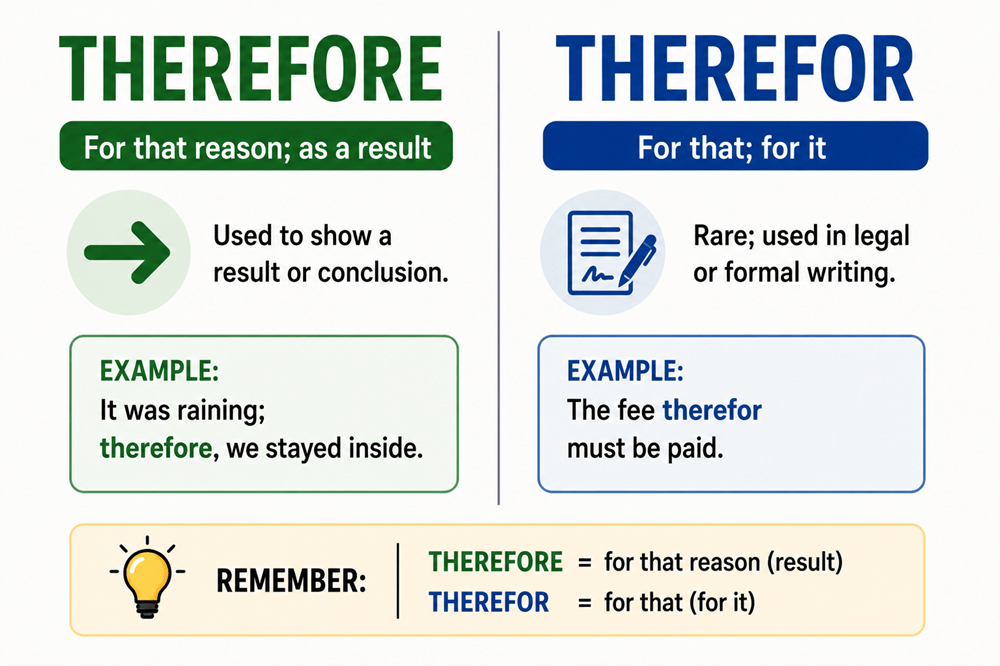
Therefore is the word you usually need. It means for that reason or as a result. Therefor is a real word, but it is rare and mostly used in legal or formal writing to mean for that or for it. In everyday writing, therefor is often a misspelling of therefore.
Quick Answer
Use therefore when you mean for that reason.
- The road was closed; therefore, we took another route.
- She studied every night; therefore, she passed the exam.
- The price was too high; therefore, we decided not to buy it.
Use therefor only in rare formal or legal writing when you mean for that thing.
- The buyer paid the price agreed therefor.
- The permit and the fee therefor must be submitted together.
The simple rule is: therefore means “for that reason,” while therefor means “for that.”
Therefor or Therefore: What Is the Difference?
The difference between therefor and therefore is meaning and usage. Therefore is common and useful in normal writing. It connects a reason to a result. Therefor is uncommon and usually appears in legal, contractual, or very formal language.
| Word | Meaning | Example |
|---|---|---|
| Therefore | For that reason; consequently | It rained; therefore, the game was canceled. |
| Therefor | For that; for it | The fee therefor must be paid. |
If you are writing an essay, email, article, message, report, or normal sentence, you almost always want therefore with the final e.
What Does Therefore Mean?
Therefore is an adverb. It means for that reason, because of that, or as a result. It is used when one idea logically follows another.
Examples:
- The store was closed; therefore, we went home.
- He forgot his password; therefore, he could not log in.
- The evidence was weak; therefore, the case was dismissed.
- The team worked hard; therefore, the project finished early.
In each sentence, therefore connects a cause to a result. Something happened first, and the next thing happened because of it.
What Does Therefor Mean?
Therefor means for that or for it. It is rare in everyday English. You are most likely to see it in legal documents, contracts, regulations, or formal notices.
Examples:
- The applicant must submit the form and the fee therefor.
- The goods were delivered, and payment therefor was received.
- The license and the application therefor were reviewed.
In these examples, therefor points back to a specific thing already mentioned. The phrase payment therefor means payment for that.
Because therefor is so rare, it can look strange to modern readers. Unless you are writing legal or formal language, it is usually better to avoid it.
Spelling Structure: Therefore Has “Fore”
The spelling therefore is easier to remember when you break it into two parts:
- there + fore = therefore
The ending fore can help you remember that therefore points forward to a result. It explains what follows from the reason before it.
- Reason: The roads were icy.
- Result: Therefore, school was delayed.
Think of therefore as a word that moves the sentence forward from cause to effect.
Spelling Structure: Therefor Has No Final E
Therefor looks like there + for:
- there + for = therefor
This makes sense because therefor means for that. The word ends with for, not fore.
- therefor = for that
- therefore = for that reason
The final e is the key spelling clue. If you mean a result or conclusion, use therefore with fore at the end.
When to Use Therefore
Use therefore when you are showing a conclusion, result, or logical consequence.
- The answer was incorrect; therefore, no points were awarded.
- She had enough experience; therefore, she got the job.
- The weather is dangerous; therefore, the trip is postponed.
- The instructions were unclear; therefore, many people made mistakes.
You can often replace therefore with so, as a result, or for that reason.
- The road was flooded, so we turned back.
- The road was flooded; therefore, we turned back.
Both sentences make sense. Therefore sounds more formal than so, but the meaning is similar.
When to Use Therefor
Use therefor only when you mean for that or for it, especially in legal or formal writing.
- The service and the charge therefor are listed below.
- The application and the documents therefor must be filed together.
- The buyer accepted the goods and paid therefor.
These sentences sound legal or old-fashioned. In normal writing, you would usually rewrite them more simply.
- Formal: The buyer paid therefor.
- Clearer: The buyer paid for it.
For most readers, for it or for that is clearer than therefor.
Common Mistakes
The most common mistake is writing therefor when you mean therefore.
Incorrect:
- It was raining; therefor, we stayed inside.
- She was late; therefor, she missed the meeting.
Correct:
- It was raining; therefore, we stayed inside.
- She was late; therefore, she missed the meeting.
Another mistake is using therefore when the sentence simply needs for that. This is rare, but it can happen in legal writing.
Formal:
- The fee therefor must be paid.
Plain English:
- The fee for that must be paid.
How to Remember the Difference
Use these memory tips:
- Therefore has fore, and it points forward to a result.
- Therefor ends in for, and it means for that.
- If you can replace the word with as a result, use therefore.
- If you can replace the word with for that, use therefor.
A simple memory sentence is: Therefore gives the reason; therefor means for that.
Final Answer
Therefore means for that reason or as a result. Example: The road was closed; therefore, we turned back.
Therefor means for that or for it. It is rare and mostly used in legal or formal writing. Example: The fee therefor must be paid.
To remember the difference, look at the ending. Therefore has fore and points forward to a result. Therefor ends in for and means for that.