Smokey or Smoky: Which Spelling Is Correct and When to Use It
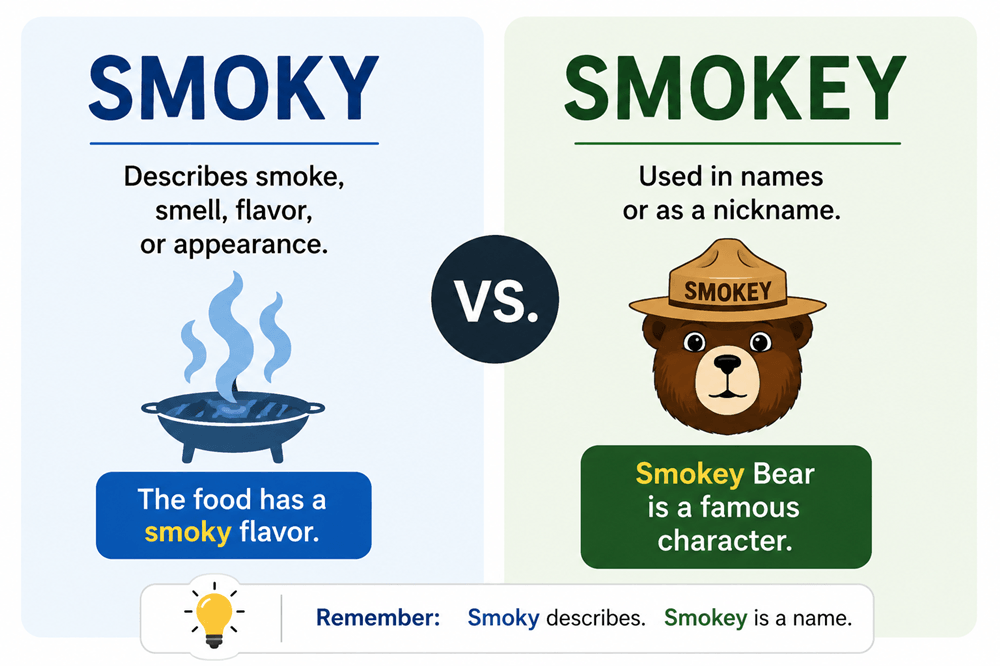
If you are choosing between smokey or smoky, the usual correct spelling is smoky. You use smoky to describe something filled with smoke, smelling like smoke, tasting like smoke, or looking hazy. Smokey is mostly used as a proper name, nickname, or brand-style spelling, not as the standard adjective.
Smokey or Smoky: What Is the Difference?
The main difference is simple: smoky is the standard adjective, while Smokey is usually a name.
Use smoky when you are describing air, flavor, smell, color, atmosphere, weather, rooms, mountains, skies, or anything affected by smoke.
For example:
Correct: The room smelled smoky after the fireplace burned all night.
Incorrect: The room smelled smokey after the fireplace burned all night.
Use Smokey when it is part of a proper name, nickname, character name, stage name, or official title.
For example:
Correct: Smokey Bear is a famous fire-prevention character.
In that sentence, Smokey is not being used as a normal descriptive word. It is part of a name. That is why the spelling with -ey is correct there.
What Does Smoky Mean?
Smoky is an adjective. It describes something that has smoke, looks like smoke, smells like smoke, tastes like smoke, or creates the mood of smoke.
You can use smoky for literal smoke:
The kitchen became smoky after the oil overheated.
This means the kitchen filled with smoke or smelled strongly of smoke.
You can also use smoky for flavor:
The sauce had a deep, smoky taste.
This means the sauce had a flavor that reminded you of smoke, grilling, roasting, barbecue, or wood fire.
You can use it for appearance:
The sunset turned the sky a smoky orange.
Here, smoky means hazy, muted, or smoke-like in color.
You can even use it for mood:
The singer had a smoky voice.
This does not mean smoke came from the singer’s mouth. It means the voice sounded low, warm, husky, soft, or atmospheric.
Why Smokey Looks Like It Could Be Correct
The misspelling smokey looks believable because many English adjectives end in -ey. You already know words like homey, gooey, spacey, gamey, and nosey. Because of that pattern, it is easy to assume that smoke should become smokey.
But English does not always follow the pattern you expect. When smoke becomes the adjective, the standard spelling drops the silent e and adds y:
smoke → smoky
This is the same basic pattern you see in other words where a final silent e is dropped before adding a suffix. The result may look a little shorter than expected, but smoky is the standard spelling.
Another reason smokey feels familiar is that you may have seen it in names. Smokey Bear, Smokey Robinson, and other proper names make the -ey spelling look normal. It is normal in names. It is just not the usual spelling for the adjective.
How to Remember the Spelling of Smoky
The easiest way to remember smoky is to connect it directly to smoke.
Start with the base word:
smoke
Then remove the silent e and add y:
smoke – e + y = smoky
That formula gives you the correct spelling every time.
You can also remember this sentence:
Smoky drops the E from smoke.
This is useful because the main spelling mistake is adding an extra e before the y. If you remember that smoky drops the e, you will avoid writing smokey when you mean the adjective.
Another simple memory trick is:
Smoke is smoky, not smokey.
It sounds a little repetitive, but that is the point. The more you repeat the correct pair, the more natural it becomes.
When Smokey Is Correct
Smokey can be correct when it is used as a proper name. Proper names do not always follow normal spelling rules. A person, character, place, business, or product can use a special spelling, and that spelling should be preserved.
For example:
Smokey Bear teaches people how to prevent wildfires.
Smokey Robinson is known for his music career.
The dog’s name was Smokey because of his gray fur.
In these examples, Smokey is a name. It should be capitalized when it is part of a proper noun.
The key is to ask whether you are describing something or naming something. If you are describing smoke-like qualities, use smoky. If you are writing an official name or nickname, use the spelling that belongs to that name, which may be Smokey.
Common Phrases With Smoky
You will often see smoky in everyday descriptions. Here are some common phrases:
Smoky flavor means a taste like smoke, fire, barbecue, roasted wood, or grilled food.
The beans had a smoky flavor from the smoked paprika.
Smoky air means air filled with smoke or haze.
The smoky air made it hard to see across the street.
Smoky room means a room that contains smoke or smells like smoke.
The old cabin had a smoky room near the fireplace.
Smoky voice means a low, husky, warm, or slightly rough voice.
Her smoky voice made the song feel intimate and calm.
Smoky eyes or smoky eye makeup means soft, blended, dark eye makeup that creates a shaded effect.
She wore smoky eye makeup for the evening event.
In all these phrases, smoky is the correct spelling because the word is describing something.
Smokey vs Smoky in Example Sentences
Side-by-side examples can make the difference easier to remember:
Correct: The smoky smell stayed in the curtains.
Incorrect: The smokey smell stayed in the curtains.
Correct: The soup had a smoky, roasted flavor.
Incorrect: The soup had a smokey, roasted flavor.
Correct: The smoky sky turned gray by afternoon.
Incorrect: The smokey sky turned gray by afternoon.
Correct: She used smoky eye shadow for a dramatic look.
Incorrect: She used smokey eye shadow for a dramatic look.
Correct: Smokey is the cat’s name.
Incorrect: Smoky is the cat’s name, if the cat’s official name is spelled Smokey.
The last example shows the important exception. When the word is a name, keep the name’s chosen spelling.
How to Check Which Word You Need
Before choosing between smokey and smoky, ask yourself one question:
Am I describing something, or am I writing a name?
If you are describing something, choose smoky.
Use smoky for:
smoky air
smoky flavor
smoky smell
smoky room
smoky sky
smoky mountains
smoky color
smoky voice
smoky eye makeup
If you are writing a name, choose the spelling used by that name.
Use Smokey for:
Smokey Bear
a pet named Smokey
a person named Smokey
a nickname spelled Smokey
a brand or title spelled Smokey
This check is quick and reliable. Description usually means smoky. Name usually means Smokey.
The Final Answer on Smokey or Smoky
The standard adjective is smoky. Use it when describing anything that contains smoke, smells like smoke, tastes like smoke, looks hazy, or has a smoke-like mood. The spelling smokey is usually not correct for ordinary descriptive writing.
Smokey is mainly correct as a proper name, nickname, character name, or official title. That is why you see it in names like Smokey Bear, but you should still write smoky flavor, smoky air, and smoky sky.
To remember the difference, use this simple rule: smoky drops the E from smoke. When you are describing something, write smoky. When you are using a name, keep the name’s spelling.