Messege or Message: Correct Spelling, Meaning, and Easy Ways to Remember It
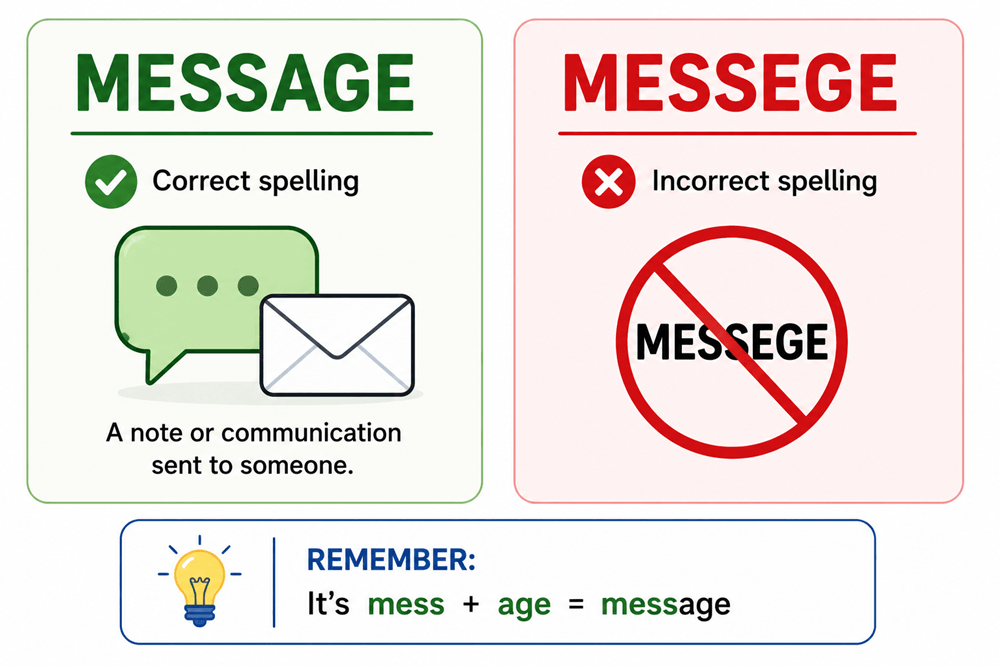
If you are choosing between messege or message, the correct spelling is message. The spelling messege is a common mistake, but it is not standard English. You use message when talking about a note, text, email, meaning, warning, or piece of communication sent from one person, group, or thing to another.
Messege or Message: Which Spelling Is Correct?
The correct spelling is message.
Messege is incorrect. It may look close to the right word, but the vowel pattern is wrong. The correct word has a in the middle:
message
You should write:
Correct: You left a message on her phone.
Incorrect: You left a messege on her phone.
The mistake usually happens because the word is pronounced quickly. When people say message, the second syllable can sound soft and unclear, almost like muhj or ij. Because of that, the middle a may not stand out when you are spelling from sound alone. But in writing, the correct form is always message.
What Does Message Mean?
A message is a piece of information, communication, or meaning sent to someone. It can be spoken, written, typed, recorded, implied, or shown through an action.
For example:
You sent a message asking what time dinner starts.
Here, message means a written or typed communication.
You might also write:
The movie has a powerful message about forgiveness.
In this sentence, message means the main idea, lesson, or meaning behind something.
The word can be used in many everyday situations. A message can be a text, voicemail, email, note, warning, announcement, signal, lesson, or emotional meaning. It does not always have to be a literal written note. Sometimes a person’s silence sends a message. Sometimes a story carries a message. Sometimes a symbol, gesture, or facial expression communicates a message without words.
Why Messege Looks Like It Could Be Right
The misspelling messege looks believable because English has many words with an e sound in the middle. When you hear message, you may focus on the first part, mess, and then continue with another e. That can lead to the mistaken spelling:
mess + ege = messege
But that is not how the word is built. The correct spelling is:
mess + age = message
This is the most useful visual clue. The word message contains age at the end:
mess + age = message
Once you see that structure, the spelling becomes easier to remember. You do not need an extra e after mess. You need age.
A Simple Way to Remember Message
The easiest memory trick is:
A message has an age.
That may sound strange at first, but it works visually. The correct spelling message ends with age:
mess-age
So when you are unsure whether to write messege or message, look for age. If the word does not contain age, it is spelled wrong.
You can also remember this phrase:
The message came with age.
This gives your mind a quick clue: message includes age. The misspelling messege does not.
Another simple trick is to break the word into two parts:
mess + age = message
The first part, mess, is easy. The second part, age, is the part you must remember. If you keep those two pieces together, the spelling becomes much harder to miss.
Common Phrases With Message
Seeing message in familiar phrases can help the correct spelling feel more natural. These are common expressions you may use often:
Text message means a message sent by phone or messaging app.
You received a text message from your friend.
Voice message means a recorded spoken message.
She left a voice message after the meeting.
Email message means a message sent through email.
The email message included the meeting link.
Clear message means a meaning that is easy to understand.
The sign sent a clear message to visitors.
Hidden message means a meaning that is not obvious at first.
The poem contained a hidden message about grief.
Take a message means to write down information for someone who is unavailable.
Could you take a message for your manager?
In every phrase, the spelling stays the same: message.
Messege vs Message in Example Sentences
Side-by-side examples make the difference easy to see:
Correct: You forgot to reply to the message.
Incorrect: You forgot to reply to the messege.
Correct: The message was short but important.
Incorrect: The messege was short but important.
Correct: He sent a message before leaving work.
Incorrect: He sent a messege before leaving work.
Correct: The story’s message stayed with you for days.
Incorrect: The story’s messege stayed with you for days.
Correct: Please check your message inbox.
Incorrect: Please check your messege inbox.
The correction is always the same. Replace messege with message.
Message as a Noun
Message is most often used as a noun. As a noun, it refers to the thing being communicated.
For example:
Your message arrived late last night.
The teacher wrote a message on the board.
The speech had a hopeful message.
The warning message appeared on the screen.
In these examples, message names a piece of communication or meaning. It can be physical, digital, spoken, symbolic, or emotional.
Message as a Verb
Message can also be used as a verb. As a verb, it means to send someone a message, usually through a phone, app, email, or online platform.
For example:
You can message me when you arrive.
She messaged the group with the new address.
He is messaging his coworker about the schedule.
Even when the word changes form, the correct spelling still begins with message:
message
messages
messaged
messaging
Notice that messaging drops the final e before adding -ing. That is normal. But the base word is still message, not messege.
How to Remember the Middle Vowel
The hardest part of spelling message is remembering the middle a. Since the word sounds soft when spoken, you may not clearly hear that letter. That is why visual memory matters more than sound here.
Use this spelling shape:
m e s s a g e
Now focus on the last three letters:
a g e
The word ends with age. That is the key. If you write messege, you are replacing age with ege, which breaks the correct pattern.
You can repeat this simple line:
Message ends in age.
That one sentence is enough to prevent the most common mistake.
How to Check Yourself Before Writing Message
Before you write the word, ask yourself whether you are talking about communication, meaning, a text, a note, a warning, or a signal. If yes, you almost certainly need message.
Then check the spelling by looking for age at the end:
mess + age = message
Use this quick test:
Does the word end with age?
Yes: message is correct.
No: messege is wrong.
This works because the misspelling usually happens in the second half of the word. Once you train yourself to see age, the correct spelling becomes much easier to choose.
The Final Answer on Messege or Message
The correct spelling is message. The spelling messege is a mistake and should be avoided in standard English. A message is a note, text, email, signal, warning, communication, or meaning sent from one person or thing to another.
To remember the spelling, break the word into two parts: mess + age = message. The key memory clue is that message ends in age. If you remember the age ending, you will not accidentally write messege.
So when you are writing about a text, email, voicemail, note, hidden meaning, warning, or idea being communicated, choose message. It is the clear, correct, and standard spelling.