Seel or Seal: Correct Spelling, Meanings, and Easy Ways to Remember
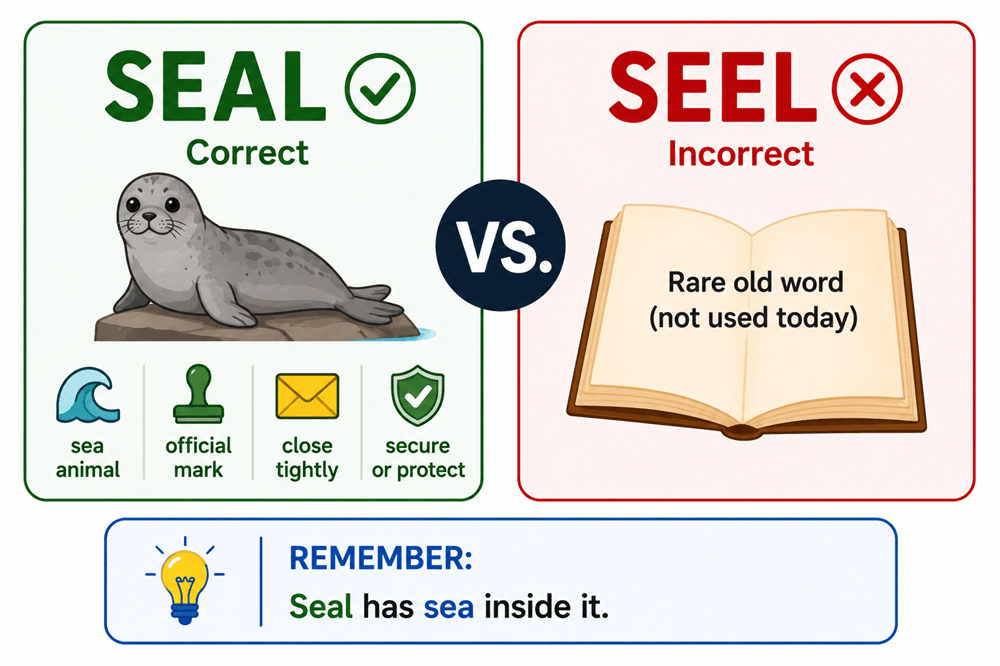
If you are choosing between seel or seal, the word you almost always want is seal. Seal can mean an ocean animal, a mark of approval, a stamp, or the act of closing something tightly. Seel is a rare old word that most people do not use today, so it usually looks like a misspelling.
Seel or Seal: Which Spelling Is Correct?
The standard word is seal.
Seel is not the correct spelling when you mean the animal, a closed edge, a stamp, an official mark, or the action of closing something securely. In most everyday writing, seel is simply a mistake.
You should write:
Correct: You need to seal the envelope.
Incorrect: You need to seel the envelope.
You should also write:
Correct: A seal was swimming near the rocks.
Incorrect: A seel was swimming near the rocks.
The correct spelling uses ea, not ee. Even though seal has a long “ee” sound, it follows the same vowel pattern as words like sea, deal, meal, real, and clean.
What Does Seal Mean?
Seal is a common English word with several meanings. It can be a noun or a verb.
As a noun, seal can mean a marine animal. A seal is a sea mammal with flippers that lives near oceans and cold coastal areas.
For example:
The seal rested on the beach after swimming all morning.
As a noun, seal can also mean a mark, stamp, or sign of approval.
For example:
The document had an official seal at the bottom.
Here, seal means an official mark that shows authority, approval, or authenticity.
As a verb, seal means to close something tightly, secure it, or prevent air, water, or anything else from getting in or out.
For example:
You should seal the jar so the food stays fresh.
In this sentence, seal means close the jar tightly.
What Does Seel Mean?
Seel is a real but very rare word. Historically, it meant to close or stitch shut the eyelids of a bird, especially a hawk used in falconry. It can also appear in older literary contexts with the idea of closing the eyes.
However, this word is so uncommon that most modern readers will not recognize it. Unless you are writing about older falconry terms, historical language, or a literary use, you probably do not need seel.
For normal writing, seel will almost always look like a misspelling of seal.
So the practical rule is simple:
Use seal for modern everyday English.
Use seel only in rare historical or specialized contexts.
Why Seel Looks Like It Could Be Right
The spelling seel looks believable because the word seal sounds like it should use ee. Many English words spell the long “ee” sound with double e, including see, feel, green, deep, week, and seem.
Because of that, your ear may tell you to write:
seel
But English has more than one way to spell the long “ee” sound. Many common words use ea for that same sound:
sea
tea
deal
meal
clean
dream
seal
That is the spelling family seal belongs to. The sound may be “ee,” but the correct letters are ea.
A Simple Way to Remember Seal
The easiest memory trick is:
A seal lives in the sea.
This works because both seal and sea use ea:
sea
seal
If you can remember that a seal is an animal from the sea, you can remember the spelling. The word seal begins with sea.
You can also use this phrase:
A sea animal is a seal.
This gives you both the meaning and the spelling in one sentence. When you are tempted to write seel, picture a seal in the sea. The ea in sea will help you choose seal.
Another Memory Trick: Seal Has Sea Inside It
Look closely at the word:
seal
The first three letters are sea. That is the strongest spelling clue.
You can remember:
Seal has sea inside it.
This works especially well for the animal meaning, but it can help with every meaning of seal. Whether you mean a marine animal, a closed envelope, a wax stamp, or an official mark, the spelling stays the same.
For example:
seal the box
official seal
wax seal
seal at the zoo
seal the deal
Every one uses seal, with ea.
Common Phrases With Seal
Seal appears in many common phrases. Learning these phrases can help the correct spelling feel natural.
Seal an envelope means close an envelope so it stays shut.
You sealed the envelope before mailing the card.
Seal a jar means close it tightly to keep air out.
The lid sealed the jar properly.
Official seal means a mark showing authority or approval.
The certificate had the school’s official seal.
Wax seal means melted wax used to close or decorate a letter.
The invitation was closed with a red wax seal.
Seal the deal means complete an agreement.
A final handshake helped seal the deal.
Seal off means close or block an area.
The workers sealed off the damaged hallway.
In all these phrases, seal is correct. Seel would not fit modern standard usage.
Seal as a Verb
As a verb, seal means to close, fasten, secure, or make something airtight or watertight. It is often used with containers, letters, packages, cracks, doors, windows, and surfaces.
For example:
You sealed the package with tape.
The plumber sealed the leak under the sink.
She sealed the paint so it would last longer.
The door was sealed to keep out cold air.
The verb forms are:
seal
seals
sealed
sealing
Notice that every form keeps the ea spelling. You write sealed, not seeled. You write sealing, not seeling.
Seal as a Noun
As a noun, seal can mean the animal, a stamp, a mark, or something that closes a space tightly.
For example:
The seal barked near the pier.
The mayor placed a seal on the official letter.
The freezer door has a broken seal.
The product came with a safety seal.
These meanings may seem different, but the spelling does not change. The word is still seal.
Seel vs Seal in Example Sentences
Side-by-side examples make the difference easy to see:
Correct: You need to seal the bag tightly.
Incorrect: You need to seel the bag tightly.
Correct: The seal swam through the cold water.
Incorrect: The seel swam through the cold water.
Correct: The letter had a wax seal.
Incorrect: The letter had a wax seel.
Correct: The company wants to seal the deal today.
Incorrect: The company wants to seel the deal today.
Correct: The window seal keeps out rain and wind.
Incorrect: The window seel keeps out rain and wind.
In almost every modern sentence, seal is the correct choice.
How to Check Yourself Before Writing Seal
Before choosing between seel and seal, ask what you mean.
If you mean an ocean animal, use seal.
If you mean closing something tightly, use seal.
If you mean an official mark, use seal.
If you mean a stamp, wax mark, safety closure, or tight edge, use seal.
Then use the memory clue:
Seal has sea inside it.
If your spelling does not begin with sea, it is probably wrong for ordinary writing.
The Final Answer on Seel or Seal
The correct spelling for almost every modern use is seal. Use it for the animal, the act of closing something, an official mark, a wax stamp, a safety closure, or a tight edge. Seel is a rare old word and will usually look like a misspelling today.
To remember the spelling, use this simple clue: a seal lives in the sea. Since seal begins with sea, you can remember the ea spelling instead of writing seel.
So when you are writing about closing a package, protecting food, approving a document, fixing a leak, finishing a deal, or seeing the ocean animal, choose seal. It is the clear, correct, and standard spelling.