Meant or Ment: Correct Spelling, Meaning, and Easy Ways to Remember
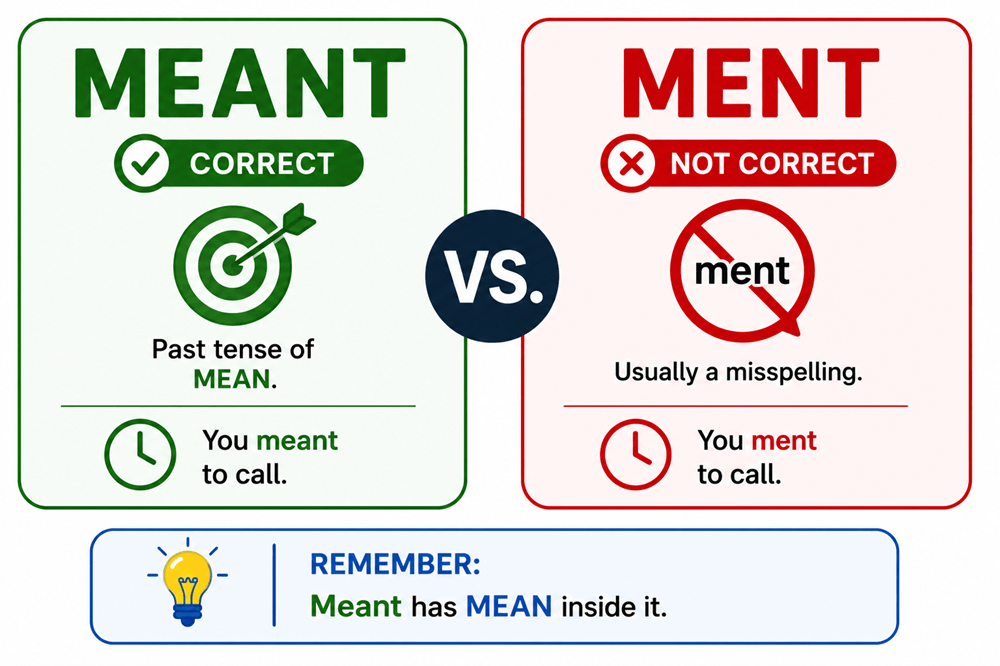
If you are choosing between meant or ment, the correct spelling is meant. The word ment is usually a misspelling when you mean “intended,” “signified,” or “had in mind.” The word meant is the past tense and past participle of mean, and it is used often in everyday English.
Meant or Ment: Which Spelling Is Correct?
The correct spelling is meant.
Ment is not the standard spelling when you are talking about what someone intended, what something expressed, or what a word, action, or situation signified.
You should write:
Correct: You meant to call earlier.
Incorrect: You ment to call earlier.
You should also write:
Correct: That comment meant a lot to you.
Incorrect: That comment ment a lot to you.
The mistake happens because meant is usually pronounced like ment. The a is not strongly heard, so people sometimes leave it out when spelling the word. But the correct written form keeps the a: meant.
What Does Meant Mean?
Meant is the past tense and past participle of mean. It can describe intention, meaning, importance, or purpose.
For example:
You meant to send the email yesterday.
This means you intended to send the email yesterday, even if you forgot or did not finish it.
You might also write:
Her words meant more than she realized.
Here, meant means the words had emotional value or importance.
Meant can also explain what something signified:
The red light meant you needed to stop.
In this sentence, meant means the red light communicated a certain meaning.
So meant can mean “intended,” “signified,” “had the purpose of,” or “was important to.” The exact meaning depends on the sentence, but the spelling stays the same.
Why Ment Looks Like It Could Be Right
The spelling ment looks tempting because it matches how meant often sounds. In speech, meant does not usually sound like meen-t. It sounds closer to ment, with a short vowel sound.
Because English spelling is not always based only on pronunciation, the sound can mislead you. If you spell only by ear, ment may seem reasonable. But standard English uses meant.
Another reason ment looks familiar is that -ment appears at the end of many real words, such as:
statement
payment
movement
agreement
development
In those words, ment is a suffix. It is not the same as the past tense of mean. When you need the word that comes from mean, the spelling is meant.
A Simple Way to Remember Meant
The easiest memory trick is:
Meant has mean inside it.
Look at the spelling:
mean + t = meant
The word meant begins with the same letters as mean. That gives you a clear spelling clue. If you are using the past form of mean, keep mean in the spelling and add t.
You can also remember this sentence:
What you mean today, you meant yesterday.
This connects the present form mean with the past form meant. The spelling changes only by adding t at the end.
Another Memory Trick: Meant Has an A for Aim
If you use meant to talk about intention, you can remember the a this way:
Meant has A because it shows your aim.
When you meant to do something, you aimed or intended to do it. The a in meant can remind you of aim.
For example:
You meant to help.
This means your aim was to help.
You meant no harm.
This means your aim was not to hurt anyone.
This memory clue is useful because the missing a is the main spelling problem. If you remember aim, you can remember that meant needs a.
Common Uses of Meant
Meant appears in many everyday phrases. Learning these phrases can help the correct spelling feel automatic.
Meant to means intended to do something.
You meant to reply, but the day got busy.
Meant for means intended for a person, purpose, or situation.
This message was meant for you.
Meant no harm means did not intend to hurt, offend, or cause damage.
He meant no harm with the joke.
Meant a lot means was emotionally important or valuable.
Your support meant a lot during that difficult week.
Well-meant means kindly intended, even if the result was not perfect.
Her advice was well-meant, though it was not very helpful.
In every phrase, the correct spelling is meant, not ment.
Meant as Intention
One of the most common uses of meant is intention. When you say you meant to do something, you are saying that was your plan or purpose.
For example:
You meant to clean the kitchen before guests arrived.
She meant to explain herself more clearly.
They meant to leave earlier, but traffic delayed them.
He meant to apologize, but he could not find the right words.
In these sentences, meant is connected to what someone intended. The action may or may not have happened, but the intention was there.
Meant as Meaning or Significance
Meant can also explain what something communicated or signified.
For example:
The sign meant the road was closed.
The silence meant she was still thinking.
The symbol meant peace in that culture.
The teacher’s note meant you needed to revise the essay.
In these examples, meant is not about someone’s personal intention. It is about meaning. A sign, silence, symbol, or note communicates something.
Meant can also show emotional importance:
That compliment meant everything to you.
This means the compliment mattered deeply.
Ment vs Meant in Example Sentences
Side-by-side examples make the difference easy to see:
Correct: You meant what you said.
Incorrect: You ment what you said.
Correct: She meant to arrive before noon.
Incorrect: She ment to arrive before noon.
Correct: The gift meant more than money.
Incorrect: The gift ment more than money.
Correct: He meant no disrespect.
Incorrect: He ment no disrespect.
Correct: The word meant something different in the past.
Incorrect: The word ment something different in the past.
The correction is always the same. If the word comes from mean, spell it meant.
What About the Suffix -ment?
The letters ment are common in English, but usually as a suffix at the end of another word. A suffix is a word part added to create a new word.
For example:
pay + ment = payment
agree + ment = agreement
move + ment = movement
state + ment = statement
In these words, -ment helps form nouns. But ment by itself is not the word you need when you mean “intended” or “signified.”
So if you are writing a word like payment or statement, ment may appear at the end. But if you are writing the past tense of mean, use meant.
How to Check Yourself Before Writing Meant
Before choosing between ment and meant, ask whether the word is connected to mean.
Ask:
Does it mean intended?
If yes, use meant.
Does it mean signified?
If yes, use meant.
Does it mean mattered or had importance?
If yes, use meant.
Then check the spelling:
mean + t = meant
This is the simplest way to catch the mistake. If your spelling does not contain mean, it is wrong for this meaning.
The Final Answer on Meant or Ment
The correct spelling is meant. It is the past tense and past participle of mean. Use it when you are talking about what someone intended, what something signified, or how much something mattered.
Ment is usually a misspelling in this context. It may appear as part of longer words like payment, statement, or agreement, but it is not the correct spelling for the past form of mean.
To remember the spelling, use this simple clue: meant has mean inside it. Think of the pattern mean + t = meant. So when you are writing you meant well, that meant a lot, or what you meant to say, keep the a and write meant.