Mold or Mould: Which Spelling Is Correct?
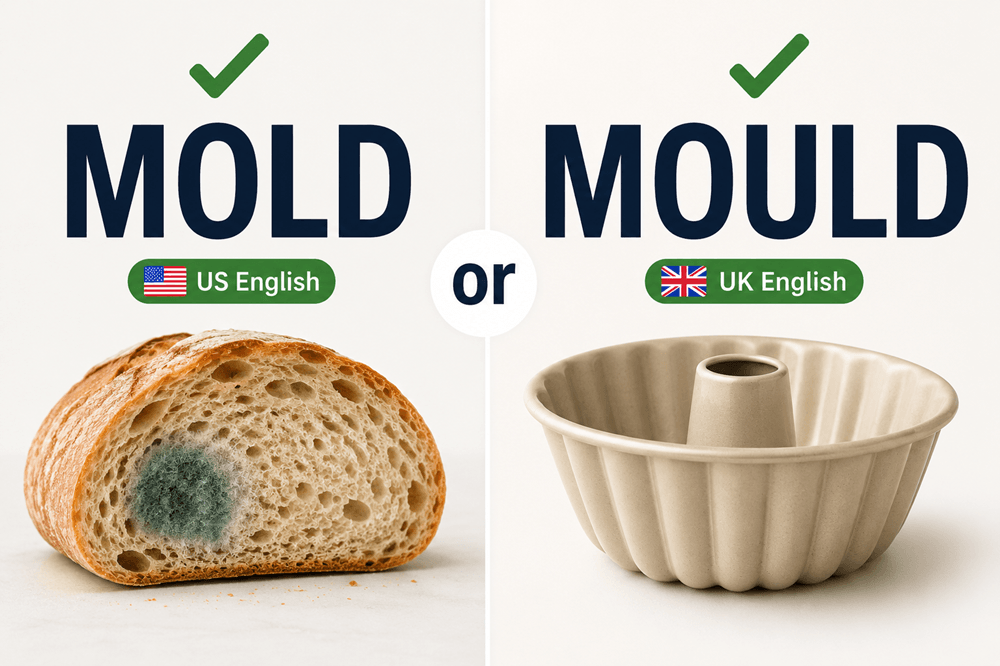
Mold and mould are both correct spellings. The difference is mainly regional.
In American English, the usual spelling is mold.
In British English, the usual spelling is mould.
They mean the same thing. The spelling changes depending on where your audience is, not because the word has a different meaning.
Examples:
- American English: There was mold on the bread.
- British English: There was mould on the bread.
- American English: Pour the chocolate into the mold.
- British English: Pour the chocolate into the mould.
For most U.S. writing, use mold. For British, Australian, or many Commonwealth audiences, use mould.
Quick Answer
Use mold in American English.
Use mould in British English.
Correct in the U.S.:
- The bathroom had black mold near the window.
Correct in the U.K.:
- The bathroom had black mould near the window.
Neither spelling is wrong. The best choice depends on your spelling style.
What Does Mold or Mould Mean?
The word mold or mould can have several meanings.
First, it can mean a type of fungus that grows on damp surfaces or old food.
Examples:
- There is mold on the cheese.
- The wall developed mould after the leak.
- Damp rooms can attract mold.
Second, it can mean a container or form used to shape something.
Examples:
- She poured the cake batter into a mold.
- The candle was made in a round mould.
- They used a plastic mold to shape the soap.
Third, it can mean to shape or influence something.
Examples:
- Teachers help mold young minds.
- His early experiences moulded his character.
- The artist molded the clay into a figure.
In all of these meanings, the American spelling is usually mold, and the British spelling is usually mould.
Mold vs. Mould: The Main Difference
The main difference is spelling region:
Mold = American English
Mould = British English
They can both refer to:
- fungus on food or walls
- a form used for shaping things
- the act of shaping or influencing something
The spelling does not change the meaning.
A U.S. reader expects:
- bread mold
- cake mold
- mold clay
- mold someone’s character
A British reader expects:
- bread mould
- cake mould
- mould clay
- mould someone’s character
The word works the same way. Only the spelling changes.
Why Are There Two Spellings?
The spelling difference comes from the way American and British English developed.
American English often simplified certain spellings. British English kept some older forms with extra letters.
This is similar to other spelling pairs:
- color / colour
- favor / favour
- humor / humour
- mold / mould
In these words, British English keeps the u, while American English usually removes it.
That is why mold looks shorter and more modern to American readers, while mould looks more natural to British readers.
Is Mould Wrong in American English?
No, mould is not technically wrong, but it will look British or unusual in American writing.
If you are writing for a U.S. audience, mold is the standard choice.
For example:
- The landlord needs to remove the mold.
- I bought a silicone mold for baking.
- The coach helped mold the team’s attitude.
Using mould in an American article may distract readers because it looks like a foreign spelling.
So if your website mainly targets American readers, choose mold.
Is Mold Wrong in British English?
Mold is understandable in British English, but mould is the standard British spelling.
For a British audience, these sentences look more natural:
- The bread had mould on it.
- She poured the jelly into a mould.
- His childhood moulded his personality.
British readers will know what mold means, but they may see it as the American spelling.
How to Remember the Difference
A simple memory trick:
Mold is shorter, and American English often uses shorter spellings.
Mould has a u, like many British spellings.
You can connect mould with other British-style words:
- colour
- favour
- humour
- mould
If the word has that extra u, it probably belongs to British spelling.
Another way to remember it:
U in mould can remind you of the U.K.
So:
mould = U.K. spelling
mold = U.S. spelling
That one-letter clue makes the difference easier to memorize.
Spelling Structure
The American spelling has four letters:
m-o-l-d
The British spelling has five letters:
m-o-u-l-d
The only difference is the letter u.
American English removes the u:
mold
British English keeps the u:
mould
This spelling pattern is useful because it appears in many other American/British word pairs.
Common Mistakes
Mistake 1: Thinking mold and mould mean different things
They do not have different meanings.
Incorrect idea:
- Mold means fungus, and mould means a shaping container.
Correct idea:
- Both words can mean fungus.
- Both words can mean a shaping container.
- Both words can mean to shape something.
The difference is regional spelling, not meaning.
Mistake 2: Mixing both spellings in one article
Inconsistent:
- The bathroom had mold, and the old bread had mould.
Better for American English:
- The bathroom had mold, and the old bread had mold.
Better for British English:
- The bathroom had mould, and the old bread had mould.
Choose one spelling style and stay consistent.
Mistake 3: Forgetting the u in British English
If you are writing in British English, remember that mould includes u.
British spelling:
- mould
- mouldy
- moulded
- moulding
American spelling:
- mold
- moldy
- molded
- molding
The spelling difference usually continues in related forms.
Moldy or Mouldy?
The same rule applies to moldy and mouldy.
American English:
- The bread is moldy.
- The room smells moldy.
British English:
- The bread is mouldy.
- The room smells mouldy.
Both words mean covered with mold or smelling like mold.
Molded or Moulded?
The same rule also applies to molded and moulded.
American English:
- The plastic was molded into a new shape.
- Her teacher molded her confidence.
British English:
- The plastic was moulded into a new shape.
- Her teacher moulded her confidence.
Again, the meaning is the same. The spelling depends on the English variety.
Example Sentences
American English:
- There was mold growing near the sink.
- I used a heart-shaped mold for the chocolate.
- The artist molded the clay by hand.
- The basement smelled moldy after the storm.
British English:
- There was mould growing near the sink.
- I used a heart-shaped mould for the chocolate.
- The artist moulded the clay by hand.
- The basement smelled mouldy after the storm.
These examples show that the spelling changes, but the meaning stays the same.
Final Answer: Mold or Mould?
Mold and mould are both correct.
Use mold in American English.
Use mould in British English.
They can both refer to fungus, a shaping form, or the act of shaping something.
The easiest way to remember the difference is that mould has a u, and U can remind you of the U.K. For American writing, keep it shorter: mold.