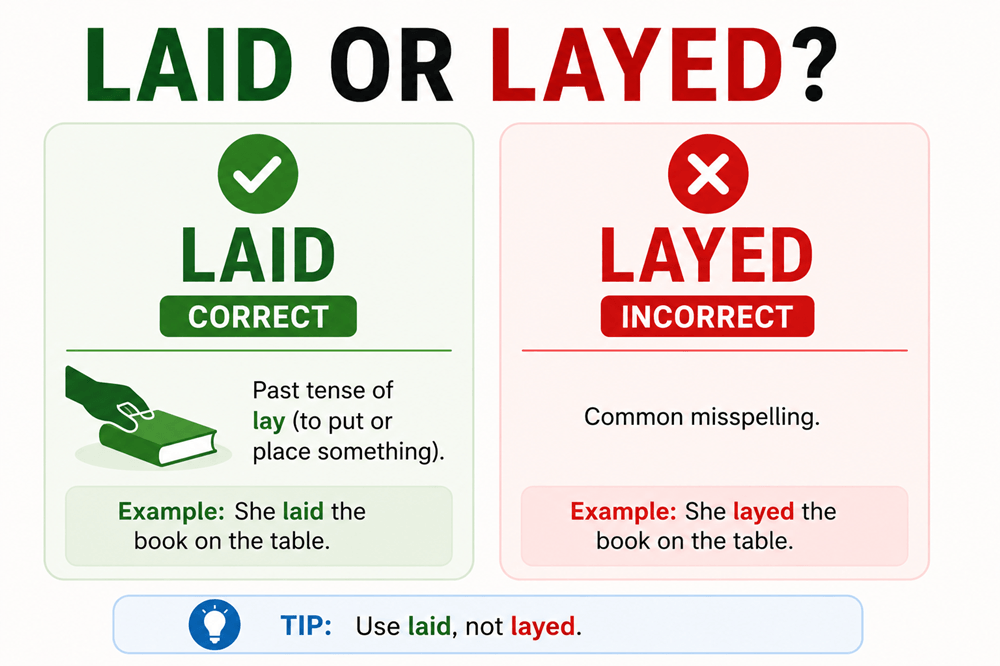
Laid or Layed: Which Spelling Is Correct for Past Tense of Lay?
Laid and layed may look like two possible past-tense forms of lay, but only one is standard in modern English. The correct spelling is laid. Use it when you mean something was placed, arranged, prepared, or set down in the past. Layed looks logical because many verbs take -ed, but it is not the accepted spelling for normal writing.
Quick Answer
Use laid as the past tense and past participle of lay.
- Correct: You laid the book on the table.
- Correct: She laid the blanket across the bed.
- Correct: They laid the foundation last year.
Layed is not the standard spelling. In most cases, it will look like a mistake.
- Incorrect: You layed the book on the table.
- Incorrect: She layed the blanket across the bed.
- Incorrect: They layed the foundation last year.
The simple rule is this: lay becomes laid, not layed.
Laid or Layed: What Is the Difference?
The difference between laid and layed is correctness. Laid is the proper past-tense form of lay. Layed is a common misspelling that happens because it follows a familiar pattern.
You already know many verbs that form the past tense by adding -ed. For example, play becomes played, stay becomes stayed, and delay becomes delayed. Because of that pattern, layed may seem reasonable at first glance.
However, lay is irregular. Its past tense does not follow the same pattern as play. Instead of becoming layed, it becomes laid.
| Word | Use | Example |
|---|---|---|
| Lay | Present tense | You lay the keys on the counter. |
| Laid | Past tense and past participle | You laid the keys on the counter. |
| Layed | Nonstandard spelling | You layed the keys on the counter. |
If you want your writing to look correct and polished, choose laid.
What Does Laid Mean?
Laid means placed, put down, arranged, prepared, or set in position. It is the past form of lay, which usually means to put something somewhere.
Examples:
- You laid your phone beside the charger.
- She laid the papers neatly on the desk.
- The worker laid the tiles in a straight line.
- He laid the baby gently in the crib.
In each sentence, someone placed something somewhere. Because the action already happened, laid is correct.
Laid can also be used in less literal ways. You may not be physically placing an object, but the idea of setting something up or putting something into position is still there.
- The team laid the groundwork for a stronger campaign.
- The lawyer laid out the facts clearly.
- The company laid plans for expansion.
- The early lessons laid the foundation for future success.
These examples show how flexible laid can be. It does not always involve a physical object, but it still carries the idea of arranging, preparing, or establishing something.
Why Layed Is Usually Incorrect
Layed is usually incorrect because standard English uses laid as the past tense of lay. The mistake is understandable, but it still looks wrong in most edited writing.
The spelling layed happens because the verb lay looks similar to verbs like play, spray, and display. Those verbs become played, sprayed, and displayed. But lay does not belong to that regular pattern.
Compare these forms:
- You play the song. Yesterday, you played the song.
- You stay home. Yesterday, you stayed home.
- You lay the book down. Yesterday, you laid the book down.
The third example is different. That difference is what causes the spelling problem.
In school writing, website articles, professional emails, captions, reports, and most everyday writing, layed should be avoided. Readers may still understand it, but it can make the sentence look careless.
Is Layed Ever a Word?
Layed may appear occasionally in older writing, dialect, creative spelling, names, song lyrics, or informal online use. However, that does not make it the standard past tense of lay.
For normal modern English, the answer is simple: use laid.
If you are writing a sentence like “She laid the dress on the bed,” laid is correct. If you write “She layed the dress on the bed,” most editors would mark it as wrong.
There may be rare situations where Layed appears as part of a title, brand, username, stylized phrase, or creative choice. Those uses are different from standard grammar. They do not change the normal rule.
When to Use Laid
Use laid when you are talking about placing something somewhere in the past.
- You laid the receipt on the counter.
- She laid the flowers near the window.
- He laid the tools beside the door.
- They laid the carpet in the hallway.
Use laid after helping verbs such as has, have, or had.
- You have laid everything out clearly.
- She has laid the clothes on the bed.
- They had laid the bricks before the rain started.
Use laid in common phrases and expressions.
- laid off
- laid back
- laid out
- laid the foundation
- laid the groundwork
Examples:
- Several employees were laid off after the company downsized.
- He has a laid-back personality.
- The instructions were laid out clearly.
- The first meeting laid the foundation for the project.
In all of these cases, laid is the correct spelling.
Common Mistakes With Laid and Layed
The most common mistake is adding -ed to lay. That creates layed, which looks logical but is not standard.
Incorrect:
- I layed the keys on your desk.
- She layed the baby in the crib.
- They layed new flooring in the kitchen.
- The manager layed out the rules.
Correct:
- I laid the keys on your desk.
- She laid the baby in the crib.
- They laid new flooring in the kitchen.
- The manager laid out the rules.
Another common mistake is confusing laid with the past tense of lie. This is where English becomes more confusing.
Lay means to place something down. It usually needs an object.
- You lay the book down.
- You laid the book down yesterday.
Lie means to recline or rest. It does not need an object.
- You lie down when you are tired.
- You lay down yesterday after lunch.
This creates confusion because lay can be the present tense of one verb and the past tense of another. Still, for the specific question laid or layed, the answer remains clear: when you mean the past tense of lay, write laid.
Laid in Everyday Sentences
Here are more examples of laid used correctly:
- You laid your jacket over the chair.
- She laid the invitation on the kitchen table.
- They laid fresh sheets on the bed.
- The workers laid concrete early in the morning.
- He laid the map across the floor.
- The teacher laid out the assignment step by step.
- The article laid the issue out in simple terms.
- The decision laid the groundwork for future changes.
Each example uses laid because the action happened in the past. You can usually test the sentence by replacing laid with placed. If placed makes sense, laid is probably the correct word.
For example, “She laid the folder on the desk” means “She placed the folder on the desk.” Since the action already happened, laid is right.
Laid Off, Laid Back, and Laid Out
Some of the most common uses of laid appear in fixed phrases.
Laid off means someone lost a job, usually because the employer reduced staff or cut costs.
- He was laid off during the restructuring.
- Many employees were laid off after the merger.
Laid back means relaxed, calm, or easygoing.
- She has a laid-back style.
- The beach town has a laid-back atmosphere.
Laid out can mean arranged, displayed, or explained.
- The clothes were laid out on the bed.
- The speaker laid out the plan clearly.
These phrases are always spelled with laid, not layed. Write laid off, laid back, and laid out.
How to Remember Laid or Layed
A simple way to remember the correct spelling is to connect laid with paid and said. These words do not follow the basic -ed pattern either.
- You pay, and yesterday you paid.
- You say, and yesterday you said.
- You lay something down, and yesterday you laid it down.
You can also remember this sentence:
You laid it down yesterday.
The word yesterday points to the past, and the correct past-tense spelling is laid.
If you are ever tempted to write layed, pause and ask whether you mean “placed.” If the answer is yes and the action already happened, use laid.
Final Answer
Laid is the correct past tense and past participle of lay. Use it when something was placed, arranged, prepared, or set down in the past. Layed is a common misspelling, but it is not the standard form in modern English.
The easiest rule is this: lay becomes laid, not layed. If you are writing for school, work, a website, or any polished setting, choose laid every time.