Discrete or Discreet: Correct Meaning, Spelling, Difference, and Examples for Clear Writing
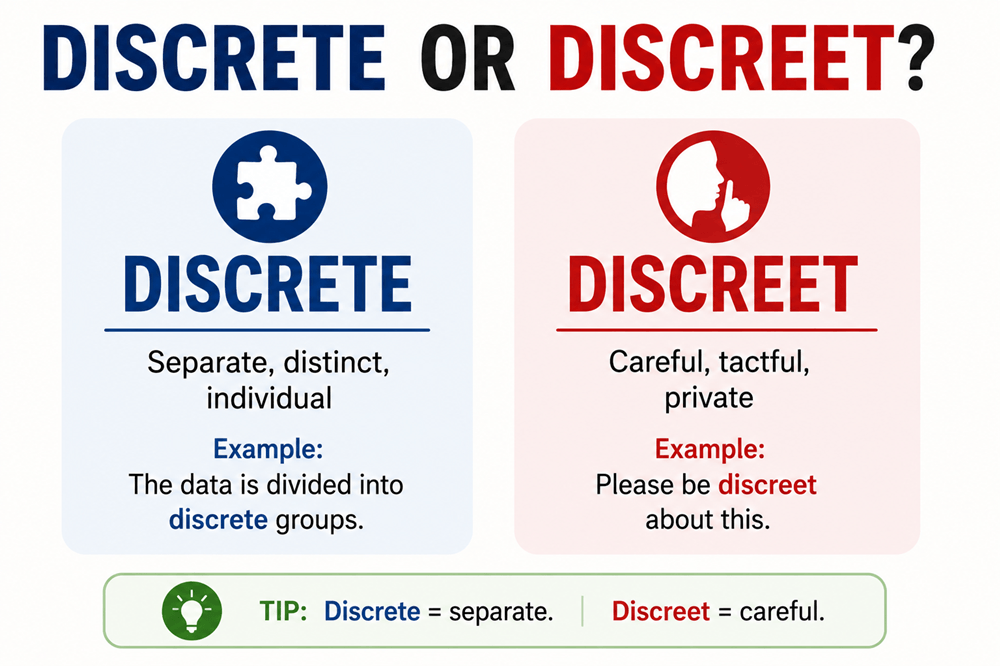
Discrete and discreet sound exactly the same, but they do not mean the same thing. Use discrete when you mean separate, distinct, or individually different. Use discreet when you mean careful, tactful, private, or not drawing attention. The easiest shortcut is this: discrete means separate, while discreet means careful.
Quick Answer
Use discrete when you are talking about things that are separate or distinct.
- Correct: The project has three discrete stages.
- Correct: The data was divided into discrete groups.
- Correct: Each department works as a discrete unit.
Use discreet when you are talking about privacy, tact, caution, or quiet behavior.
- Correct: Please be discreet about the surprise party.
- Correct: She gave him a discreet warning.
- Correct: The hotel offers discreet service for private guests.
The simple rule is this: discrete means separate. Discreet means careful or private.
Discrete or Discreet: What Is the Difference?
The difference between discrete and discreet is meaning. These words are homophones, which means they are pronounced the same way, but they have different spellings and definitions.
Discrete describes things that are separate from one another. If something can be counted, divided, grouped, or treated as an individual part, it may be described as discrete.
Discreet describes behavior that is careful, quiet, respectful, or private. A discreet person does not reveal secrets, attract unnecessary attention, or handle sensitive matters carelessly.
| Word | Meaning | Example |
|---|---|---|
| Discrete | Separate, distinct, individual | The system has several discrete parts. |
| Discreet | Careful, tactful, private | She was discreet about the conversation. |
Because the two words sound alike, the mistake is easy to make. But once you connect discrete with separation and discreet with careful behavior, the difference becomes much easier to remember.
What Does Discrete Mean?
Discrete means separate, distinct, or individually different. It is often used when something is divided into clear parts instead of blending together as one continuous thing.
For example, if a company has three separate divisions, you might call them discrete divisions. If a process has five clear steps, those steps can be described as discrete. If data is grouped into separate categories, those categories are discrete.
Examples:
- The course is divided into four discrete sections.
- Each problem should be treated as a discrete issue.
- The artist used discrete blocks of color.
- The report separates the results into discrete categories.
In each sentence, discrete points to separation. The sections, issues, blocks, or categories are not all blended together. They can be noticed or handled individually.
What Does Discreet Mean?
Discreet means careful, tactful, private, or intentionally not obvious. It often describes someone who handles sensitive information or delicate situations in a respectful way.
A discreet person does not gossip about private matters. A discreet warning is given quietly instead of publicly. A discreet design does not call too much attention to itself. A discreet conversation is kept private.
Examples:
- Please be discreet about what you heard.
- He made a discreet exit before the argument began.
- The assistant handled the matter in a discreet way.
- She gave a discreet nod from across the room.
In these sentences, discreet has to do with caution, privacy, and good judgment. It suggests that someone is being careful with attention, information, or behavior.
Why Discrete and Discreet Are So Easy to Confuse
Discrete and discreet are confusing because they sound the same and look very similar. Only the order of the final letters changes. That small spelling difference creates a completely different meaning.
Another reason they are confusing is that both words can appear in serious or professional writing. You might see discrete in science, math, technology, business, or research. You might see discreet in social situations, service descriptions, personal communication, or privacy-related writing.
For example:
- The scientist studied discrete variables.
- The lawyer gave discreet advice.
Both sentences sound formal. Both words look like they belong in careful writing. But they are not interchangeable.
When to Use Discrete
Use discrete when you mean separate or distinct. It is useful when describing parts, pieces, categories, stages, units, or values.
Examples:
- The machine is made from several discrete components.
- The teacher divided the lesson into discrete topics.
- The study looked at three discrete age groups.
- The software stores information in discrete files.
Discrete is especially common in math, statistics, science, and technical writing. In those contexts, it often means something can be counted separately rather than measured along a continuous scale.
For example, the number of students in a classroom is discrete because you can count individual students. Temperature, on the other hand, is often treated as continuous because it can change gradually across many possible values.
You do not need to be writing about math to use discrete, though. Any time you mean clearly separate, discrete may be the right word.
When to Use Discreet
Use discreet when you mean careful, private, tactful, subtle, or not attracting attention. This word is often used when the situation involves manners, secrecy, sensitivity, or personal judgment.
Examples:
- She asked a discreet question after the meeting.
- The staff was trained to be discreet with guest information.
- He sent a discreet message instead of speaking out loud.
- The logo was placed in a discreet corner of the page.
Discreet can describe people, actions, designs, services, warnings, looks, gestures, and conversations. It usually has a positive meaning. It suggests that someone knows how to handle something without being loud, rude, obvious, or careless.
If privacy or tact is involved, discreet is probably the word you want.
Common Mistakes With Discrete and Discreet
The most common mistake is writing discrete when you mean discreet. This can make a sentence confusing because “separate” does not always make sense where “careful” is needed.
Incorrect:
- Please be discrete about this news.
- He gave her a discrete warning.
- The company promised discrete customer service.
Correct:
- Please be discreet about this news.
- He gave her a discreet warning.
- The company promised discreet customer service.
Another common mistake is writing discreet when you mean discrete. This usually happens in technical or academic contexts.
Incorrect:
- The data was divided into discreet groups.
- The device has several discreet parts.
- The course includes six discreet lessons.
Correct:
- The data was divided into discrete groups.
- The device has several discrete parts.
- The course includes six discrete lessons.
In these examples, the groups, parts, and lessons are separate. They are not being tactful or private. That is why discrete is correct.
Discrete in Example Sentences
Here are more examples of discrete used correctly:
- The book is organized into discrete chapters.
- Each symptom was recorded as a discrete observation.
- The business operates through several discrete brands.
- The problem can be broken into discrete tasks.
- The design uses discrete panels instead of one large surface.
- The researchers measured several discrete outcomes.
In each sentence, discrete means separate, distinct, or individually identifiable.
Discreet in Example Sentences
Here are more examples of discreet used correctly:
- She was discreet when discussing the family matter.
- The waiter gave a discreet signal that the table was ready.
- He made a discreet apology after the meeting.
- The celebrity entered through a discreet side door.
- The message was written in a discreet tone.
- The nurse was discreet with the patient’s information.
In each sentence, discreet means careful, tactful, subtle, or private.
Discreetly or Discretely?
The same difference applies to discreetly and discretely.
Discreetly means carefully, privately, or without drawing attention.
- She discreetly left the room.
- He discreetly warned his friend.
- The issue was handled discreetly.
Discretely means separately or as distinct parts. It is much less common in everyday writing and appears more often in technical contexts.
- The values were measured discretely.
- The objects were stored discretely rather than blended together.
If you are talking about privacy or tact, use discreetly. If you are talking about separation, use discretely.
How to Remember Discrete or Discreet
A simple memory trick is to look at the letters near the end of each word.
Discrete has the two e letters separated by a t: discrete. That can remind you that discrete means separate.
Discreet keeps the two e letters together: discreet. You can imagine them quietly staying together and not drawing attention. That can remind you that discreet means tactful or private.
- Discrete = separate
- Discreet = careful
You can also remember this sentence:
Separate things are discrete; careful people are discreet.
That one line captures the main difference.
Final Answer
Discrete and discreet are both correct words, but they mean different things. Use discrete when something is separate, distinct, or divided into individual parts. Use discreet when someone or something is careful, tactful, private, or subtle.
The easiest rule is simple: discrete means separate, and discreet means careful. If you remember that difference, you can choose the right spelling every time.