Mangoes or Mangos: Correct Plural Spelling, Usage, and Examples for Clear Writing
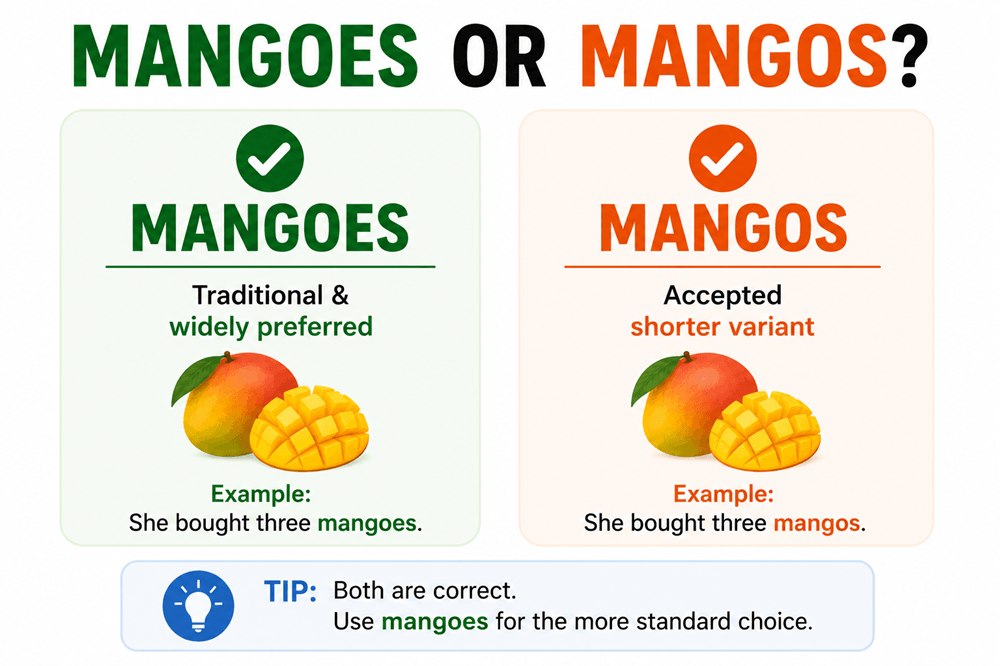
Mangoes and mangos are both used as the plural of mango, and both spellings are accepted. The more traditional and widely preferred spelling is mangoes. Mangos is a shorter variant that is also correct, especially in American English and food-related writing. If you want the safest choice for polished writing, use mangoes.
Quick Answer
Use mangoes when you want the more traditional and widely accepted plural of mango.
- Correct: She bought three mangoes at the market.
- Correct: The recipe calls for ripe mangoes.
- Correct: Mangoes are sweet, juicy, and fragrant.
Mangos is also an accepted plural spelling, but it is less traditional.
- Correct: She bought three mangos at the market.
- Correct: The recipe calls for ripe mangos.
The simple rule is this: mangoes is the safer standard choice, while mangos is an accepted shorter variant.
Mangoes or Mangos: What Is the Difference?
The difference between mangoes and mangos is spelling, not meaning. Both words refer to more than one mango. You can use either form, and readers will understand what you mean.
However, mangoes is often preferred in careful writing because many nouns ending in -o form their plural with -es. That pattern appears in words like tomato and potato, which become tomatoes and potatoes.
Mangos follows the simpler plural pattern of adding only -s. This spelling is common enough that it is accepted, especially in casual, commercial, and food-related contexts.
| Word | Status | Example |
|---|---|---|
| Mangoes | Traditional and widely preferred plural | The basket was full of mangoes. |
| Mangos | Accepted shorter variant | The basket was full of mangos. |
If you are writing for school, a website, a recipe, or a polished article, mangoes is usually the better choice.
What Does Mangoes Mean?
Mangoes is the plural form of mango. It means more than one mango.
Examples:
- The mangoes were perfectly ripe.
- He sliced two mangoes for breakfast.
- The grocery store had mangoes on sale.
- Fresh mangoes make the smoothie taste sweeter.
In each sentence, mangoes refers to multiple pieces of fruit. The spelling with -es looks natural to many readers because it follows a familiar English plural pattern.
You may also see mangoes in broader descriptions of fruit, farming, cooking, nutrition, and grocery shopping.
- Mangoes grow in warm climates.
- Some mangoes are sweeter than others.
- Green mangoes are often used in salads and pickles.
- Ripe mangoes have a soft texture and rich aroma.
This is the spelling most people expect in standard writing.
What Does Mangos Mean?
Mangos also means more than one mango. It is a shorter plural form, made by adding only -s to mango.
Examples:
- The store sells fresh mangos every summer.
- She packed two mangos in her lunch bag.
- These mangos are not ripe yet.
- The chef used mangos in the salsa.
These sentences are not wrong. Mangos is an accepted spelling, and it appears often enough that it should not be treated as a simple misspelling.
Still, mangos may look less traditional to some readers. In formal writing, educational content, or a grammar-focused article, mangoes usually feels more polished.
Why Mangoes Is Often Preferred
Mangoes is often preferred because English has a long-standing habit of adding -es to some nouns ending in -o. That is why many people naturally expect mango to become mangoes.
Examples of similar plurals include:
- tomato → tomatoes
- potato → potatoes
- hero → heroes
- echo → echoes
Because mango looks similar to those words, mangoes feels natural. It also has a familiar rhythm in writing. A phrase like “ripe mangoes” may look more traditional than “ripe mangos.”
This does not mean mangos is automatically wrong. It simply means mangoes is the form that many editors, teachers, and careful writers are more likely to prefer.
Why Mangos Is Also Accepted
Mangos is accepted because not all nouns ending in -o take -es. Many form the plural by adding only -s.
Examples include:
- piano → pianos
- photo → photos
- radio → radios
- studio → studios
Because English has both patterns, some nouns can have more than one accepted plural. Mango is one of those words. You may see both mangoes and mangos, especially in food labels, menus, recipes, supermarket signs, and casual writing.
For example, a juice brand might write “made with fresh mangos,” while a cookbook might write “choose ripe mangoes.” Both are understandable. The choice usually depends on style, audience, and preference.
When to Use Mangoes
Use mangoes when you want the more standard-looking plural. It is a good choice for school writing, articles, recipes, food blogs, formal descriptions, and general English usage.
Examples:
- The mangoes were soft enough to slice easily.
- She added mangoes to the fruit salad.
- Fresh mangoes are often used in smoothies.
- The farmer harvested hundreds of mangoes.
- Mangoes can be eaten fresh, dried, blended, or cooked.
This spelling is especially useful when you want to avoid distracting the reader. Since mangoes is widely recognized as the traditional plural, it is usually the safest option.
When to Use Mangos
Use mangos if you prefer the shorter accepted spelling or if you are following a style that uses simpler plural forms for words ending in -o. It can work in casual writing, menus, product descriptions, and everyday communication.
Examples:
- The smoothie contains bananas, pineapples, and mangos.
- These mangos are sweet and juicy.
- The market sells mangos by the box.
- Frozen mangos are useful for quick desserts.
Mangos is clear and accepted, but it may not be the best choice if the article is specifically teaching spelling. In that case, using mangoes as the preferred form helps readers follow the more traditional standard.
Common Mistakes With Mangoes and Mangos
The main mistake is thinking that one spelling is always wrong. Unlike pairs such as vendor and vender, this pair is not a simple correct-versus-incorrect situation. Mangoes and mangos are both acceptable plurals.
However, another mistake is switching between both spellings in the same article. For example:
- The store sells mangoes in summer. These mangos are imported from Mexico.
This is not grammatically confusing, but it looks inconsistent. A cleaner version would choose one spelling and use it throughout:
- The store sells mangoes in summer. These mangoes are imported from Mexico.
Or:
- The store sells mangos in summer. These mangos are imported from Mexico.
For most polished writing, consistency matters more than the small spelling preference.
Mangoes in Example Sentences
Here are more examples using the preferred spelling mangoes:
- The mangoes smelled sweet before they were even cut.
- She bought mangoes, peaches, and strawberries for dessert.
- The children ate the mangoes with sticky fingers.
- Ripe mangoes should give slightly when pressed.
- The recipe works best with fresh mangoes.
- The tree produced more mangoes than expected this year.
These examples all use mangoes naturally as the plural of mango.
Mangos in Example Sentences
Here are examples using the accepted variant mangos:
- The fruit stand had mangos near the entrance.
- She blended frozen mangos with yogurt.
- The box of mangos arrived early in the morning.
- Some mangos are yellow, while others have red or green skin.
- The salsa included chopped mangos and peppers.
- They packed mangos for the picnic.
These sentences are also correct. The spelling simply looks a little shorter and less traditional.
Mangoes vs Mangos in American English
In American English, both mangoes and mangos are used. Mangoes is still often the more familiar spelling in edited writing, but mangos appears commonly in food marketing, grocery labels, recipes, and casual writing.
If you are writing for a general American audience, either spelling can work. Still, if the goal is to teach clear spelling or avoid debate, mangoes is the better default.
For example:
- Best for polished writing: The recipe needs two ripe mangoes.
- Also acceptable: The recipe needs two ripe mangos.
The meaning is identical. The difference is style.
How to Remember Mangoes or Mangos
A simple way to remember the choice is this:
- Mangoes = traditional and widely preferred
- Mangos = accepted shorter variant
You can also compare mangoes with tomatoes and potatoes. Since those words add -es, the spelling mangoes may be easier to remember.
Try this sentence:
Tomatoes, potatoes, and mangoes all look natural with -es.
That memory trick is not a perfect rule for every -o word, but it works well for remembering the preferred spelling of mangoes.
Final Answer
Mangoes and mangos are both correct plural forms of mango. The spelling mangoes is more traditional and usually preferred in polished writing, while mangos is an accepted shorter variant.
If you want the safest choice for a website, school assignment, article, or formal piece of writing, use mangoes. If you use mangos, stay consistent and use that spelling throughout the same piece.