Neither or Either: Correct Meaning, Difference, Usage, and Examples for Clear Writing
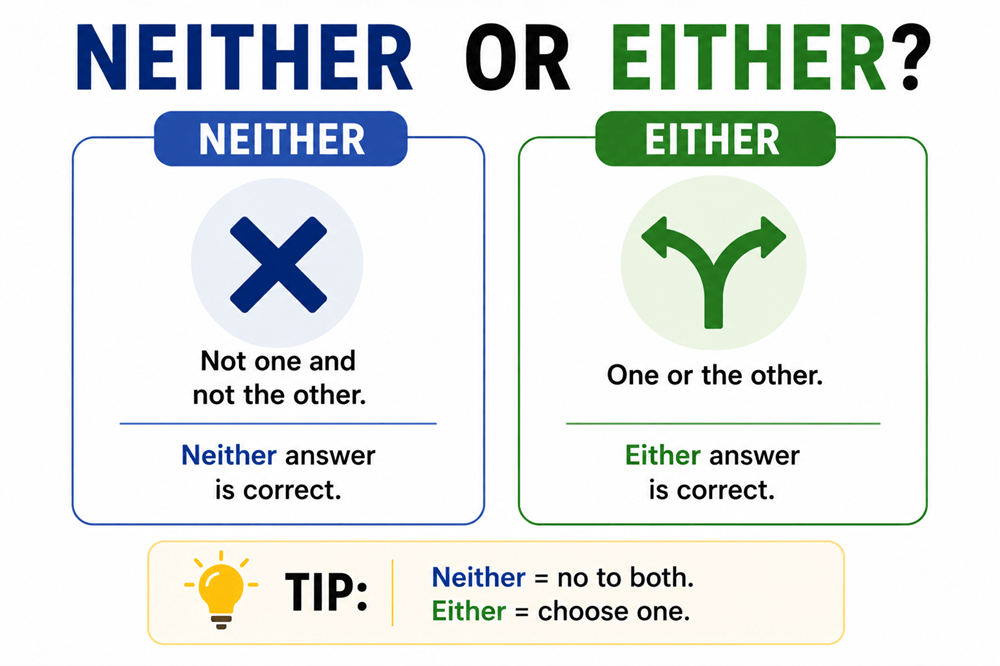
Neither and either are both used when you are talking about two choices, but they do not mean the same thing. Use neither when you mean “not one and not the other.” Use either when you mean “one or the other,” “any one of two,” or sometimes “also” in a negative sentence. The easiest rule is this: neither is negative, while either gives a choice.
Quick Answer
Use neither when both options are rejected, excluded, or not true.
- Correct: Neither answer is correct.
- Correct: Neither of the restaurants is open.
- Correct: She likes neither coffee nor tea.
Use either when one of two options is possible, acceptable, or being offered.
- Correct: Either answer could be correct.
- Correct: You can choose either restaurant.
- Correct: She can have either coffee or tea.
The simple rule is this: neither means not either one. Either means one or the other.
Neither or Either: What Is the Difference?
The difference between neither and either is mainly about negativity and choice. Neither is negative. It means that both of two options are not true, not chosen, not available, or not included. When you use neither, you are saying no to both options.
Either is usually about choice. It means one of two options, any one of two options, or sometimes both possibilities considered separately. When you use either, you are usually saying that at least one option is possible.
| Word | Main Meaning | Example |
|---|---|---|
| Neither | Not one and not the other | Neither shirt fits. |
| Either | One or the other | Either shirt is fine. |
Here is the difference in one simple comparison:
- Neither option works. This means both options fail.
- Either option works. This means both options are acceptable, and you can choose one.
If the sentence means “not this one and not that one,” use neither. If the sentence means “this one or that one,” use either.
What Does Neither Mean?
Neither means not one and not the other. It is used when you are talking about two people, two things, two ideas, or two options, and both are rejected or untrue.
Examples:
- Neither dress looked right for the event.
- Neither student knew the answer.
- Neither road leads to the beach.
- Neither plan solved the problem.
In each sentence, both choices are ruled out. The two dresses did not look right. The two students did not know the answer. The two roads do not lead to the beach. The two plans did not solve the problem.
Neither often appears with nor. This pair creates a balanced negative structure.
- Neither the manager nor the assistant was available.
- She wanted neither praise nor attention.
- Neither rain nor snow stopped the delivery.
In these examples, neither…nor means both listed options are excluded.
What Does Either Mean?
Either usually means one or the other of two options. It can show that one choice is possible, that both options are acceptable, or that a sentence applies to both choices separately.
Examples:
- You can sit on either side of the table.
- Either answer will be accepted.
- We can leave on either Monday or Tuesday.
- Either path will take you to the garden.
In these sentences, either gives a choice. One side of the table or the other is fine. One answer or the other will be accepted. Monday or Tuesday works.
Either can also appear in negative sentences to mean “also.”
- I do not like mushrooms either.
- She was not ready either.
- They did not call either.
In this use, either does not mean “one or the other.” It means the negative statement is also true for another person, thing, or situation.
When to Use Neither
Use neither when you are rejecting two options or saying that both are not true.
Examples:
- Neither candidate answered the question clearly.
- Neither movie was as good as the trailer made it seem.
- Neither of the keys opened the door.
- Neither explanation made sense.
You can often test neither by replacing it with not either one.
- Neither answer is right.
- Not either one of the answers is right.
The second version sounds awkward, but the meaning is the same. Both answers are wrong, so neither is correct.
Use neither when the sentence already has a negative meaning. Be careful not to create a double negative by adding another negative word unnecessarily.
- Correct: Neither answer is correct.
- Incorrect: Neither answer is not correct.
Since neither already means “not either,” you usually do not need another not.
When to Use Either
Use either when you are choosing between two options or saying that one of two options is possible.
Examples:
- You may choose either dessert.
- Either jacket will keep you warm.
- The meeting can happen on either day.
- Either answer might be accepted, depending on the teacher.
Use either with or when you want to connect two choices.
- You can have either soup or salad.
- Either call me tonight or send me an email tomorrow.
- The package will arrive either today or tomorrow.
Either…or means one option or the other. Sometimes both may be possible in casual use, but the basic idea is a choice between two things.
Use either at the end of a negative sentence when you mean “also not.”
- I do not want to go either.
- She cannot drive either.
- The second option does not work either.
In these examples, either adds another negative case.
Neither Nor or Either Or?
Use neither…nor when both options are negative.
- Neither the red shirt nor the blue shirt fits.
- She speaks neither French nor German.
- Neither the laptop nor the tablet was charged.
Use either…or when you are choosing between two options.
- You can wear either the red shirt or the blue shirt.
- She can study either French or German.
- Either the laptop or the tablet will work.
The pairings matter. Neither normally goes with nor. Either normally goes with or.
| Pair | Meaning | Example |
|---|---|---|
| Neither…nor | Not this and not that | Neither tea nor coffee is available. |
| Either…or | This or that | Either tea or coffee is available. |
If your sentence has a negative meaning, choose neither…nor. If your sentence offers a choice, choose either…or.
Neither Is or Neither Are?
Neither is often treated as singular when it means “not either one.” That means neither is is usually the safer choice in formal writing.
- Correct: Neither answer is correct.
- Correct: Neither of the boys is ready.
- Correct: Neither option is perfect.
However, neither are is also common in everyday speech, especially when the sentence refers to two plural things.
- Common in speech: Neither of the boys are ready.
- More formal: Neither of the boys is ready.
For polished writing, neither is is usually safer. If the sentence sounds too stiff, you can often rewrite it.
- Formal: Neither of the boys is ready.
- Smoother: Both boys are not ready.
- Smoother: The boys are not ready.
Either Is or Either Are?
Either is also usually singular when it means “one or the other.” That means either is is usually the standard choice.
- Correct: Either answer is acceptable.
- Correct: Either of the rooms is available.
- Correct: Either choice is fine.
In casual speech, you may hear plural verbs after either of when the noun is plural, but in careful writing, the singular verb is often preferred.
- Casual: Either of the rooms are available.
- More formal: Either of the rooms is available.
For WordBriefs-style clarity, the best general rule is this: use is after either and neither when you are talking about one of two options.
Me Neither or Me Either?
The common phrase is me neither when you are agreeing with a negative statement.
- Person A: I do not like cold coffee.
- Person B: Me neither.
This means “I do not like cold coffee either.”
Me either is also used in casual American speech, but me neither is more widely accepted and usually sounds better in standard writing.
- Casual: Me either.
- More standard: Me neither.
In formal writing, you may want to avoid both and use a complete sentence instead.
- Casual: Me neither.
- More formal: I do not either.
- Also natural: I do not like it either.
Neither Do I or Either Do I?
The correct phrase is usually neither do I when you are agreeing with a negative statement.
- She does not like horror movies. Neither do I.
- He cannot attend the meeting. Neither can I.
- They were not ready. Neither were we.
You can also use I do not either.
- She does not like horror movies. I do not either.
Do not say either do I in standard English.
- Incorrect: She does not like horror movies. Either do I.
- Correct: She does not like horror movies. Neither do I.
- Correct: She does not like horror movies. I do not either.
Neither works at the beginning of the response. Either usually works at the end of the negative sentence.
Neither of Us or Either of Us?
Use neither of us when both people are not included, not doing something, or not true.
- Neither of us knows the answer.
- Neither of us wanted to leave early.
- Neither of us has seen that movie.
Use either of us when one of the two people could be included or chosen.
- Either of us can drive.
- You can call either of us for help.
- Either of us would be happy to answer questions.
The difference is simple: neither of us means not you and not the other person. Either of us means one of the two people.
Common Mistakes With Neither and Either
The most common mistake is using neither with another negative word.
Incorrect:
- Neither answer is not correct.
- She does not like neither option.
- We did not choose neither plan.
Correct:
- Neither answer is correct.
- She does not like either option.
- We did not choose either plan.
Another common mistake is using either when the meaning is clearly negative for both choices.
Incorrect:
- Either answer is correct.
This sentence means one or both answers may be acceptable. If you mean both answers are wrong, write:
- Neither answer is correct.
A third mistake is mixing neither with or or either with nor.
Incorrect:
- Neither tea or coffee is available.
- Either tea nor coffee is available.
Correct:
- Neither tea nor coffee is available.
- Either tea or coffee is available.
Examples of Neither in Sentences
Here are examples of neither used correctly:
- Neither answer matched the question.
- Neither of the windows would open.
- Neither child wanted to go to bed.
- Neither plan seemed realistic.
- She chose neither the red dress nor the black dress.
- Neither the teacher nor the principal was available.
- Neither option gives you enough time.
- Neither of us expected the meeting to last so long.
In each sentence, neither has a negative meaning. Both options are rejected, unavailable, untrue, or not chosen.
Examples of Either in Sentences
Here are examples of either used correctly:
- Either answer could be right.
- You may sit on either side.
- Either of the dates works for me.
- We can take either bus to the station.
- She can order either pasta or soup.
- The package will arrive either today or tomorrow.
- I do not want dessert either.
- The second explanation does not make sense either.
In most of these sentences, either gives a choice. In the final two examples, either appears in a negative sentence and means “also not.”
How to Remember Neither or Either
A simple way to remember the difference is this:
- Neither = not either one
- Either = one or the other
You can also remember these pairs:
- Neither…nor = no to both
- Either…or = choose one
Try this quick test:
- If the sentence means “not this and not that,” use neither.
- If the sentence means “this or that,” use either.
Examples:
- Neither shirt fits. That means not this shirt and not that shirt.
- Either shirt fits. That means this shirt or that shirt will work.
That contrast captures the main difference.
Final Answer
Neither and either are both correct words, but they are used differently. Use neither when both of two options are not true, not chosen, not available, or not included. Use either when one of two options is possible, acceptable, or being offered.
The easiest rule is simple: neither means not either one, while either means one or the other. Use neither…nor for two negative choices and either…or for two possible choices.