Purposely or Purposefully: Difference, Correct Usage, Meaning, Examples, and Memory Tips Explained
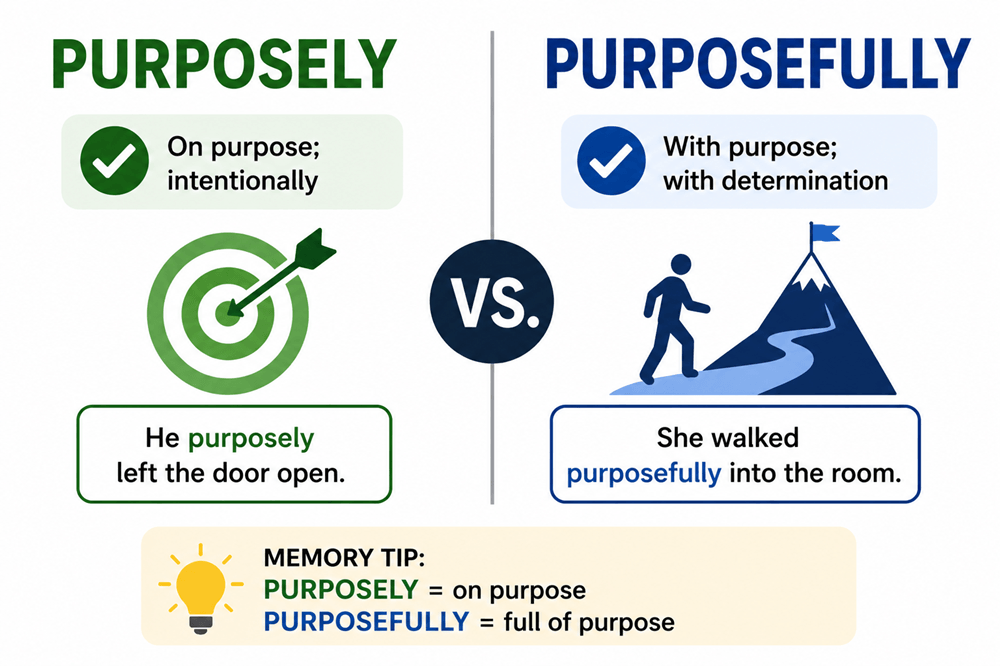
Purposely and purposefully are both correct words, but they do not always mean exactly the same thing. Purposely usually means intentionally or on purpose. Purposefully means with purpose, determination, or clear intention. The difference is small, but it matters in careful writing.
Quick Answer
Use purposely when you mean someone did something intentionally.
- She purposely ignored the message.
- He purposely left the door open.
- The child purposely hid the toy.
Use purposefully when you mean someone acted with determination, direction, or a clear goal.
- She walked purposefully into the room.
- He spoke purposefully during the meeting.
- They worked purposefully toward their goal.
The simple rule is: purposely means on purpose, while purposefully means with purpose.
Purposely or Purposefully: What Is the Difference?
The difference between purposely and purposefully is mostly about tone and emphasis. Purposely focuses on intention. It answers the question: Was it done on purpose?
Purposefully focuses on manner. It answers the question: Was it done with purpose, confidence, or direction?
| Word | Main Meaning | Example |
|---|---|---|
| Purposely | Intentionally; on purpose | He purposely broke the rule. |
| Purposefully | With purpose or determination | He walked purposefully to the stage. |
If someone meant to do something, use purposely. If someone did something in a focused, determined, or goal-driven way, use purposefully.
What Does Purposely Mean?
Purposely means intentionally, deliberately, or on purpose. It shows that an action was not an accident.
Examples:
- She purposely spilled the water.
- He purposely arrived late.
- The player purposely kicked the ball out of bounds.
- Someone purposely deleted the file.
- The dog purposely avoided the muddy path.
In each example, the action was done intentionally. The person or subject meant to do it. That is the key idea behind purposely.
A useful test is to replace purposely with on purpose. If the sentence still makes sense, purposely is probably correct.
- She purposely ignored him.
- She ignored him on purpose.
Both sentences mean the same thing.
What Does Purposefully Mean?
Purposefully means in a purposeful way. It suggests direction, focus, confidence, or determination. The action is not random or careless; it is guided by a clear aim.
Examples:
- She moved purposefully through the crowd.
- He answered the question purposefully.
- The team worked purposefully toward a solution.
- The speaker paused, then continued purposefully.
- They built the program purposefully over several years.
In these examples, purposefully does not simply mean “not by accident.” It adds the idea of control, intention, and direction.
A useful test is to replace purposefully with with purpose. If the sentence still sounds natural, purposefully is probably the right word.
- She walked purposefully into the room.
- She walked with purpose into the room.
Both sentences suggest confidence and direction.
Spelling Structure: Why Purposefully Has “Full” Inside It
Purposefully is longer because it is built from purposeful plus -ly.
- purpose + ful = purposeful
- purposeful + ly = purposefully
This structure helps explain the meaning. Purposeful means full of purpose. When you add -ly, it becomes an adverb meaning in a purposeful way.
Think of the spelling like this:
- purposefully = full of purpose + ly
That makes purposefully the better word when the sentence describes someone acting with focus, direction, or determination.
Spelling Structure: Why Purposely Is Shorter
Purposely is shorter and more direct. It comes from purpose plus -ly, but the final e drops before the ending.
- purpose + ly = purposely
The spelling may look a little surprising because it is not purposelye or purposeley. The correct form is:
- purposely
A simple way to remember it is that purposely is the shorter word for the simpler idea: on purpose.
When to Use Purposely
Use purposely when the main point is that something was done intentionally, not accidentally.
- He purposely gave the wrong answer.
- She purposely left her name off the list.
- The child purposely made a mess.
- They purposely avoided the topic.
- Someone purposely moved my chair.
Purposely often appears in situations involving blame, choice, mistakes, behavior, or responsibility. It can sound slightly negative because many intentional actions are harmful, rude, or suspicious. However, it is not always negative.
- She purposely chose a quiet table so they could talk.
- He purposely saved the best part for last.
When to Use Purposefully
Use purposefully when describing the manner of an action. It often suggests confidence, intention, planning, or a clear goal.
- She walked purposefully toward the office.
- He spoke slowly and purposefully.
- The group worked purposefully to finish the project.
- The coach planned each practice purposefully.
- They purposefully designed the room to feel calm.
Purposefully often has a more positive or neutral tone than purposely. It can make someone sound focused rather than merely intentional.
Common Mistakes
A common mistake is using purposefully when the sentence only means on purpose.
Less clear:
- He purposefully broke the cup.
Clearer:
- He purposely broke the cup.
Another mistake is using purposely when the sentence describes determined movement or focused action.
Less natural:
- She walked purposely to the front of the room.
Better:
- She walked purposefully to the front of the room.
The first sentence suggests she intentionally walked there. The second suggests she walked there with confidence and direction.
Purposely vs Purposefully in One Example
Compare these two sentences:
- She purposely closed the door.
- She purposefully closed the door.
The first sentence means she closed the door intentionally. Maybe someone thinks it was an accident, and the sentence explains that it was not.
The second sentence means she closed the door in a deliberate, meaningful, or determined way. The action may feel controlled or significant.
That is the practical difference: purposely tells you the action was intentional; purposefully tells you the action had a sense of purpose.
How to Remember the Difference
Use these memory tips:
- Purposely = on purpose.
- Purposefully = full of purpose.
- Purposely is shorter, so use it for the simple idea of intention.
- Purposefully contains ful, like full, so use it when the action feels full of purpose.
A simple memory sentence is: If it was done on purpose, it was done purposely. If it was done with purpose, it was done purposefully.
Final Answer
Purposely means intentionally or on purpose. Use it when the point is that something was not accidental.
Purposefully means with purpose, focus, or determination. Use it when describing how someone acts or moves toward a goal.
To remember the difference, connect purposely with on purpose and purposefully with full of purpose.