Momma or Mama: Which Spelling Fits Best in Everyday Family Writing Today?
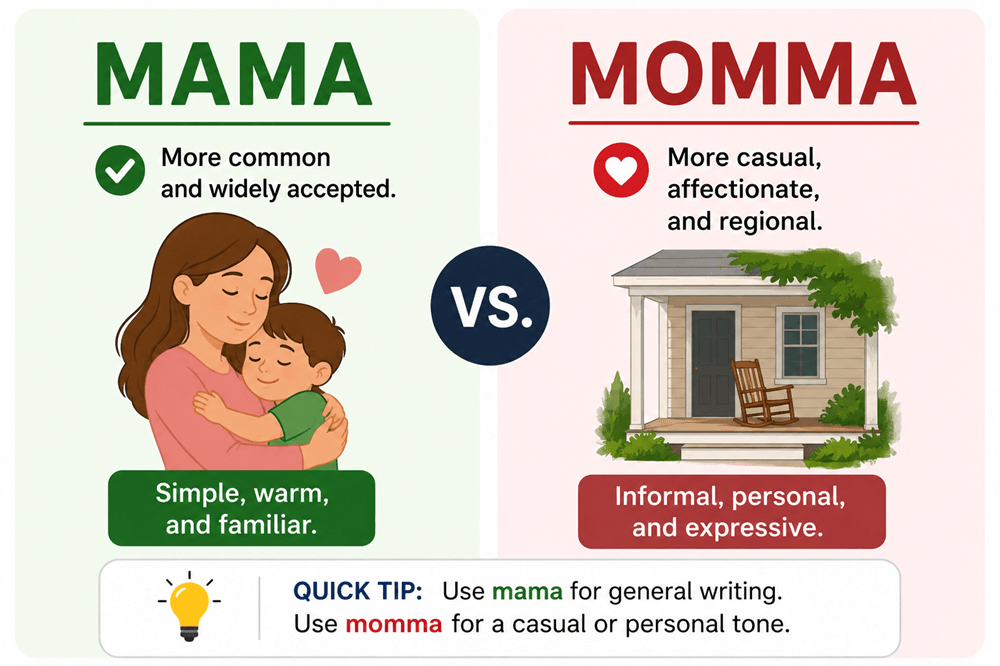
If you are choosing between momma or mama, both spellings can be correct, but they do not always feel the same. Mama is the more common and widely accepted spelling for an affectionate word meaning mother. Momma is also used, especially in casual American English, but it often feels more informal, regional, or emotionally expressive.
Momma or Mama: What Is the Difference?
Mama and momma both refer to a mother. They are warm, familiar, affectionate words, often used by children, family members, or adults speaking with tenderness. The difference is mainly about spelling style, sound, region, and tone.
Mama is the simpler and more standard spelling. It is widely recognized in English and many other languages. If you want the safest, cleanest spelling for general writing, mama is usually the better choice.
Momma is a more casual variant. It often reflects a pronunciation closer to mom-uh. You may see it in personal stories, dialogue, song lyrics, captions, Southern American speech, affectionate family writing, or emotional scenes.
For example:
Mama always knew how to make the house feel safe.
This sounds simple, warm, and familiar.
Momma told you not to worry.
This sounds more conversational, intimate, and possibly regional.
When to Use Mama
Use mama when you want the most common and broadly accepted spelling. It works well in everyday writing, family stories, children’s dialogue, cards, captions, blog posts, personal essays, and emotional writing.
For example:
The baby reached for mama.
Mama packed lunch before the long drive.
You still remember the way mama laughed in the kitchen.
She became a mama before she felt ready.
In these examples, mama feels natural and easy to understand. It does not call attention to itself. That makes it a reliable choice when you want the word to feel affectionate without seeming too stylized.
Mama can also be used as a direct name. When it replaces a person’s name, it is often capitalized.
For example:
Can you help me, Mama?
Here, Mama works like a name, so the capital letter makes sense.
If you are speaking about a mother generally, lowercase is usually better:
Every mama needs rest sometimes.
When to Use Momma
Use momma when you want a more casual, affectionate, or speech-like tone. It can feel warmer, softer, and more personal in certain contexts. It is especially common when a writer wants to capture a particular voice.
For example:
Momma said there would be days like this.
That little girl ran straight to her momma.
You could hear Momma singing from the porch.
He called his momma every Sunday evening.
Momma often feels less formal than mama. It can suggest closeness, childhood memory, Southern or rural speech, family storytelling, or a deep emotional bond. That does not make it wrong. It simply means it carries a stronger style.
If you are writing dialogue, momma may be perfect when it matches how a character speaks. If you are writing a clean explanation, article, greeting, or general sentence, mama may look more standard.
Is Momma a Real Word?
Yes, momma is a real word. It is an informal spelling for mother, similar in meaning to mama or mom. You do not need to treat it as a misspelling in every situation.
The important point is tone. Momma is not usually the most formal choice. It fits casual, emotional, familiar, or character-driven writing. If your sentence needs a polished, neutral spelling, mama is usually safer.
Think of it this way:
Mama is simple and widely accepted.
Momma is informal and expressive.
Both can be correct, but one may fit your sentence better than the other.
Why the Spellings Are Easy to Confuse
The confusion comes from sound. When people say mama, the vowel sound can vary depending on accent, region, age, and family habit. Some people say it closer to mah-mah. Others say it closer to mom-uh. Because pronunciation changes, spelling choices change too.
Mama looks simple because it uses repeated syllables: ma-ma. This is one reason it feels natural as an early childhood word. It is short, soft, and easy to say.
Momma looks closer to mom. If you already use mom instead of mum or mother, then momma may feel more natural. It keeps the mom spelling and adds a soft ending.
That gives you two different spelling instincts:
mama feels like ma-ma.
momma feels like mom-ma.
Neither instinct is strange. The best choice depends on the voice you want.
A Simple Way to Remember Mama
To remember mama, look at the repeated pattern:
ma + ma = mama
This spelling is short, balanced, and easy. If you want the most common affectionate word for mother, choose mama.
You can remember it with this phrase:
Mama is the simple spelling.
That memory trick works because mama has no extra letters. It is clean and direct. When you are unsure which spelling looks better in general writing, mama is usually the safest answer.
A Simple Way to Remember Momma
To remember momma, connect it with mom.
mom + ma = momma
This spelling keeps mom at the beginning. That can help you remember why it feels more American, casual, and speech-like.
You can use this memory trick:
Momma sounds like mom speaking softly.
That phrase captures the tone of the word. Momma often belongs in emotional dialogue, family memories, or informal storytelling.
Momma vs Mama in Example Sentences
Both spellings can work, but the tone changes slightly.
Mama made breakfast before sunrise.
This feels simple, warm, and natural.
Momma made breakfast before sunrise.
This feels more personal, conversational, or regional.
The baby wanted mama.
This sounds like a common, general sentence.
The baby wanted momma.
This sounds a little more informal or voice-driven.
Mama, can you read this story?
This is a clean direct address.
Momma, can you read this story?
This feels more tender, casual, or character-specific.
The meaning is nearly the same. The feeling is the difference.
What About Mom, Mommy, and Mother?
Mom, mommy, mama, momma, and mother all refer to the same family role, but they carry different tones.
Mother is the most formal.
Mom is common and casual.
Mommy sounds childlike or very affectionate.
Mama sounds warm, simple, and familiar.
Momma sounds informal, emotional, regional, or speech-like.
If you are writing a formal sentence, use mother. If you are writing naturally in American English, mom often works. If you want tenderness, mama or momma may fit better.
How to Choose the Right Spelling
Before choosing between momma and mama, ask what kind of voice you want.
If you want the simpler, more widely accepted spelling, use mama.
If you want a more casual, emotional, or regional feeling, use momma.
If you are writing for a broad audience, mama is usually safer. If you are writing dialogue or personal memory, momma may sound more natural depending on the speaker.
You can also choose based on pronunciation. If the word sounds like mah-mah in your sentence, mama fits well. If it sounds like mom-uh, momma may better match the voice.
The Final Answer on Momma or Mama
Mama and momma are both used for mother, but mama is the more common and standard spelling. It is the best choice for most general writing. Momma is also acceptable, especially in casual writing, dialogue, family storytelling, and regional speech.
To remember the difference, think of mama as the simple spelling: ma + ma. Think of momma as the informal spelling that keeps mom inside it.
So when you want a clean, widely understood word, choose mama. When you want a softer, more personal, speech-like feeling, momma can work beautifully.