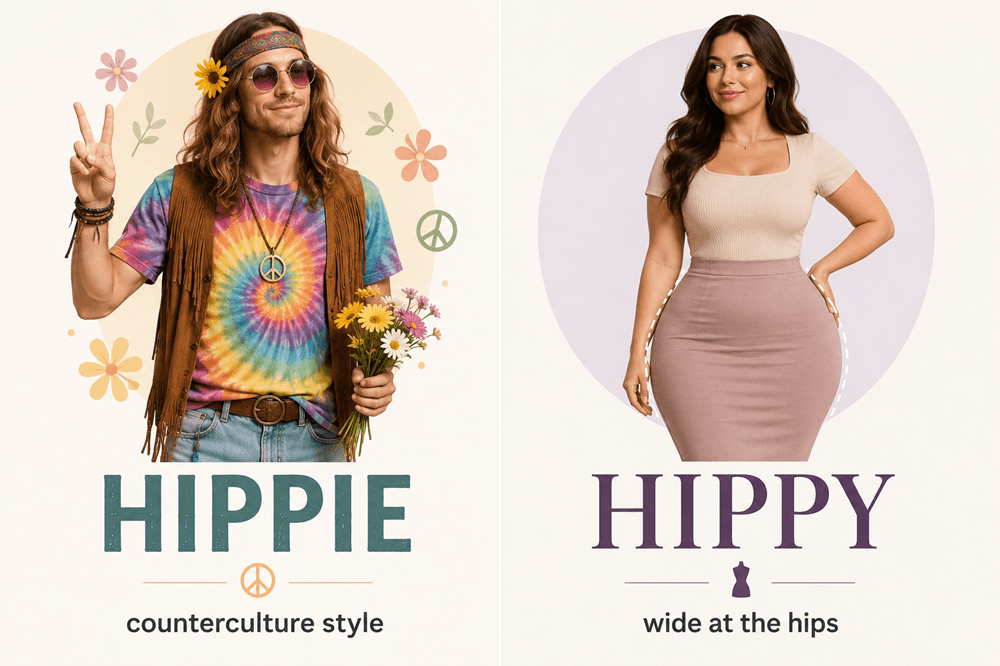
Hippy or Hippie: Which Spelling Is Correct?
Hippie is the more common and standard spelling when you mean a person connected with the 1960s counterculture, peace movement, free-spirited lifestyle, or bohemian style.
Hippy can also appear as a variant spelling, but it is less common for this meaning. It can also mean having large or noticeable hips, which makes it more confusing.
Examples:
- She wore a hippie dress with flowers and beads.
- The festival had a relaxed hippie atmosphere.
- He was part of the hippie movement in the 1960s.
- That skirt has a slightly hippy shape around the waist.
If you are talking about peace signs, flower crowns, tie-dye, counterculture, or free-spirited style, the safer spelling is hippie.
Quick Answer
Use hippie for the person, style, or cultural movement.
Use hippy only if you mean shaped around the hips, or if you are using a less common variant spelling.
Best choice:
- She has a hippie style.
Less common:
- She has a hippy style.
Different meaning:
- The dress looked a little hippy around the sides.
For most modern writing, choose hippie.
What Does Hippie Mean?
A hippie is a person associated with a free-spirited, anti-establishment, peace-loving, or bohemian lifestyle, especially connected with the 1960s and 1970s counterculture.
Common ideas connected with hippies include:
- peace signs
- tie-dye clothing
- long hair
- flower power
- folk music
- communal living
- anti-war protests
- natural living
- spiritual exploration
- bohemian fashion
Examples:
- The old photo showed a group of hippies at a music festival.
- She decorated her room with hippie posters and tapestries.
- His parents were part of the hippie generation.
- The shop sells hippie jewelry, incense, and handmade clothes.
Today, hippie can also describe a style rather than a literal member of the 1960s movement.
Example:
- She wore a hippie-inspired outfit with a long skirt and layered necklaces.
What Does Hippy Mean?
Hippy has two possible uses.
First, it can be a less common spelling of hippie.
Example:
- He wore a hippy shirt and sandals.
Many readers will understand this, but hippie is usually preferred.
Second, hippy can mean having large hips or being wide around the hips.
Examples:
- The coat looked hippy because of the cut.
- She avoided that dress because it made her look hippy.
- The skirt had a hippy silhouette.
This meaning is unrelated to the hippie movement. It comes from the body part hip.
Because hippy can mean “wide at the hips,” it can create confusion if you use it when you mean hippie.
Hippie vs Hippy: The Main Difference
The main difference is usage and meaning:
Hippie = standard spelling for a free-spirited person, movement, or style
Hippy = less common variant, or an adjective meaning wide around the hips
Compare:
- She wore a hippie necklace.
- The pants looked hippy at the sides.
The first sentence is about style or culture.
The second sentence is about body shape or clothing fit.
If your meaning is cultural, use hippie.
If your meaning is about hips, hippy may be correct.
Why Is Hippie the Better Spelling?
Hippie is the spelling most readers expect when talking about the counterculture movement.
It looks natural in phrases like:
- hippie movement
- hippie culture
- hippie style
- hippie music
- hippie festival
- hippie fashion
- modern hippie
The spelling hippie also avoids confusion with hippy, the adjective related to hips.
So if you are writing an article, caption, product description, fashion post, or historical explanation, hippie is usually the cleaner choice.
Is Hippy Wrong?
Hippy is not always wrong.
It can be used as a variant spelling of hippie, and some people may write it that way. However, it is less common and can look less standard.
It is also correct when it means related to hips.
Examples:
- The design was slightly hippy.
- The dress looked hippy in the wrong place.
But if you mean the person or cultural style, hippie is better.
Better:
- She loves hippie fashion.
Less preferred:
- She loves hippy fashion.
Hippies or Hippys?
The plural of hippie is hippies.
Correct:
- Many hippies gathered at the festival.
- The documentary interviewed former hippies.
- The town became popular with artists and hippies.
Do not write:
- hippys
Because hippie ends in -ie, the plural becomes -ies:
hippie → hippies
If someone uses hippy as a noun, the plural would technically be hippies too, but again, hippie is the better base spelling for the cultural meaning.
Hippie Style or Hippy Style?
Use hippie style.
Examples:
- She wore a hippie style dress.
- The room had a warm hippie style with plants and tapestries.
- His look was casual, colorful, and hippie-inspired.
The phrase hippy style is understandable, but it may look less polished. It may also make some readers think of hips instead of the cultural style.
For fashion, decor, lifestyle, and historical writing, use hippie.
How to Remember the Difference
A simple memory trick:
Hippie ends in -ie, like tie-dye.
Tie-dye is strongly connected with hippie style, so the -ie ending can remind you of the correct spelling.
Think:
hippie = tie-dye
Another trick:
Hippy has “hip” in it.
That can remind you of the body-shape meaning:
hippy = about hips
So remember:
hippie = peace, flowers, counterculture
hippy = hips, or less common variant
Spelling Structure
Hippie is spelled:
h-i-p-p-i-e
It ends in -ie.
Hippy is spelled:
h-i-p-p-y
It ends in -y.
The key difference is the ending:
hippie = cultural word
hippy = hip-related adjective or less common variant
If you mean the 1960s-style person, movement, or aesthetic, use the -ie ending:
hippie
Common Mistakes
Mistake 1: Using hippy for the cultural meaning
Less preferred:
- The store sells hippy clothes.
Better:
- The store sells hippie clothes.
Mistake 2: Writing hippys as the plural
Incorrect:
- The park was full of hippys.
Correct:
- The park was full of hippies.
The plural changes to -ies.
Mistake 3: Confusing hippie with hipster
A hippie is associated with counterculture, peace, nature, and bohemian style.
A hipster is associated with modern alternative tastes, indie culture, vintage style, or trend-conscious individuality.
Examples:
- He wore a hippie tie-dye shirt.
- He wore a hipster vintage jacket.
These words can overlap in fashion, but they are not the same.
Example Sentences With Hippie
- She wore a colorful hippie skirt.
- The festival had a relaxed hippie vibe.
- His parents were old-school hippies.
- The room was decorated with hippie tapestries.
- The band attracted artists, travelers, and hippies.
- She likes hippie-inspired jewelry and natural fabrics.
Example Sentences With Hippy
- The dress looked a little hippy on me.
- The jacket had a hippy cut around the waist.
- Some people write hippy as a variant of hippie, but hippie is more common.
Final Answer: Hippy or Hippie?
Use hippie when you mean a person, style, or movement connected with peace, counterculture, bohemian fashion, or the 1960s.
Use hippy only when you mean wide around the hips, or when intentionally using a less common variant.
The easiest way to remember the difference is:
Hippie = tie-dye, peace, counterculture
Hippy = hips
For most writing, the correct choice is:
hippie
Not:
hippy