Is Everyday One Word or Two? Everyday vs. Every Day Explained
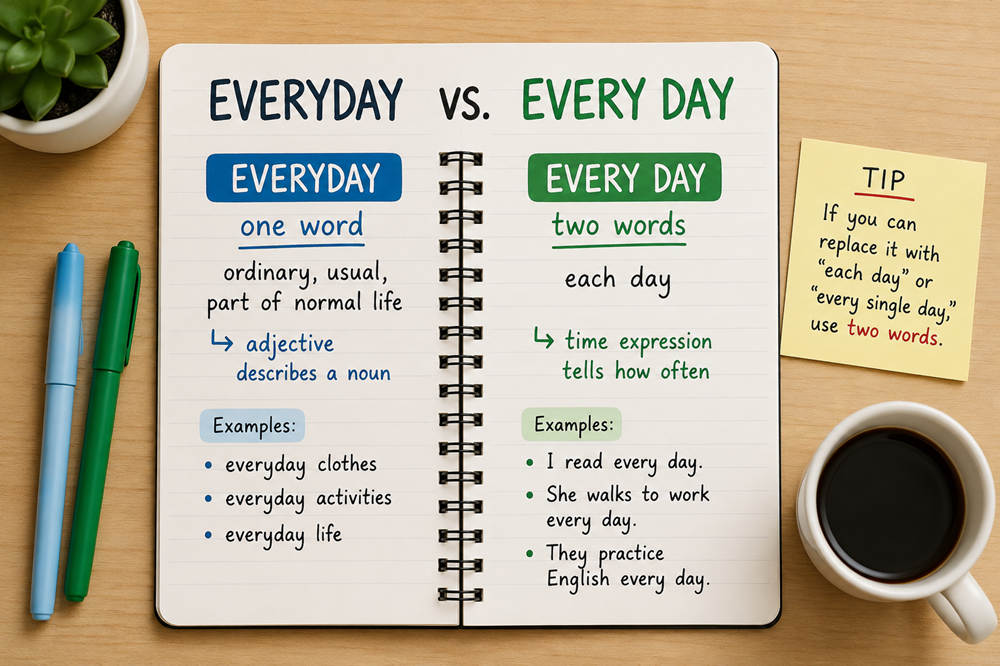
Everyday is one word when it means ordinary, usual, or part of normal life. Every day is two words when it means each day.
For example, you might wear everyday clothes, but you wear them every day. Both forms are correct; the right choice depends on how the expression is used in the sentence.
Everyday vs. Every Day at a Glance
| Form | Meaning | Use | Example |
|---|---|---|---|
| Everyday | Ordinary, usual, or common | Adjective | These are my everyday shoes. |
| Every day | Each day | Time expression | I wear these shoes every day. |
When to Use Everyday
Everyday is an adjective that describes something as ordinary, familiar, or regularly used. It most often appears before the noun it describes.
Common examples include:
- everyday clothes
- everyday activities
- everyday language
- everyday problems
- everyday life
Here are a few examples in complete sentences:
- This bag is strong enough for everyday use.
- The guide explains the subject in everyday language.
- Cooking is an everyday activity in many homes.
- Mobile phones have become part of everyday life.
In each sentence, everyday describes the noun that follows it. It does not tell us how often something happens.
When to Use Every Day
Use every day as two words when you mean each day. The phrase usually explains how often an action takes place.
- I check my email every day.
- She walks to work every day.
- They practise English every day.
- The café opens at seven every day.
A common mistake is using the one-word form when describing frequency:
Incorrect: I exercise everyday.
Correct: I exercise every day.
The correct sentence means “I exercise each day,” so every day must be written as two words.
How to Remember the Difference
The easiest way to choose between the two forms is to replace the expression with each day.
Consider this sentence:
I read before bed every day.
You could also write:
I read before bed each day.
Because the replacement makes sense, the two-word form is correct.
Now consider:
Reading is part of my everyday routine.
“Reading is part of my each day routine” does not work. In the original sentence, everyday describes the noun “routine,” so it should be one word.
You can also try placing single between “every” and “day.” If every single day fits naturally, write every day as two words. This is one of the simple tests used to explain the difference between everyday and every day.
- She calls me every single day.
- She calls me every day.
Everyday and Every Day in Sentences
These paired examples show how the spelling changes according to the expression’s role in the sentence:
- Walking is part of my everyday routine.
I go for a walk every day. - These are common everyday problems.
We deal with these problems every day. - This jacket is suitable for everyday wear.
He wears the jacket every day. - The book contains useful everyday expressions.
People use these expressions every day.
In the first sentence of each pair, everyday describes a noun. In the second, every day tells us when or how often something happens.
Is Everyday Hyphenated?
Everyday is normally written as one word without a hyphen. The phrase every day is written as two separate words.
- Correct: This is an everyday occurrence.
- Correct: It happens every day.
- Incorrect: This is an every-day occurrence.
The hyphenated form every-day is unnecessary in standard modern English.
Final Summary
Use everyday to describe something ordinary or usual, as in “everyday clothes.” Use every day when you mean each day, as in “I wear them every day.” If you can replace the expression with “each day” or “every single day,” write it as two words.