Busses or Buses: Correct Plural, Spelling Difference, Usage, and Examples Explained Clearly
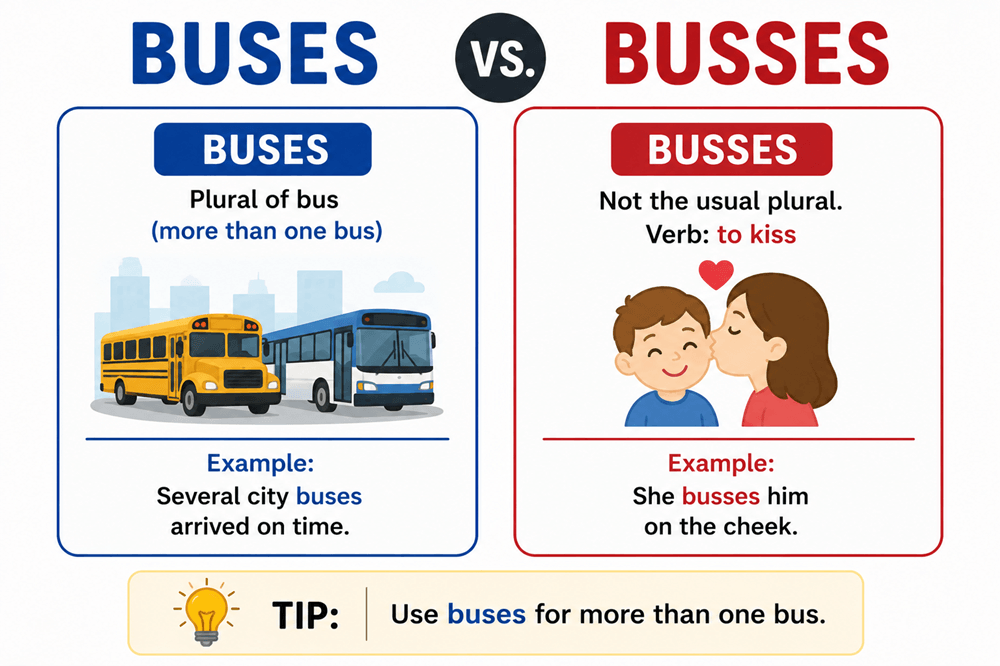
Buses is the standard plural of bus. Use buses when you mean more than one bus, such as school buses, city buses, shuttle buses, or tour buses. Busses is a less common spelling and is usually avoided for the vehicle meaning. It can also be a verb form of buss, an old-fashioned word meaning to kiss.
Quick Answer
Use buses when talking about more than one bus.
- The school has three buses.
- Several city buses stopped near the station.
- The airport uses shuttle buses.
Busses is not the usual plural for vehicles. It may appear as a rare variant, but buses is the safer and more standard choice.
- Less common: The school has three busses.
- Better: The school has three buses.
The simple rule is: buses is the normal plural of bus.
Busses or Buses: What Is the Difference?
The difference between busses and buses is mostly spelling and standard usage. Both forms have appeared in English, but they are not equally common today.
Buses is the regular, widely accepted plural of bus. It is the spelling you should use in school writing, business writing, transportation writing, news articles, signs, schedules, and everyday sentences.
Busses is a less common plural variant. It may look logical because many words ending in s form the plural by adding -es after doubling the final consonant, but bus usually becomes buses, not busses. The spelling busses can also be a form of the verb buss, which means to kiss. That older meaning makes busses less clear when you mean vehicles.
| Word | Main Use | Example |
|---|---|---|
| Buses | Standard plural of bus | The city added more buses. |
| Busses | Rare plural variant; also a verb meaning kisses | He busses her on the cheek. |
If your sentence is about transportation, choose buses.
What Does Buses Mean?
Buses means more than one bus. A bus is a large road vehicle used to carry passengers. Buses may be used by schools, cities, airports, hotels, tour companies, churches, sports teams, and private organizations.
Examples:
- The buses arrived at the school early.
- Two buses were waiting outside the hotel.
- The city replaced its older buses.
- Tour buses filled the parking lot.
- The airport runs shuttle buses every ten minutes.
In every sentence, buses refers to more than one vehicle. This is the spelling most readers expect.
What Does Busses Mean?
Busses can sometimes appear as a plural spelling of bus, but it is much less common than buses. For modern writing, buses is usually better.
Busses also has another meaning. It can be the third-person singular verb form of buss. The verb buss means to kiss, especially in an old-fashioned or playful style.
Examples:
- He busses his grandmother on the cheek.
- The child busses the baby gently.
This meaning is rare today, but it is still one reason busses can look odd when used for transportation. To avoid confusion, use buses for vehicles.
Why Bus Becomes Buses
The word bus becomes buses in standard modern English. Since bus ends in an s sound, the plural adds -es.
- bus → buses
This pattern appears in other words too:
- class → classes
- box → boxes
- church → churches
- watch → watches
However, bus does not normally double the s in the standard plural. That is why buses is preferred over busses.
Is Busses Ever Correct?
Busses is not always impossible, but it is rarely the best choice when you mean more than one bus. Some dictionaries may list it as a variant plural, but most modern writing prefers buses.
Less common:
- The company bought five new busses.
Preferred:
- The company bought five new buses.
If you are writing for a website, school assignment, business document, article, sign, or transportation page, use buses. It looks cleaner and more standard.
Buses in Transportation Writing
Buses is the spelling to use in transportation contexts. This includes anything about public transit, school transportation, airport shuttles, charter trips, schedules, routes, traffic, or passenger service.
Examples:
- The city added electric buses to its fleet.
- School buses must stop at railroad crossings.
- The shuttle buses leave every fifteen minutes.
- Several buses were delayed by traffic.
- The station has signs for trains, taxis, and buses.
In these sentences, busses would look less polished. Buses is the natural spelling.
School Buses or School Busses?
The correct and standard phrase is school buses.
Correct:
- The school buses arrived late.
- Yellow school buses lined up outside.
- Parents waited near the school buses.
Less standard:
- The school busses arrived late.
If you are writing about the vehicles that take students to and from school, use buses.
City Buses or City Busses?
The standard phrase is city buses.
Correct:
- City buses run throughout the day.
- The new city buses have cleaner engines.
- Many workers depend on city buses.
Less standard:
- City busses run throughout the day.
For public transportation, buses is the better spelling.
Busing or Bussing?
The related -ing forms can be more confusing. Busing is commonly used when talking about transporting people by bus.
- The school district began busing students to another campus.
- The company is busing guests from the hotel to the venue.
Bussing can also appear, especially in American English, when talking about clearing tables in a restaurant.
- He spent the summer bussing tables.
- She got a job bussing dishes at a café.
This is a separate but related spelling issue. For the plural noun, however, the standard spelling remains buses.
Bused or Bussed?
The past tense can also vary. Bused is common when the meaning is transported by bus.
- The students were bused to the museum.
- Guests were bused from the parking lot.
Bussed is common when the meaning is cleared tables in a restaurant.
- He bussed tables after school.
- She bussed dishes during the lunch rush.
Still, for more than one bus, use buses.
Examples of Buses in Sentences
Here are natural examples of buses used correctly:
- The buses were parked behind the station.
- Several buses arrived at the same time.
- The city bought new electric buses.
- School buses stopped along the road.
- Tour buses brought visitors to the museum.
- The hotel offers shuttle buses to the airport.
- Old buses were replaced with cleaner vehicles.
- The schedule shows when the buses leave.
These examples all refer to more than one bus, so buses is the correct standard spelling.
Examples of Busses in Sentences
Here are examples of busses used as a verb from buss, meaning kisses:
- He busses his child on the forehead.
- She busses her grandmother on the cheek.
This use is uncommon and may sound old-fashioned. Most modern writers would simply write kisses.
Because busses can carry this unrelated meaning, buses is clearer when you mean vehicles.
Common Mistakes to Avoid
The most common mistake is using busses as the main plural of bus.
Less standard:
- The airport has shuttle busses.
- The school bought new busses.
- Several busses were late.
Better:
- The airport has shuttle buses.
- The school bought new buses.
- Several buses were late.
Another mistake is using an apostrophe for a simple plural.
Incorrect:
- The school has five bus’s.
Correct:
- The school has five buses.
Use an apostrophe only for possession, not for regular plurals.
How to Remember Buses or Busses
Here is an easy way to remember the difference:
Buses has one middle s and is the standard plural.
Busses has double s and is usually not needed for vehicles.
- Bus = one vehicle
- Buses = more than one vehicle
- Busses = rare variant or verb meaning kisses
You can also remember this sentence:
The bus stop is for buses.
If your sentence is about transportation, the spelling you want is buses.
Final Answer
Buses is the standard plural of bus. Use it for school buses, city buses, shuttle buses, tour buses, and any other meaning involving more than one bus. Busses is a less common plural variant and can also be a verb meaning kisses. For clear modern writing, use buses when talking about vehicles.