Natzi or Nazi: Correct Spelling, Meaning, Capitalization, and Usage Examples Explained Clearly
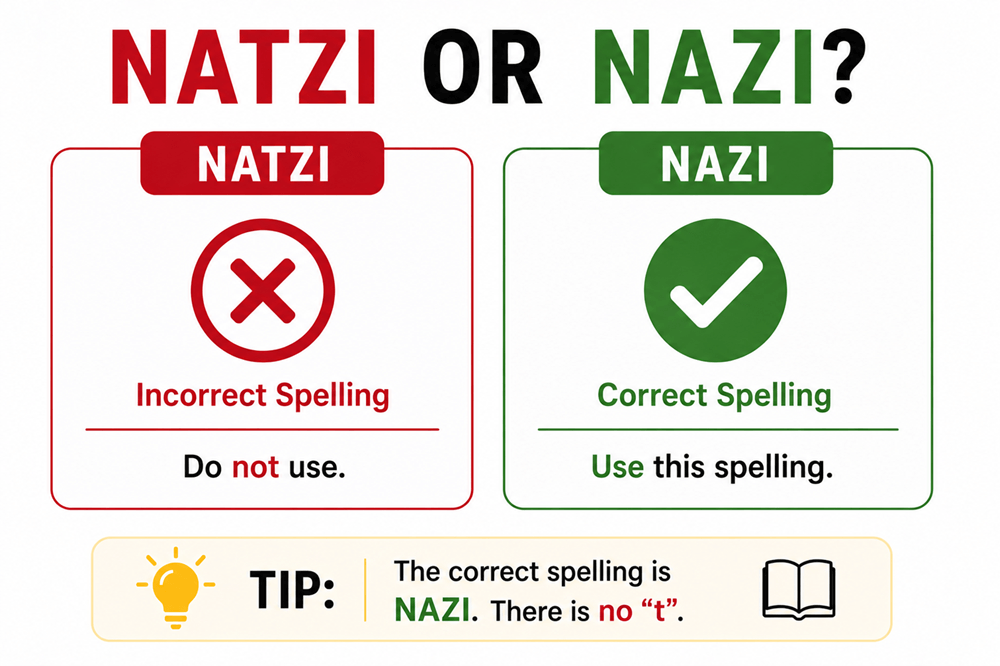
Nazi is the correct spelling. Natzi is a misspelling and should not be used in standard English. The word Nazi refers to a member or supporter of the National Socialist German Workers’ Party, the political party led by Adolf Hitler in Germany. It can also describe something connected to Nazi Germany, Nazi ideology, or the Nazi regime. Because the word carries serious historical meaning, it should be spelled correctly and used carefully.
Quick Answer
Use Nazi, not Natzi.
- Correct: The documentary explained the rise of the Nazi Party.
- Correct: Nazi Germany invaded several countries during World War II.
- Correct: The museum includes exhibits about Nazi propaganda.
Natzi is not the standard spelling.
- Incorrect: The documentary explained the rise of the Natzi Party.
- Incorrect: Natzi Germany invaded several countries during World War II.
- Incorrect: The museum includes exhibits about Natzi propaganda.
The simple rule is this: the correct spelling is Nazi, with no t.
Natzi or Nazi: What Is the Difference?
The difference between Natzi and Nazi is spelling. Nazi is the accepted and correct word. Natzi is a common-looking mistake, likely because the word’s pronunciation can make some people imagine a hidden t sound.
Nazi is a proper historical term. It refers to a specific political movement, party, regime, and ideology. Because it is tied to real history, war, dictatorship, genocide, antisemitism, racism, and extremist politics, it should not be treated like a casual spelling choice.
| Word | Status | Example |
|---|---|---|
| Nazi | Correct spelling | The article discussed Nazi Germany. |
| Natzi | Incorrect spelling | The article discussed Natzi Germany. |
If you are writing about history, politics, World War II, propaganda, extremist ideology, or a person connected to the Nazi movement, use Nazi.
What Does Nazi Mean?
Nazi most directly means a member or supporter of the National Socialist German Workers’ Party. The party rose to power in Germany in the early twentieth century and was led by Adolf Hitler. The term is strongly associated with dictatorship, fascism, antisemitism, racial ideology, war crimes, and the Holocaust.
Examples:
- The Nazi Party controlled Germany from 1933 to 1945.
- The book studies Nazi propaganda during World War II.
- The survivor described life under Nazi occupation.
- The film shows the dangers of Nazi ideology.
In these examples, Nazi is not a casual label. It refers to a specific historical and political subject. That is why the word should be handled with accuracy and seriousness.
Nazi can function as a noun or an adjective. As a noun, it refers to a person connected with Nazism. As an adjective, it describes something related to the Nazi Party, Nazi Germany, or Nazi ideology.
- Noun: The Nazi gave a speech at the rally.
- Adjective: Nazi policies caused enormous suffering.
In modern writing, the word may also appear when discussing neo-Nazis, which are people or groups who support or revive Nazi beliefs after World War II. That use is also serious and should not be used casually.
Why Natzi Is Incorrect
Natzi is incorrect because the standard English spelling is Nazi. There is no t in the word. The mistaken spelling may come from the way some people hear the word or from confusion with words that contain a tz sound.
However, English spelling does not use Natzi for this historical term. In school papers, articles, captions, books, essays, reports, and professional writing, Natzi will look like a spelling error.
Compare these examples:
- Incorrect: The Natzi regime used propaganda to control public opinion.
- Correct: The Nazi regime used propaganda to control public opinion.
- Incorrect: Many people suffered under Natzi rule.
- Correct: Many people suffered under Nazi rule.
- Incorrect: The class studied Natzi Germany.
- Correct: The class studied Nazi Germany.
The correct spelling is always Nazi when referring to the historical party, movement, ideology, regime, or related ideas.
Should Nazi Be Capitalized?
Nazi is usually capitalized. It began as a term connected to a specific political party and historical movement, so the capital letter is standard in most writing.
Examples:
- The Nazi Party rose to power in Germany.
- Nazi Germany was defeated in 1945.
- The historian studied Nazi documents.
- The article examined Nazi ideology.
You may sometimes see nazi in lowercase when the word is used informally or as part of a compound expression, but for careful writing, especially historical writing, Nazi with a capital N is the safer and more respectful choice.
The same applies to Nazism, which is usually capitalized because it names the ideology associated with the Nazi movement.
- Correct: The course covered Nazism and fascism.
- Correct: The book explains the development of Nazism.
If you are writing for a website, school assignment, article, or historical explanation, capitalize Nazi.
Nazi as a Noun
Use Nazi as a noun when you are talking about a person who was a member or supporter of the Nazi Party or Nazi ideology.
Examples:
- The Nazi supported Hitler’s regime.
- Several Nazis were tried after the war.
- The historian studied letters written by former Nazis.
The plural of Nazi is Nazis, not Nazies and not Natzis.
- Correct: Nazis
- Incorrect: Nazies
- Incorrect: Natzis
Examples:
- The Nazis controlled Germany during the dictatorship.
- The trial focused on crimes committed by Nazis.
- The book explains how the Nazis used fear and propaganda.
When using Nazi as a noun, remember that it refers to a person or group connected to a violent extremist movement. It is not a neutral label.
Nazi as an Adjective
Use Nazi as an adjective when describing something connected to the Nazi Party, Nazi Germany, Nazi ideology, or the Nazi regime.
Examples:
- Nazi propaganda spread hateful ideas.
- Nazi soldiers occupied the city.
- Nazi leaders promoted racist policies.
- The museum displayed Nazi-era documents.
In adjective form, Nazi still keeps the same spelling. Do not add a t, and do not change the word to Natzi.
You may also see compound phrases such as:
- Nazi Germany
- Nazi Party
- Nazi regime
- Nazi ideology
- Nazi propaganda
- Nazi occupation
- Nazi-era documents
These phrases all use the correct spelling: Nazi.
Common Mistakes With Natzi and Nazi
The most common mistake is adding a t and writing Natzi. This spelling is not correct.
Incorrect:
- The Natzi Party ruled Germany.
- The article discussed Natzi beliefs.
- The film showed life under Natzi occupation.
- The textbook described Natzi propaganda.
Correct:
- The Nazi Party ruled Germany.
- The article discussed Nazi beliefs.
- The film showed life under Nazi occupation.
- The textbook described Nazi propaganda.
Another mistake is using the word too casually. Because Nazi refers to a specific extremist movement responsible for enormous historical harm, it should not be used lightly as a general insult or exaggeration.
For example, calling a strict teacher a “Nazi” or calling someone a “grammar Nazi” may be common in casual speech, but it can feel offensive, insensitive, or careless. In polished writing, it is usually better to avoid that kind of casual comparison.
Is “Grammar Nazi” Appropriate?
The phrase grammar Nazi is sometimes used informally to describe someone who corrects grammar too aggressively. However, many people find the phrase insensitive because it compares a minor social annoyance to a violent historical ideology.
Instead of using grammar Nazi, you can use clearer and less offensive alternatives:
- grammar stickler
- grammar perfectionist
- strict editor
- language purist
- grammar critic
Examples:
- Better: He is a grammar stickler.
- Better: She is a strict editor.
- Better: My friend is a language perfectionist.
These alternatives communicate the idea without using a historically charged term casually.
Nazi, Nazism, and Neo-Nazi
Nazi, Nazism, and neo-Nazi are related but not identical words.
Nazi refers to a person connected to the Nazi Party or something related to that movement.
- The Nazi Party promoted extremist ideology.
Nazism refers to the ideology of the Nazi movement.
- The class studied the rise of Nazism in Europe.
Neo-Nazi refers to someone or a group that supports or revives Nazi beliefs after the original Nazi regime ended.
- The report discussed the danger of neo-Nazi groups.
All of these terms carry serious historical and political meaning. They should be used only when they are accurate and relevant.
Examples of Nazi in Sentences
Here are examples of Nazi used correctly:
- The historian wrote about the rise of the Nazi Party.
- Nazi Germany began World War II in Europe.
- The documentary explained how Nazi propaganda worked.
- The museum preserves evidence of Nazi crimes.
- The lesson covered Nazi ideology and its consequences.
- Many families suffered under Nazi occupation.
- The article discussed resistance against Nazi rule.
- The trial examined actions taken by Nazi officials.
In each sentence, Nazi is spelled correctly and used in a historical or political context.
Examples of Natzi as an Incorrect Spelling
Here are examples showing why Natzi should be avoided:
- Incorrect: The Natzi Party controlled Germany.
- Correct: The Nazi Party controlled Germany.
- Incorrect: The book explains Natzi ideology.
- Correct: The book explains Nazi ideology.
- Incorrect: The teacher assigned a chapter on Natzi Germany.
- Correct: The teacher assigned a chapter on Nazi Germany.
- Incorrect: The museum displayed Natzi-era materials.
- Correct: The museum displayed Nazi-era materials.
The correct spelling is short and direct: Nazi.
How to Remember Natzi or Nazi
A simple way to remember the spelling is this:
- Nazi has four letters.
- Natzi has an extra letter that does not belong.
You can also remember that Nazi begins with Na and ends with zi. There is no t in the middle.
Another quick reminder:
Nazi is the correct historical spelling. Natzi is a misspelling.
If you are writing about World War II, Nazi Germany, the Nazi Party, Nazi propaganda, Nazism, or neo-Nazi groups, use the correct spelling every time.
Final Answer
Nazi is the correct spelling. Natzi is a misspelling and should not be used in standard English. Use Nazi when referring to a member or supporter of the Nazi Party, something connected to Nazi Germany, or the ideology known as Nazism.
The easiest rule is simple: write Nazi, with no t. Because the word has serious historical meaning, use it accurately, capitalize it in careful writing, and avoid using it casually as an insult or exaggeration.