Axe or Ax: Difference, Correct Spelling, Regional Usage, and Memory Tips Explained
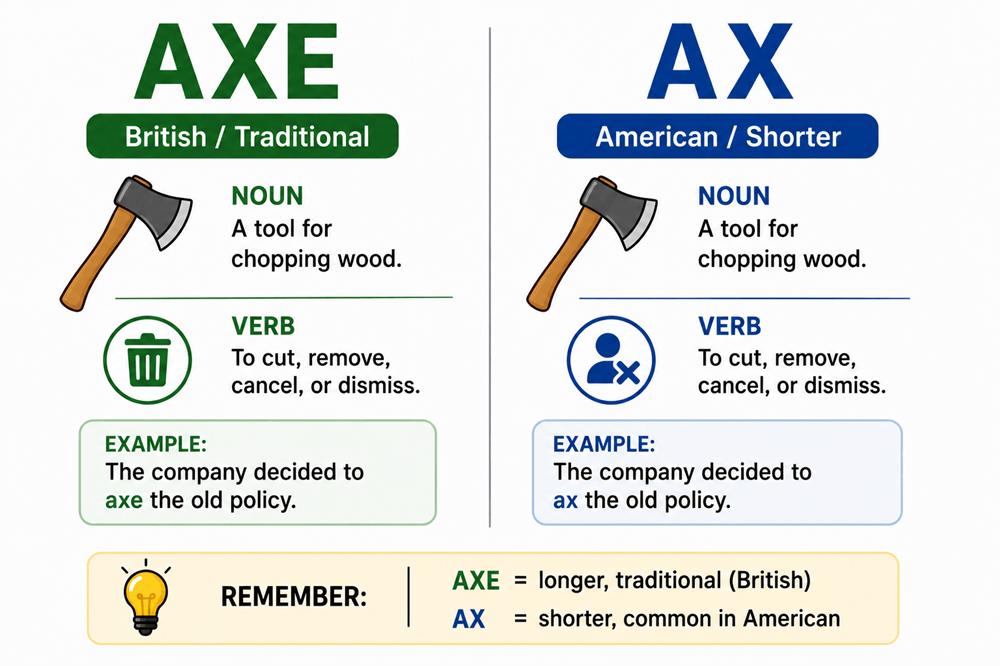
Axe and ax are both correct spellings. They mean the same thing: a tool with a heavy blade used for chopping wood, or a verb meaning to cut, remove, cancel, or dismiss. The main difference is regional style. Axe is more common in British English, while ax is common in American English.
Quick Answer
Use axe if you prefer the traditional or British spelling.
- He used an axe to chop firewood.
- The company decided to axe the old policy.
- She kept an axe in the shed.
Use ax if you prefer the shorter American spelling.
- He used an ax to chop firewood.
- The company decided to ax the old policy.
- She kept an ax in the shed.
The simple rule is: axe and ax are both correct, but axe is more traditional, and ax is more American.
Axe or Ax: What Is the Difference?
The difference between axe and ax is spelling, not meaning. Both words can refer to the same chopping tool. Both can also be used as verbs.
| Spelling | Best Use | Example |
|---|---|---|
| Axe | British English or traditional spelling | He sharpened the axe. |
| Ax | American English shortened spelling | He sharpened the ax. |
If you are writing for a British, Australian, or international audience, axe may look more natural. If you are writing for an American audience, ax is also fully acceptable. In many cases, either spelling will be understood.
What Does Axe Mean?
Axe is a noun and a verb. As a noun, it means a tool with a sharp blade attached to a handle. People use it to chop wood, split logs, cut branches, or break through material.
Examples:
- The woodsman carried an axe over his shoulder.
- She used an axe to split the log.
- The old axe had a wooden handle.
- He sharpened the axe before camping.
As a verb, axe means to cut, remove, cancel, or dismiss. This use is common in business, media, politics, and everyday conversation.
- The studio axed the show after one season.
- The manager axed the plan because it was too expensive.
- Several jobs were axed during the budget cuts.
In this figurative use, nobody is literally using a chopping tool. The word suggests cutting something away.
What Does Ax Mean?
Ax means the same thing as axe. It is simply the shorter spelling. It can also be a noun or a verb.
Examples:
- He bought a new ax for the cabin.
- The firefighter carried an ax.
- The school may ax the program next year.
- The editor axed the weakest paragraph.
Ax is especially common in American English because American spelling often prefers shorter forms. The missing final e does not change the pronunciation or meaning.
Spelling Structure: Why Axe Has an E
Axe is the older-looking spelling. The final e is silent. It does not change how the word sounds.
- axe sounds like “aks”
- the final e is not pronounced
The spelling axe may feel more complete because many short English words end with a silent e. It is also the form many readers expect in British English.
A simple way to remember it is:
- axe = extra e
- axe = English/British-style spelling
The extra e can remind you of the more traditional form.
Spelling Structure: Why Ax Has No E
Ax is shorter and more direct. It keeps only the letters needed for the sound:
- a + x = ax
This makes ax easy to remember. It is compact, sharp, and simple, much like the tool itself. The spelling also fits the American preference for shorter forms in some words.
A helpful memory trick is:
- ax is the short American spelling
- axe is the longer traditional spelling
When to Use Axe
Use axe if your writing follows British English or if you want the more traditional spelling.
- The gardener used an axe to cut the branch.
- The company may axe several outdated services.
- The old axe hung on the wall.
- The committee decided to axe the proposal.
Axe is also common in phrases like:
- axe handle
- battle axe
- axe blade
- get the axe
The phrase get the axe means to be fired, removed, or canceled.
- The project got the axe after funding disappeared.
When to Use Ax
Use ax if your writing follows American English or if you prefer the shorter spelling.
- He grabbed an ax from the garage.
- The crew used an ax to clear the trail.
- The network may ax the series.
- The company axed several positions.
In American writing, ax often looks clean and normal. However, axe is also understood in the United States, so the choice is usually a matter of style.
Axe vs Ax as a Verb
Both spellings can be used as verbs. The past tense is usually axed, whether you start from axe or ax.
- The show was axed.
- The proposal was axed.
- They axed the old design.
You may also see axed used figuratively for cuts, layoffs, cancellations, or major edits.
Common Mistakes
A common mistake is thinking one spelling is always wrong. That is not true. Axe and ax are both accepted spellings.
Another mistake is switching between the two in the same article.
Inconsistent:
- He picked up an axe. The ax was heavy.
Better:
- He picked up an axe. The axe was heavy.
Or:
- He picked up an ax. The ax was heavy.
Choose one spelling and use it consistently.
How to Remember Axe and Ax
Use these memory tips:
- Axe has an extra e, so it is the longer traditional spelling.
- Ax is shorter and common in American English.
- Both words mean the same tool or the same action.
- Pick one spelling style and stay consistent.
A simple memory sentence is: Axe has extra letters; ax is extra short.
You can also remember it this way: British writing often keeps axe; American writing often cuts it down to ax.
Final Answer
Axe and ax are both correct. They can mean a chopping tool or the action of cutting, canceling, removing, or dismissing something.
Axe is more common in British English and traditional spelling. Ax is common in American English and is the shorter form.
To remember the difference, use this rule: axe is the longer traditional spelling; ax is the shorter American spelling.