Another Word for A Lot: Better Synonyms for Writing and Speaking
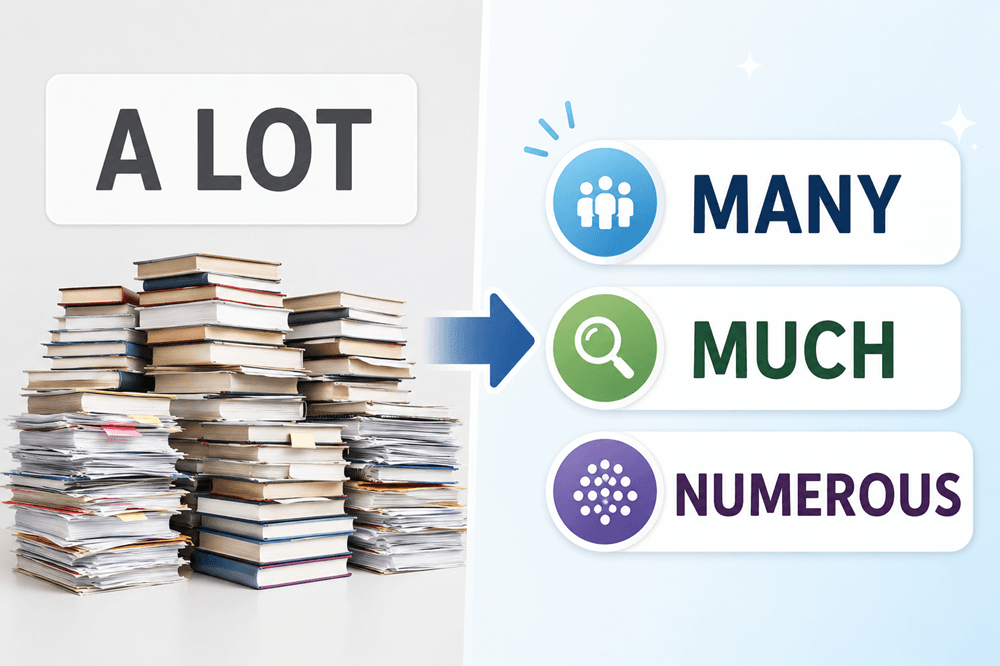
If you want another word for a lot, the best choice depends on what you mean.
Use many when talking about countable things.
Use much when talking about uncountable things.
Use plenty of when you mean more than enough.
Use numerous in formal writing.
Use a great deal of when talking about a large amount.
Examples:
- There are many reasons to exercise.
- She has much experience in marketing.
- We have plenty of time.
- The report found numerous errors.
- He spent a great deal of money on repairs.
The phrase a lot is not wrong. It is common and natural in everyday English. But in formal writing, school essays, business writing, or polished articles, you may want a more precise word.
Quick Answer
Common synonyms for a lot include:
- many
- much
- plenty
- numerous
- several
- countless
- abundant
- a great deal
- a large amount
- a large number
- a considerable amount
- a significant amount
The best general replacements are:
many for countable nouns
much for uncountable nouns
plenty of for casual writing
numerous for formal writing
a great deal of for larger amounts
Examples:
- A lot of people came.
- Many people came.
- She has a lot of patience.
- She has a great deal of patience.
Is “A Lot” Wrong?
No, a lot is not wrong.
It is a normal phrase in English. You can use it in casual speech, everyday writing, emails, texts, and simple explanations.
Examples:
- I like this movie a lot.
- We have a lot of work to do.
- She helped me a lot.
- There were a lot of people at the event.
The problem is not that a lot is incorrect. The problem is that it can be too general.
If you use it again and again, your writing may feel repetitive or vague.
Better:
- There were many people at the event.
- The project required considerable effort.
- She has extensive experience.
- We received numerous complaints.
These choices sound more specific.
Many
Use many with countable nouns.
A countable noun is something you can count one by one.
Examples:
- many books
- many people
- many problems
- many reasons
- many questions
Example sentences:
- There are many ways to solve the problem.
- She has visited many countries.
- The teacher answered many questions.
- We made many changes to the article.
Use many when you can ask, “How many?”
Much
Use much with uncountable nouns.
An uncountable noun is something you do not usually count one by one.
Examples:
- much water
- much money
- much time
- much advice
- much information
Example sentences:
- We do not have much time left.
- She has much experience in this field.
- The article gave me much useful information.
- There was not much interest in the idea.
Use much when you can ask, “How much?”
Plenty of
Plenty of means enough or more than enough.
It is useful in casual and friendly writing.
Examples:
- We have plenty of time.
- There is plenty of food on the table.
- She has plenty of ideas.
- The city has plenty of restaurants.
Plenty of is often more positive than a lot of.
Compare:
- We have a lot of time.
- We have plenty of time.
The second sentence suggests that there is enough time, so there is no need to worry.
Numerous
Use numerous in formal or polished writing.
It means many.
Examples:
- The study found numerous benefits.
- The company received numerous complaints.
- There were numerous errors in the report.
- The author gives numerous examples.
Numerous works best with countable nouns.
Good:
- numerous problems
- numerous studies
- numerous examples
- numerous reasons
Less natural:
- numerous water
- numerous patience
For uncountable nouns, use much, a great deal of, or a significant amount of instead.
A Great Deal of
Use a great deal of when talking about a large amount.
It often works with uncountable nouns.
Examples:
- She has a great deal of experience.
- The job requires a great deal of patience.
- He spent a great deal of money.
- The issue caused a great deal of stress.
This phrase sounds more formal than a lot of.
Casual:
- She has a lot of experience.
More polished:
- She has a great deal of experience.
A Large Number of
Use a large number of with countable plural nouns.
Examples:
- A large number of students attended.
- A large number of people applied.
- A large number of homes were damaged.
- A large number of articles mention this topic.
This phrase is useful when you want a more neutral or formal tone.
It is especially common in reports, essays, news writing, and analysis.
A Large Amount of
Use a large amount of with uncountable nouns.
Examples:
- The recipe uses a large amount of sugar.
- The company spent a large amount of money.
- The project required a large amount of time.
- The storm caused a large amount of damage.
Do not confuse number and amount.
Use number for things you can count.
Use amount for things you measure as a whole.
Correct:
- a large number of people
- a large amount of money
Countless
Countless means so many that they are difficult or impossible to count.
Examples:
- She has heard that story countless times.
- There are countless ways to decorate a small room.
- The internet offers countless resources.
- He made countless mistakes before he improved.
Countless is stronger than many. Use it when you want emphasis.
Abundant
Abundant means more than enough or available in large quantities.
Examples:
- The garden has abundant sunlight.
- The region has abundant natural resources.
- The article provides abundant evidence.
- Fresh fruit is abundant in summer.
Abundant is a good word for nature, resources, evidence, opportunities, and supplies.
It sounds more polished than a lot of.
Several
Several means more than two, but not necessarily a very large number.
Examples:
- I have several questions.
- She gave me several options.
- We visited several stores.
- The article includes several examples.
Use several when you mean “some” or “a few,” not a huge amount.
Compare:
- Several people attended.
- Many people attended.
- Countless people attended.
Each one suggests a different size.
Formal Synonyms for A Lot
For formal writing, use:
- many
- much
- numerous
- considerable
- substantial
- extensive
- a great deal of
- a large number of
- a large amount of
- a significant amount of
Examples:
- The company made substantial progress.
- The report includes extensive research.
- The study found numerous examples.
- The plan requires considerable effort.
- The storm caused significant damage.
These words are better than a lot when you want your writing to sound professional.
Casual Synonyms for A Lot
For casual writing, use:
- lots of
- plenty of
- tons of
- loads of
- heaps of
- so much
- so many
Examples:
- We have lots of snacks.
- There are tons of videos online.
- She has loads of homework.
- I learned so much from the class.
Be careful with words like tons of, loads of, and heaps of. They are casual and expressive, but they may not fit formal writing.
Another Word for A Lot in Different Sentences
Here are better replacements depending on the sentence.
A lot of people
Better:
- many people
- numerous people
- a large number of people
- countless people
Example:
- Many people attended the concert.
A lot of money
Better:
- much money
- a great deal of money
- a large amount of money
- substantial money
- significant funds
Example:
- The repairs cost a great deal of money.
A lot of time
Better:
- much time
- plenty of time
- considerable time
- a large amount of time
Example:
- The project took considerable time.
A lot of work
Better:
- much work
- plenty of work
- a great deal of work
- extensive work
Example:
- The report required extensive work.
A lot of examples
Better:
- many examples
- numerous examples
- several examples
- countless examples
Example:
- The article gives numerous examples.
How to Choose the Best Synonym
Ask yourself two questions.
First, is the noun countable?
If yes, use words like:
- many
- numerous
- several
- countless
- a large number of
Example:
- Many students joined the club.
Second, is the noun uncountable?
If yes, use words like:
- much
- plenty of
- a great deal of
- a large amount of
- a significant amount of
Example:
- She has a great deal of experience.
This is the easiest way to choose the right synonym.
Common Mistakes
Mistake 1: Writing alot as one word
Incorrect:
- I learned alot.
Correct:
- I learned a lot.
A lot is always two words.
Mistake 2: Using much with countable nouns
Incorrect:
- There are much people here.
Correct:
- There are many people here.
Use many with countable nouns.
Mistake 3: Using many with uncountable nouns
Incorrect:
- She has many patience.
Correct:
- She has much patience.
Better:
- She has a great deal of patience.
Use much or a great deal of with uncountable nouns.
Final Answer: Another Word for A Lot
The best synonym for a lot depends on the sentence.
Use many for countable things.
Use much for uncountable things.
Use plenty of for a casual and positive tone.
Use numerous for formal writing.
Use a great deal of for a large amount.
The easiest rule is:
many = countable
much = uncountable
plenty of = enough or more than enough
numerous = formal many
a great deal of = formal large amount
Also remember that a lot is always two words, not alot.