Bare or Bear: What’s the Difference?
Bare and bear are both real words, but they mean very different things.
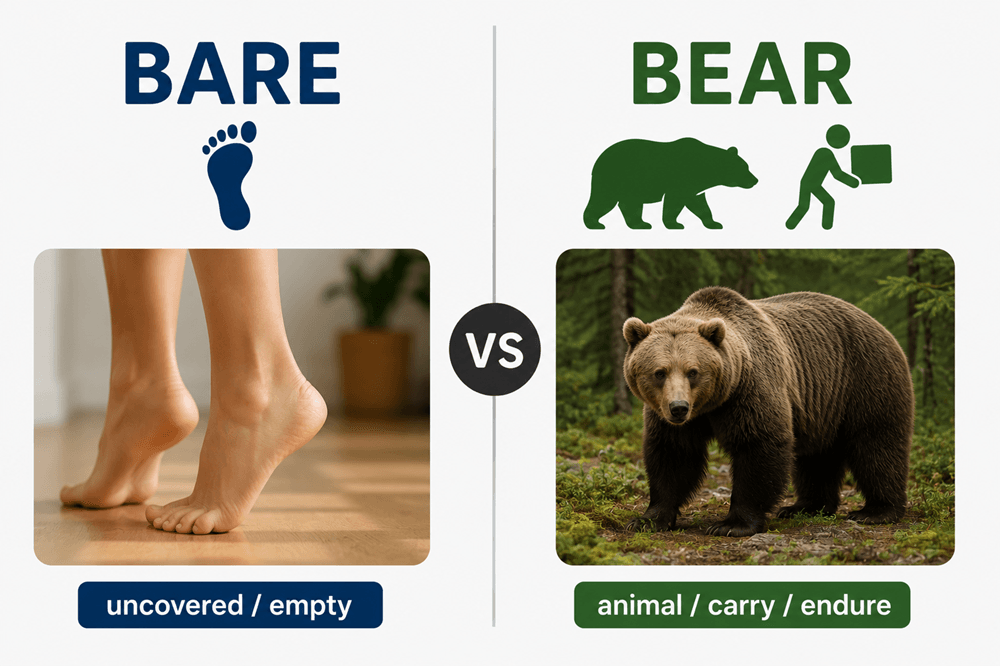
Bare usually means uncovered, naked, empty, plain, or minimal.
Bear can mean a large animal, or it can mean to carry, support, tolerate, or endure something.
Examples:
Correct: He walked outside with bare feet.
Correct: We saw a bear in the forest.
Correct: The room looked bare after they moved out.
Correct: I cannot bear the noise.
The easiest rule is this: use bare for something uncovered or plain. Use bear for the animal or for carrying, enduring, or tolerating something.
What Does Bare Mean?
Bare means uncovered, exposed, plain, or lacking extra things.
Examples:
She walked on the beach with bare feet.
The tree had bare branches in winter.
The room was almost bare.
He gave only the bare facts.
The walls were bare after the pictures were removed.
In these examples, bare suggests that something is uncovered, empty, simple, or without decoration.
Bare can describe:
- skin
- feet
- walls
- branches
- rooms
- facts
- minimum amounts
Common phrases include:
bare feet
bare hands
bare minimum
bare branches
bare walls
bare truth
What Does Bear Mean?
Bear has two main meanings.
First, a bear is a large wild animal.
Examples:
A bear walked through the forest.
The zoo has a brown bear.
We saw bear tracks near the river.
Second, bear can be a verb meaning to carry, support, produce, or tolerate.
Examples:
I cannot bear the pain.
She had to bear a heavy responsibility.
The tree will bear fruit in summer.
This bridge can bear a lot of weight.
In these sentences, bear is not about the animal. It means carry, endure, support, or produce.
Bare vs Bear: The Main Difference
The main difference is meaning.
Bare = uncovered, plain, empty, or minimal
Bear = animal, carry, support, tolerate, or produce
Examples:
Correct: The baby had bare arms.
Correct: The camper saw a bear.
Correct: Please do not touch the wire with bare hands.
Correct: I cannot bear another delay.
Correct: The room looked bare without furniture.
Correct: The tree will bear apples.
If you mean “not covered,” choose bare. If you mean “animal” or “endure,” choose bear.
Bare as an Adjective
Bare is often used as an adjective. It describes something uncovered, empty, or simple.
Examples:
The child ran across the grass in bare feet.
The shelves were bare.
The mountain looked bare after the fire.
The article gave a bare summary of the event.
The word can also mean only the most basic amount.
Examples:
They packed the bare essentials.
We have only the bare minimum.
He shared the bare facts.
Here, bare means no extra details, no decoration, or only what is necessary.
Bare as a Verb
Bare can also be a verb. As a verb, it means to uncover or reveal.
Examples:
The dog bared its teeth.
She bared her soul in the letter.
The storm bared the roots of the tree.
This use is less common than the adjective, but it is still correct.
A common phrase is bare your soul, which means to reveal your deepest feelings.
Bear as an Animal
When bear is a noun, it often means the animal.
Examples:
The bear searched for food.
A polar bear lives in cold regions.
The hikers stayed away from the bear.
The child carried a teddy bear.
In these examples, bear is a noun.
Types of bears include:
black bear
brown bear
polar bear
grizzly bear
panda bear
teddy bear
Bear as a Verb
As a verb, bear has several meanings.
It can mean to endure:
I cannot bear the heat.
She could hardly bear the sadness.
He cannot bear being interrupted.
It can mean to carry or support:
The table can bear the weight.
She had to bear the burden alone.
The wall bears the pressure of the roof.
It can mean to produce:
The tree will bear fruit.
The plant bears small white flowers.
The effort may bear results later.
In all of these cases, the spelling is bear, not bare.
Common Phrases With Bare
Here are common phrases using bare:
bare feet
Meaning: feet without shoes or socks
Example: She walked outside in bare feet.
bare hands
Meaning: hands without gloves or tools
Example: He moved the stones with his bare hands.
bare minimum
Meaning: the smallest acceptable amount
Example: She did the bare minimum.
bare truth
Meaning: the plain truth without extra details
Example: He told the bare truth.
bare walls
Meaning: walls with nothing on them
Example: The apartment had bare walls.
Common Phrases With Bear
Here are common phrases using bear:
bear with me
Meaning: please be patient with me
Example: Bear with me while I find the file.
bear in mind
Meaning: remember or consider
Example: Bear in mind that the rules may change.
bear the cost
Meaning: pay or take responsibility for the cost
Example: The company will bear the cost.
bear fruit
Meaning: produce results
Example: Her hard work finally began to bear fruit.
cannot bear
Meaning: cannot tolerate
Example: I cannot bear the smell.
Bare With Me or Bear With Me?
The correct phrase is bear with me.
Correct: Bear with me for a moment.
Incorrect: Bare with me for a moment.
This phrase means “please be patient with me.” It comes from bear, meaning to endure or tolerate.
Bare with me would literally suggest becoming uncovered with someone, which is not the intended meaning.
Bare in Mind or Bear in Mind?
The correct phrase is bear in mind.
Correct: Bear in mind that traffic may be heavy.
Incorrect: Bare in mind that traffic may be heavy.
Bear in mind means remember, consider, or keep something in your thoughts.
Memory Trick
Use this simple trick:
Bare has A, like air.
If something is bare, it may be exposed to the air.
Examples:
bare skin
bare feet
bare branches
Bear has ear.
A bear has ears.
Also, bear can mean to carry or endure something heavy.
Examples:
bear pain
bear weight
bear responsibility
So remember:
Bare = exposed to air
Bear = animal with ears, or to carry/endure
Common Mistakes
A common mistake is writing bare in the phrase bear with me.
Incorrect: Please bare with me.
Correct: Please bear with me.
Another common mistake is writing bear when describing uncovered skin or feet.
Incorrect: She walked in bear feet.
Correct: She walked in bare feet.
Another mistake is confusing bare minimum with bear minimum.
Incorrect: He did the bear minimum.
Correct: He did the bare minimum.
The phrase means the smallest amount, so the correct word is bare.
Quick Test
Choose the correct word:
She walked across the floor in ___ feet.
Answer: bare
A ___ climbed the tree.
Answer: bear
Please ___ with me for a minute.
Answer: bear
The room looked ___ without furniture.
Answer: bare
The tree will ___ fruit next year.
Answer: bear
Final Answer
Bare and bear are both correct words, but they are not interchangeable.
Use bare when something is uncovered, plain, empty, or minimal.
Correct: She walked in bare feet.
Correct: The room had bare walls.
Use bear for the animal, or when you mean carry, support, tolerate, or produce.
Correct: We saw a bear in the woods.
Correct: I cannot bear the pain.
Correct: The tree will bear fruit.
The easiest way to remember the difference is: bare means exposed to air, while bear is an animal with ears or means to carry or endure.