Learnt or Learned: Difference, Correct Usage, Regional Spelling, and Memory Tips Explained
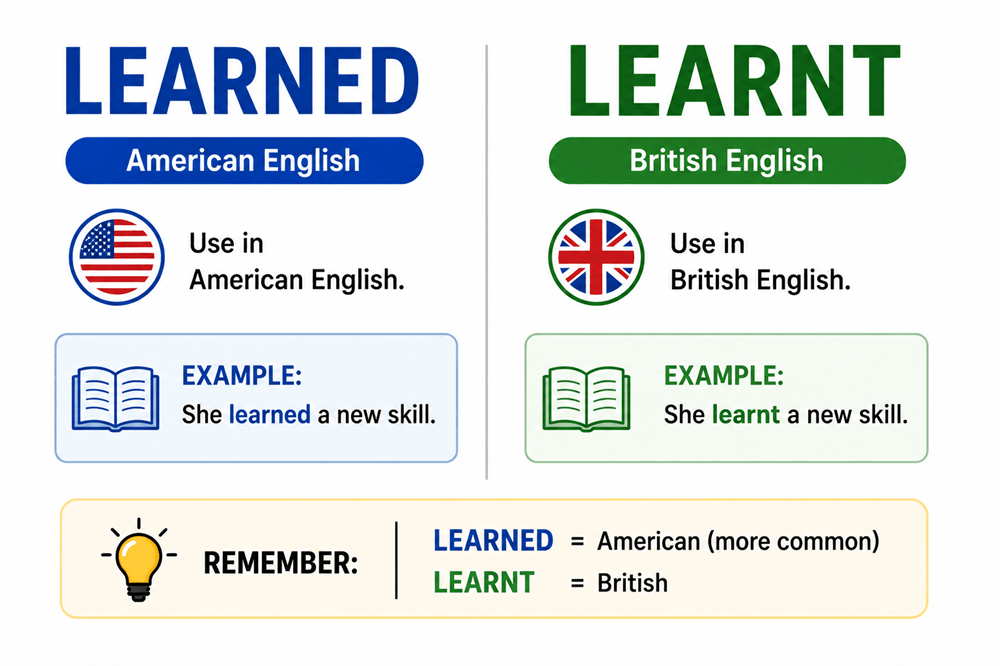
Learned and learnt are both correct, but they are used differently depending on region and sentence style. Learned is the standard form in American English. Learnt is more common in British English. If you are writing for a U.S. audience, use learned. If you are writing in British English, learnt is also acceptable.
Quick Answer
Use learned in American English and as the safest general choice.
- She learned a new word today.
- I learned how to cook from my grandmother.
- They learned the lesson the hard way.
Use learnt mainly in British English.
- She learnt a new word today.
- I learnt how to cook from my grandmother.
- They learnt the lesson the hard way.
The simple rule is: learned is more American; learnt is more British.
Learnt or Learned: What Is the Difference?
The difference between learnt and learned is mostly regional. Both can be the past tense and past participle of learn. Both mean that someone gained knowledge, developed a skill, discovered information, or understood something through experience.
| Word | Best Use | Example |
|---|---|---|
| Learned | American English; safest global choice | She learned French. |
| Learnt | British English | She learnt French. |
If you are unsure which spelling to choose, learned is usually safer because it is widely accepted and more common in formal global writing.
What Does Learned Mean?
Learned is the regular past tense and past participle of learn. It means gained knowledge, found out something, or became able to do something.
Examples:
- He learned the answer after reading the article.
- She learned to swim when she was six.
- The students learned about ancient history.
- We learned from our mistakes.
- I have learned a lot from this experience.
Learned follows the regular English past tense pattern:
- learn + ed = learned
This makes it easy to remember. In American English, learned is the expected spelling in schoolwork, articles, business writing, emails, and everyday sentences.
What Does Learnt Mean?
Learnt is also a past tense and past participle form of learn. It means the same thing as learned, but it is more common in British English.
Examples:
- He learnt the truth later.
- She learnt to drive in London.
- The children learnt their lines for the play.
- We have learnt many useful lessons.
To American readers, learnt may sound old-fashioned, poetic, or British. That does not make it wrong. It simply means the spelling belongs more naturally to a different English style.
Spelling Structure: Why Learned Uses ED
Learned is easy to build because it uses the common -ed ending.
- learn + ed = learned
This is the same pattern used in many regular verbs:
- work → worked
- talk → talked
- look → looked
- learn → learned
If you want the most predictable spelling, choose learned. It keeps the full base word learn and simply adds ed.
Spelling Structure: Why Learnt Ends in T
Learnt uses a shorter -t ending:
- learn → learnt
This pattern appears in some British English past tense forms:
- dream → dreamt
- spell → spelt
- burn → burnt
- learn → learnt
These -t forms are shorter and often sound more British to American readers. They are not mistakes, but they may feel less standard in U.S. writing.
When to Use Learned
Use learned when writing in American English or when you want the safest form for a broad audience.
- I learned something new today.
- She learned the rules quickly.
- They learned how to solve the problem.
- He has learned patience over time.
- We learned that the meeting was canceled.
Learned works well in formal and informal writing. It is also the better choice for most international websites, educational content, and business communication unless you are intentionally using British spelling.
When to Use Learnt
Use learnt when writing in British English or when your article follows British spelling throughout.
- I learnt the song by heart.
- She learnt the answer from her teacher.
- They learnt a lot during the trip.
- He had learnt from his earlier mistakes.
If your writing also uses words like colour, favour, organise, or centre, then learnt may fit naturally. If your writing uses color, favor, organize, and center, use learned.
Learned as an Adjective
There is one important extra point: learned can also be an adjective. When used as an adjective, it means educated, scholarly, or knowledgeable. In this meaning, it is usually pronounced with two syllables, like learn-ed.
Examples:
- She is a learned professor.
- The book was written by a learned scholar.
- He gave a learned lecture on ancient law.
You do not use learnt for this adjective meaning. Write learned scholar, not learnt scholar.
Common Mistakes
A common mistake is thinking learnt is always wrong. It is correct in British English, but it is not the usual American spelling.
Another mistake is mixing both forms in the same article.
Inconsistent:
- She learned Spanish last year and learnt French this year.
Consistent American English:
- She learned Spanish last year and learned French this year.
Consistent British English:
- She learnt Spanish last year and learnt French this year.
The best choice depends on the spelling style you are using. Pick one and stay consistent.
How to Remember Learnt and Learned
Use these memory tips:
- Learned has ed, like a regular past tense verb.
- Learnt has t, like British-style forms such as dreamt and spelt.
- Use learned for American English.
- Use learnt for British English if it matches the rest of your writing.
- Use learned for the adjective meaning educated or scholarly.
A simple memory sentence is: Americans usually learned; Britons may have learnt.
Final Answer
Learned and learnt are both correct as past tense forms of learn. Learned is the standard American English spelling and the safest general choice. Example: She learned the answer.
Learnt is more common in British English. Example: She learnt the answer.
To remember the difference, use this rule: learned is regular and American; learnt is shorter and British. For most WordBriefs-style writing aimed at a broad audience, learned is usually the better default.