Signer or Signor: Meanings, Differences, and Simple Ways to Remember Each Word
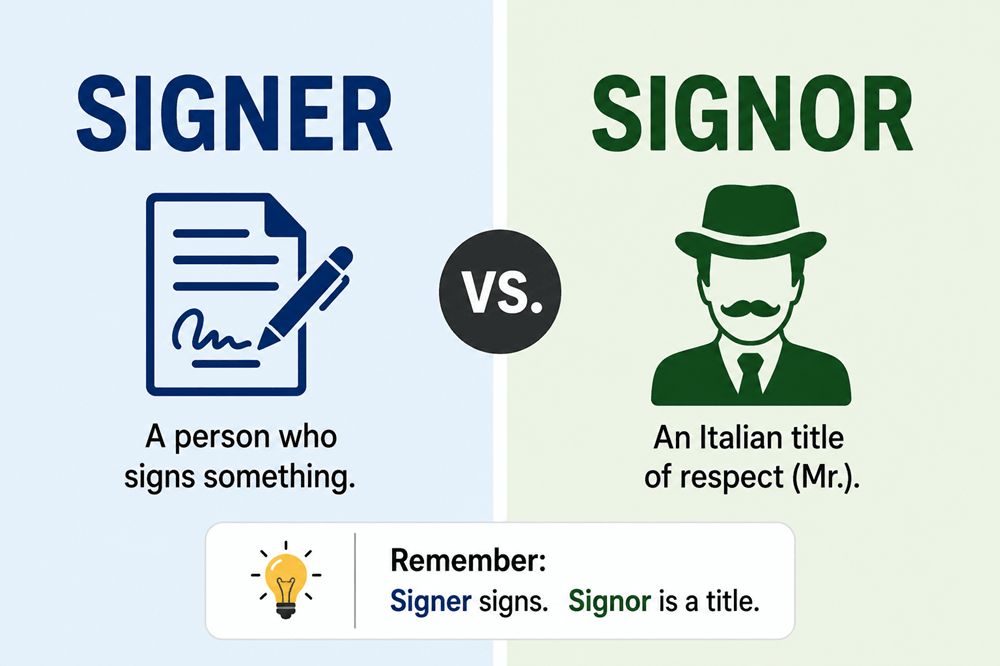
If you are choosing between signer or signor, the correct word depends on what you mean. A signer is a person who signs something, such as a document, contract, letter, petition, or form. Signor is an Italian title of respect, similar to Mr. or sir. The two words look close, but they are not interchangeable.
Signer or Signor: What Is the Difference?
The main difference is simple:
Signer means someone who signs something.
Signor means an Italian man, gentleman, or title of respect.
You use signer when you are talking about a signature. If someone writes their name on a document, that person is the signer.
You use signor when you are using an Italian-style title, usually before a man’s name. It is not the usual English word for someone who signs something.
For example:
Correct: The signer must date the form before submitting it.
Incorrect: The signor must date the form before submitting it.
In that sentence, the person is signing a form, so signer is correct.
Now look at this example:
Correct: Signor Bianchi welcomed the guests warmly.
Here, Signor is being used as a title, similar to Mr. Bianchi. It has nothing to do with signing a document.
What Does Signer Mean?
A signer is a person who signs. The word comes from the verb sign, which means to write your name, mark approval, communicate with signs, or formally agree to something.
You will often see signer in legal, business, financial, political, and administrative writing. It appears anywhere signatures matter.
For example:
Each signer must provide a valid ID.
This means every person who signs the document must also show identification.
You might also write:
The petition had more than two thousand signers.
This means more than two thousand people signed the petition.
In everyday English, signer can also refer to a person who uses sign language, though the context usually makes that meaning clear.
For example:
She is a fluent signer and interpreter.
Here, signer means someone who signs in a language such as American Sign Language or another signed language.
What Does Signor Mean?
Signor is an Italian title used for a man. In English writing, it is usually used when referring to an Italian man or when creating an Italian setting, tone, name, or character. It is similar in meaning to Mr. or sir.
For example:
Signor Romano owned a small café near the square.
This means Mr. Romano owned the café.
You may also see Signor in older books, opera programs, historical writing, travel writing, or stories set in Italy. It is not a common everyday English word unless the context is clearly Italian.
Because signor looks so much like signer, it can easily cause confusion. But the meaning is completely different. A signor is not automatically someone who signs. A signer is not an Italian title.
Why Signer and Signor Are Easy to Confuse
The confusion happens because the words are almost identical in spelling. They both begin with sign, and they both have two syllables. The only difference is the ending:
signer ends in -er
signor ends in -or
That one-letter difference changes the word completely.
The ending -er often means “a person who does something.” You see this pattern in words like writer, reader, teacher, driver, and runner. A signer follows that same pattern. It means a person who signs.
The ending -or appears in some English words too, such as actor, doctor, editor, and visitor. That can make signor look like it might mean a person who signs. But in this case, signor is not formed from the English verb sign. It comes from Italian, so it has its own meaning.
A Simple Way to Remember Signer
The easiest way to remember signer is to connect it with sign.
A signer signs.
That short phrase gives you everything you need. If the sentence is about a signature, a document, a petition, a contract, or sign language, the word is usually signer.
You can also remember the ending:
-er = a person who does something
A writer writes.
A reader reads.
A driver drives.
A signer signs.
This pattern is practical and easy to apply. When you see -er, think of the action. The action is sign, so the person is the signer.
A Simple Way to Remember Signor
To remember signor, connect it with Italy. The word is used as an Italian title, so the memory clue should point you away from signatures and toward names, respect, and address.
Try this:
Signor sounds formal, like an Italian title.
You can also remember the final letters:
Signor has “or,” like honor.
This works because signor is a title of respect. It is connected to honor, politeness, and formal address, not to signing papers.
Another helpful clue is capitalization. When Signor appears before a name, it is often capitalized like a title:
Signor Conti
Signor Russo
Signor Bellini
That title-like position can help you recognize it. If the word comes before an Italian name, Signor may be correct. If the word comes after the, each, every, or authorized in a document-related sentence, you probably need signer.
Common Examples With Signer
Here are common sentences where signer is the correct choice:
The signer must complete every required field.
Each signer agreed to the terms of the contract.
The document is invalid without the signer’s date and initials.
The petition gained hundreds of new signers overnight.
The interpreter was also a skilled signer.
In each sentence, the word is connected to signing a name, agreeing to something, or using sign language. That means signer is correct.
Common Examples With Signor
Here are examples where signor is correct:
Signor Moretti greeted the visitors at the door.
The letter was addressed to Signor Ricci.
Signor Paolo spoke with quiet confidence.
The old novel introduced him as Signor Lorenzo.
In the opera, Signor Carlo appears in the second act.
These examples use Signor as a respectful title. The word is not about signing anything.
Signer vs Signor in Side-by-Side Sentences
Side-by-side examples can make the difference easier to see:
Correct: The signer forgot to include the date.
Incorrect: The signor forgot to include the date.
Correct: Signor Rossi entered the room quietly.
Incorrect: Signer Rossi entered the room quietly.
Correct: Every signer must read the agreement carefully.
Incorrect: Every signor must read the agreement carefully.
Correct: The invitation was written to Signor Luca Marino.
Incorrect: The invitation was written to Signer Luca Marino.
Correct: The signer’s name was difficult to read.
Incorrect: The signor’s name was difficult to read.
The rule is clear: use signer for someone who signs, and use signor as an Italian title.
How to Check Which Word You Need
Before choosing the word, ask yourself one quick question:
Is this about a signature?
If yes, use signer.
Then ask:
Is this an Italian title before a man’s name?
If yes, use signor.
This quick check works in most situations. In forms, contracts, applications, petitions, authorizations, and legal documents, signer is almost always the word you need. In Italian names, formal address, historical fiction, opera, or travel writing, signor may be the correct word.
The Final Answer on Signer or Signor
Signer and signor are both real words, but they mean different things. A signer is a person who signs something. Signor is an Italian title of respect, similar to Mr. or sir.
To remember the difference, use the phrase a signer signs. The -er ending points to a person doing an action, just like writer, reader, or driver. For signor, remember that it is a formal title connected to Italian names and respectful address.
So if you are writing about a contract, form, petition, signature, or signed agreement, choose signer. If you are writing an Italian title before a man’s name, choose signor.