Lay or Lie: Correct Meaning, Grammar, Tense, and Examples for Clear Writing
Lay and lie are easy to confuse because their forms overlap in a frustrating way. Use lay when someone puts or places something down. Use lie when someone or something reclines, rests, or is already in a flat position. The easiest rule is this: lay needs an object, but lie does not.
Quick Answer
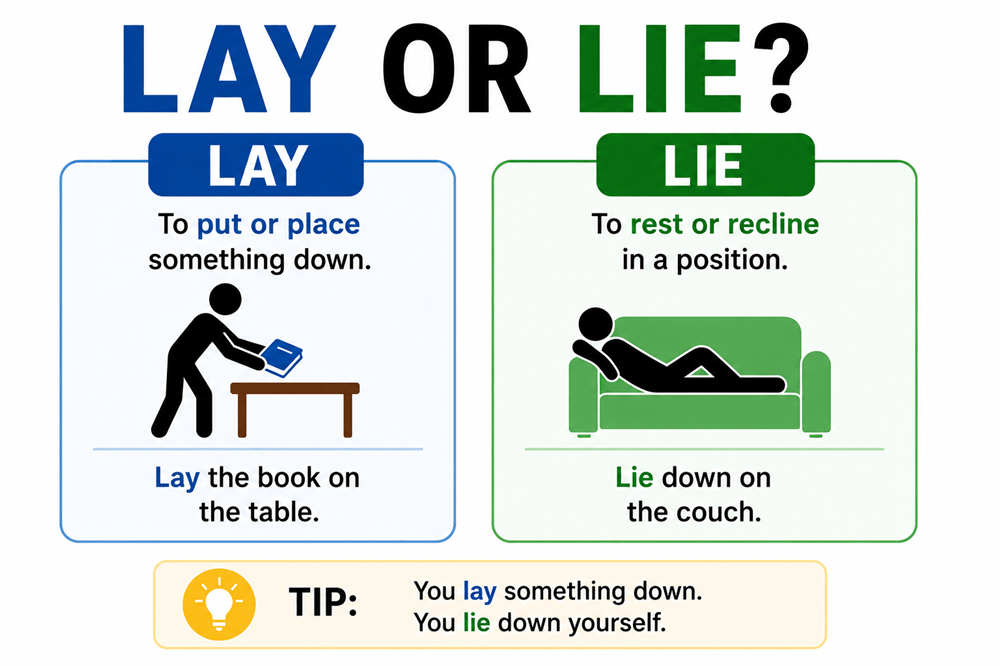
Use lay when you mean to put or place something somewhere.
- Correct: Lay the book on the table.
- Correct: She lays the blanket across the bed.
- Correct: Please lay your phone beside the charger.
Use lie when you mean to recline, rest, or be in a flat position.
- Correct: Lie down if you feel tired.
- Correct: The dog likes to lie in the sun.
- Correct: He will lie on the couch after work.
The simple rule is this: you lay something down, but you lie down yourself.
Lay or Lie: What Is the Difference?
The difference between lay and lie is whether something is being placed. Lay means to put or set something down. It usually needs a direct object, which means there must be something being laid.
For example, in the sentence “Lay the keys on the counter,” the keys are the object. You are placing the keys somewhere. That is why lay is correct.
Lie means to recline, rest, or remain in a flat position. It does not need an object. You can simply lie down. A cat can lie on a rug. A book can lie on a desk. Nothing is being placed by someone in that moment; the subject is resting or staying in position.
| Word | Meaning | Needs an Object? | Example |
|---|---|---|---|
| Lay | To put or place something down | Yes | Lay the folder on my desk. |
| Lie | To recline or rest in a position | No | Lie down and rest. |
If something is being placed, use lay. If someone or something is resting, reclining, or already positioned, use lie.
What Does Lay Mean?
Lay means to put, place, set, or arrange something somewhere. It is an action that someone does to another thing. That “other thing” is what makes lay different from lie.
Examples:
- Lay the towel on the chair.
- She lays the baby gently in the crib.
- He lays the papers in a neat stack.
- They lay bricks in the driveway every morning.
In each sentence, something is being placed: the towel, the baby, the papers, or the bricks. Because there is an object receiving the action, lay is the correct verb.
Lay can also be used in figurative expressions. You might lay a foundation, lay out a plan, lay blame on someone, or lay the groundwork for future success.
- The first meeting will lay the foundation for the project.
- The manager will lay out the schedule tomorrow.
- The article lays the problem out clearly.
Even when the meaning is not physical, lay still carries the idea of placing, arranging, or setting something up.
What Does Lie Mean?
Lie means to recline, rest, or remain in a flat or resting position. Unlike lay, it does not take a direct object. The subject is not placing something else. The subject is resting or staying somewhere.
Examples:
- Lie on the bed until you feel better.
- The cat likes to lie near the window.
- The papers lie scattered across the floor.
- The town lies between two mountains.
In these sentences, nothing is being placed by the subject. The person, cat, papers, or town is simply resting, reclining, or existing in a position.
Lie can describe people, animals, objects, places, and even abstract things.
- The answer may lie in the details.
- The problem lies with the timing.
- The old road lies beyond the bridge.
In these examples, lie does not mean someone is physically lying down. It means something exists, remains, or is located somewhere.
The Tense Forms of Lay and Lie
The hardest part of lay and lie is not the present tense. The hardest part is the past tense because the past tense of lie is lay. That overlap causes most of the confusion.
| Verb | Present | Past | Past Participle | Present Participle |
|---|---|---|---|---|
| Lay = place something | lay | laid | laid | laying |
| Lie = recline | lie | lay | lain | lying |
Here is the key pattern:
- Today, you lay the book on the table.
- Yesterday, you laid the book on the table.
- Today, you lie down.
- Yesterday, you lay down.
This is why sentences like “I lay down yesterday” can be correct. In that sentence, lay is not the present tense of lay. It is the past tense of lie.
When to Use Lay
Use lay when something is being placed somewhere. The sentence should have an object, even if the object appears later in the sentence.
Examples:
- Lay the cards on the table.
- Please lay the package by the door.
- She lays her coat over the chair.
- The worker lays tile in the kitchen.
You can test the sentence by asking, “What is being placed?” If you can answer that question, lay is probably correct.
- Lay the book down. What is being placed? The book.
- Lay your head on the pillow. What is being placed? Your head.
- Lay the blanket over the sofa. What is being placed? The blanket.
If there is a clear object being placed, use lay.
When to Use Lie
Use lie when someone or something reclines, rests, remains, or is located somewhere. The sentence does not need an object.
Examples:
- Lie down for a few minutes.
- The dog lies beside the fireplace.
- The village lies near the river.
- The answer lies in the final paragraph.
You can test the sentence by asking, “Is someone placing something?” If the answer is no, lie may be the correct word.
- You lie on the couch.
- The blanket lies on the floor.
- The truth lies somewhere in the middle.
In these sentences, the subject is not placing another object. The subject is simply resting, existing, or being located.
Lay Down or Lie Down?
The correct present-tense phrase is usually lie down when you mean to recline yourself.
- Correct: I need to lie down.
- Correct: Lie down if you feel dizzy.
- Correct: The dog wants to lie down.
Lay down is correct when you are placing something down.
- Correct: Lay down the knife carefully.
- Correct: Lay down your backpack by the door.
- Correct: Lay the baby down in the crib.
The confusion comes from casual speech. Many people say “I am going to lay down” when standard grammar would prefer “I am going to lie down.” In everyday conversation, that mistake is common. In polished writing, however, lie down is the better choice when the subject is reclining.
Laid Down or Lay Down?
Laid down is correct when someone placed something down in the past.
- Correct: She laid the book down.
- Correct: He laid his keys down and forgot them.
- Correct: They laid the baby down for a nap.
Lay down is correct as the past tense of lie down.
- Correct: I lay down after lunch yesterday.
- Correct: She lay down for ten minutes.
- Correct: The dog lay down under the table.
This is the part that feels strange. In the present, you say “I lie down.” In the past, you say “I lay down.” But if you are placing an object, the past tense is laid.
Common Mistakes With Lay and Lie
The most common mistake is using lay when the sentence should use lie.
Incorrect:
- I need to lay down.
- The dog likes to lay in the sun.
- She will lay on the couch after work.
Correct:
- I need to lie down.
- The dog likes to lie in the sun.
- She will lie on the couch after work.
Another common mistake is using lay in the past when laid is needed.
Incorrect:
- She lay the book on the desk yesterday.
- He lay the blanket over the chair.
- They lay the bricks last week.
Correct:
- She laid the book on the desk yesterday.
- He laid the blanket over the chair.
- They laid the bricks last week.
If something was placed in the past, use laid.
Lay or Lie in Example Sentences
Here are examples that show the difference clearly:
- Lay the notebook on the desk.
- The notebook lies on the desk.
- She lays the blanket on the bed.
- The blanket lies on the bed.
- He laid the phone beside him.
- He lay beside the phone for a few minutes.
- Please lay the baby in the crib.
- The baby lies quietly in the crib.
Notice the pattern. When someone puts something somewhere, use lay. When something rests somewhere, use lie.
What About Lie Meaning Not Tell the Truth?
There is another word lie that means to say something false. This word is different from lie meaning to recline.
When lie means not telling the truth, its forms are simpler:
- Present: lie
- Past: lied
- Past participle: lied
- Present participle: lying
Examples:
- Do not lie about what happened.
- He lied about his age.
- She has never lied to you.
- They were lying about the results.
This article focuses mainly on lay and lie as placement and reclining verbs, but it helps to know that lie can also mean telling an untruth.
How to Remember Lay or Lie
A simple memory trick is this:
- Lay means place.
- Lie means recline.
Both lay and place contain the letter a. That can help you remember that lay is about placing something.
You can also remember this sentence:
You lay something down, but you lie down yourself.
If there is an object, choose lay. If there is no object and the subject is resting or reclining, choose lie.
Final Answer
Lay and lie are both correct words, but they are used differently. Use lay when someone puts or places something down. Use lie when someone or something reclines, rests, or remains in a position.
The easiest rule is simple: lay needs an object, and lie does not. You lay the book down, but you lie down yourself. Remember that rule, and the difference becomes much easier to handle.